Demand Response: Get Paid to Ease Grid Strain
September 3, 2026 | Samantha Mariano
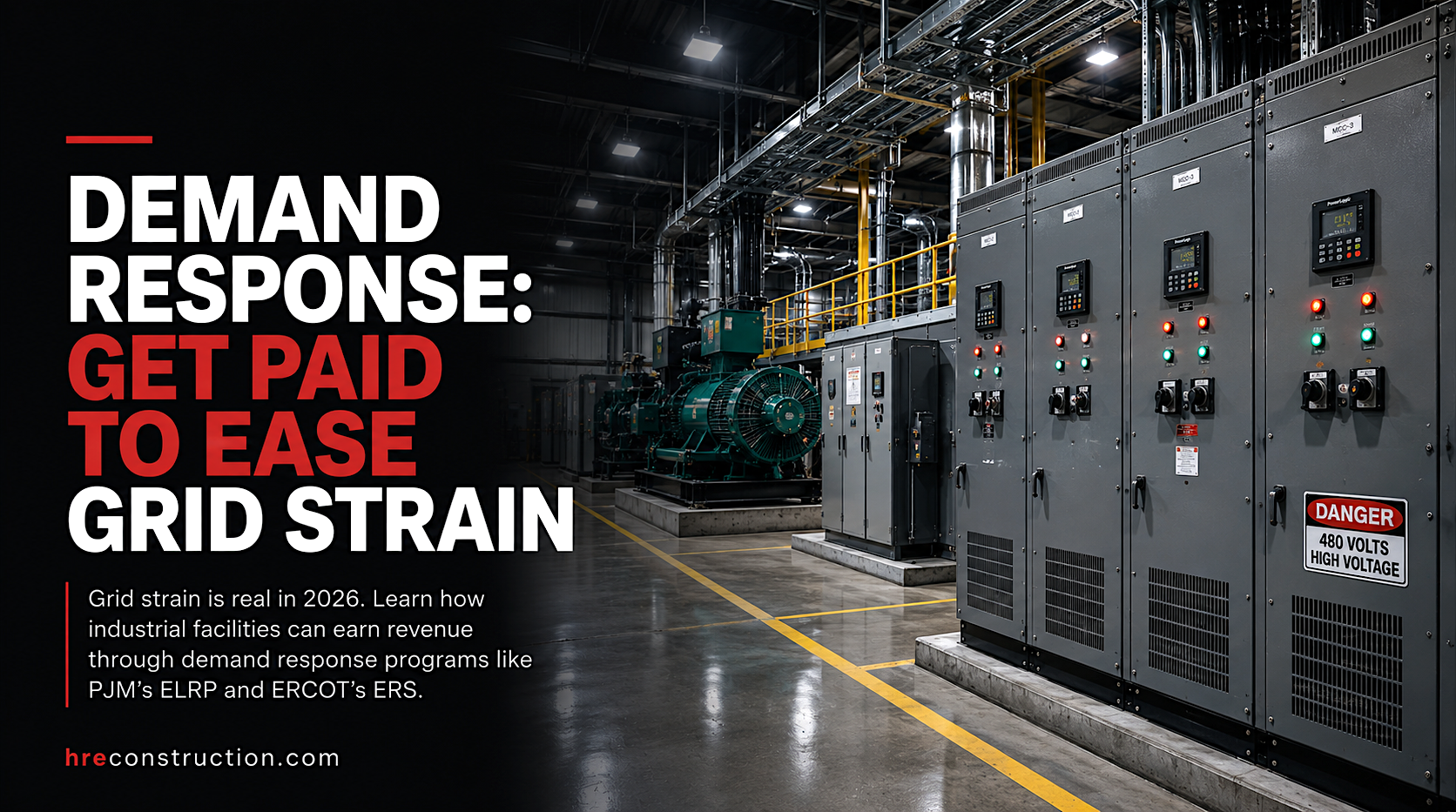
\The grid is under more pressure than it's been in years. In July 2026, a record heat wave pushed PJM's forecasted demand past the all-time record set back in 2006, and the Department of Energy issued emergency orders authorizing PJM to curtail large loads just to keep the lights on. That wasn't a one-off. Between data center growth, industrial electrification, and renewed manufacturing activity, grid operators across the country are flagging the same problem: demand is climbing faster than new supply and transmission capacity can keep up.
For industrial facilities, that's usually framed as a risk. It can also be a revenue stream, if your facility can flex its load when the grid needs it most.
What demand response actually is
Demand response programs pay commercial and industrial facilities to reduce their electricity consumption during periods of grid stress, typically extreme heat or cold events when supply runs thin. Instead of building another power plant to cover peak demand, grid operators pay large consumers to temporarily cut load instead. From the grid's perspective, a facility that can reliably shed a few megawatts is just as valuable as a generator that size, and often faster to call on.
Depending on where your facility sits, this runs through a regional grid operator or through your utility directly:
- PJM (covering parts of our Ohio, West Virginia, and Kentucky service areas) runs the Emergency Load Response Program and a Synchronized Reserve Market. The 2026/2027 capacity auction cleared at some of the strongest pricing PJM has seen, a clear signal that demand response is in real demand right now.
- ERCOT (Texas) runs Emergency Response Service and Responsive Reserve Service, with facilities committing to curtail a set amount of load within 10 or 30 minutes of a dispatch signal, usually during summer and winter peak seasons.
- Vertically integrated utilities in states without an organized wholesale market, which covers most of our South Carolina, North Carolina, Georgia, Arkansas, Arizona, Louisiana, and Mississippi footprint, often run their own industrial curtailment or interruptible-rate programs directly. Terms vary by utility, so this is worth a direct conversation with your account representative.
What it actually looks like on the floor
This isn't about shutting down production. Most industrial participants target load that can flex without touching the process itself: cycling HVAC and refrigeration, staggering non-critical equipment starts, shifting compressor or pump loads, or drawing on backup generation or battery storage for a few hours instead of pulling from the grid. A facility with automated controls can often identify curtailable load without a human making real-time decisions during an event.
What to check before enrolling
- Metering and telemetry. Programs generally require interval metering and, for the faster-response tiers, real-time telemetry back to the grid operator. If your facility's metering hasn't been reviewed recently, that's the first thing to look at.
- Automation readiness. The tightest-response programs call for automated load-shedding, not a phone tree. If curtailment currently depends on someone manually cutting equipment, that's a gap between what you can technically commit to and what you can actually deliver under a real dispatch.
- Non-performance risk. Committing to curtail and then not delivering during an actual event usually costs more than the payment would have been worth. Don't over-commit capacity you can't reliably shed.
- Baseline calculation. Payments are typically based on how much you reduced load relative to your normal usage pattern, so a facility that's already lean on energy use has less room to show a dramatic reduction. This is worth understanding before you commit to a program, not after.
How HRE Can Help
Enrolling in a demand response program starts with an honest look at your facility's electrical infrastructure: what can actually be automated, what metering is in place, and where the gaps are between what a program requires and what your system can deliver today. We help industrial facilities across our footprint assess curtailable load, upgrade metering and controls where needed, and get equipment ready for automated response before committing to a program, not after signing a contract you can't fully deliver on. If you're evaluating whether demand response makes sense for your facility, interconnection queues and grid capacity are part of that same conversation, and we're glad to walk through both with you.
Frequently Asked Questions
Q: Does participating in demand response mean my facility could lose power unexpectedly?
A: No. Demand response is voluntary curtailment you commit to and control, not an involuntary outage. You reduce specific, pre-identified load when notified, you don't get disconnected without warning.
Q: How much can an industrial facility actually earn from this?
A: It varies significantly by region, program, contract capacity, and how many events occur in a given season, so we won't quote a specific number here. What matters more upfront is whether your facility has curtailable load and the metering/automation to reliably deliver on a commitment. That's the conversation worth having before looking at revenue projections.
Q: My facility is in a state without ERCOT or PJM. Does this still apply to me?
A: Likely yes, just through a different channel. Vertically integrated utilities in states like South Carolina, Georgia, and Mississippi typically run their own industrial curtailment or interruptible-rate programs rather than a grid-operator market. Your utility account representative is the right first call.
Q: Is this related to the grid interconnection delays HRE has written about before?
A: They're connected but distinct. Interconnection delays affect how long it takes new generation or new large loads to connect to the grid. Demand response is about existing facilities flexing their usage to help manage the grid that's already in place. Rising demand is putting pressure on both.