2026 NEC Changes for Classified Locations Explained
September 2, 2026 | Samantha Mariano
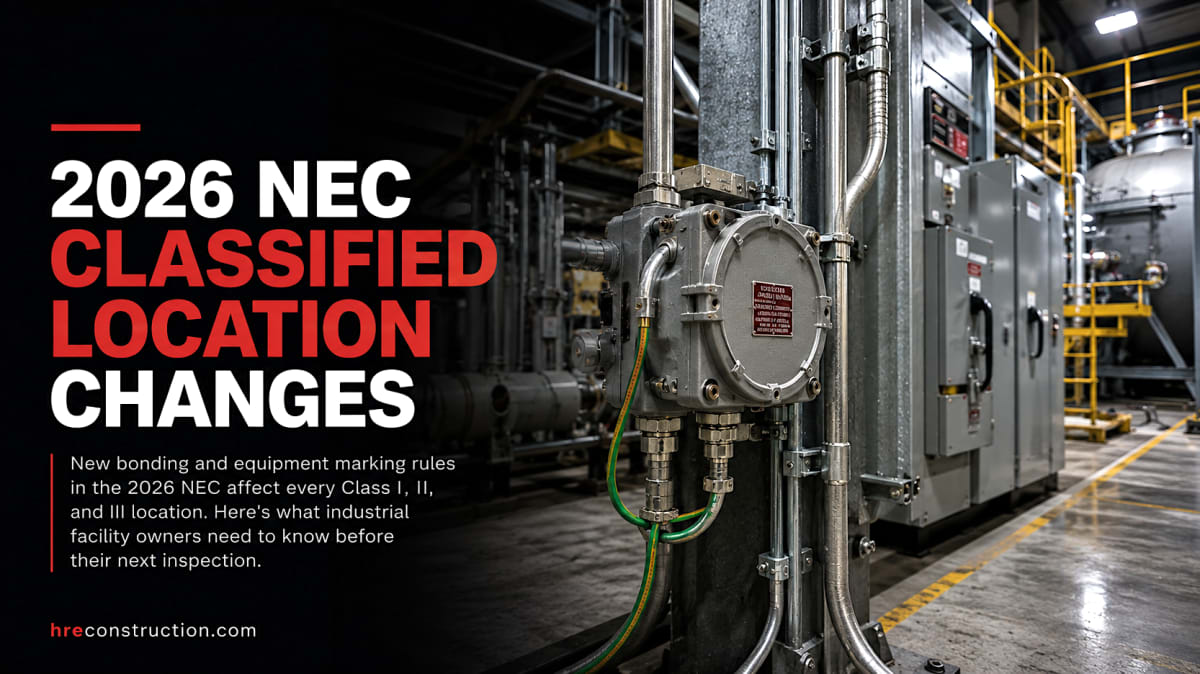
If your facility has a classified area, a paint booth, a grain handling line, a fuel storage yard, a chemical process room, the 2026 edition of the National Electrical Code brings two changes worth knowing about before your next project or inspection. Neither one rewrites how classified locations work. For the fundamentals, our earlier guide on classified locations and NEC Article 500 compliance still covers the Class, Division, and Zone basics, this post picks up where that one leaves off. Both changes below affect what an installer has to document and verify.
A new bonding requirement lands in Article 500
The 2026 NEC adds Section 500.30, a bonding requirement that sits in Article 500 and applies across Articles 501 through 503, meaning it touches Class I, Class II, and Class III locations alike. Bonding in hazardous areas has always mattered for the same reason it matters everywhere else in the Code: an uncontrolled potential difference between metal parts can produce a spark, and a spark is the one thing a classified location is built around avoiding. What's different in 2026 is that the requirement is now written into the Code as its own section rather than left to be inferred from general bonding rules in Article 250. For facilities running conduit, cable tray, or metallic enclosures through a classified area, that means bonding continuity in those runs is now something an inspector can point to directly, not something argued from general principle.
Equipment listing and marking gets more specific
Articles 501, 502, and 503 also pick up new tables addressing how equipment must be listed and marked for the specific Class, Division, and Group of the area it's installed in. This is less about new equipment requirements and more about documentation catching up to how classified-location equipment already gets specified and installed. In practice, it means the nameplate and listing paperwork on motors, fittings, and enclosures in your classified areas need to match the area's classification more precisely than a general "explosion-proof" label used to satisfy.
Why this matters for industrial and not just refineries
It's easy to read "hazardous locations" and think oil and gas exclusively. In practice, plenty of facilities across our service area carry classified areas without necessarily thinking of themselves as high-hazard sites: grain handling and storage, spray finishing and paint lines, battery charging areas, solvent storage, and fuel dispensing on an industrial yard all fall under Article 500 somewhere. If your facility has any of those, the bonding and marking changes apply whether or not "hazardous location" is a phrase anyone on staff uses day to day.
What to do before your next inspection or buildout
- Pull your existing area classification drawings and confirm they're current. Section 500.4 has always required this documentation; a bonding citation is a bad time to discover it's out of date.
- Check bonding continuity on conduit and cable tray runs through classified areas as part of routine maintenance, not just new installs.
- When specifying or replacing equipment in a classified area, confirm the listing and marking match the area's Class, Division, and Group, not just a general hazardous-duty rating.
- If your state hasn't adopted the 2026 NEC yet, treat this as planning information rather than an immediate compliance deadline, adoption timelines vary and we track them for every state we work in.
How HRE Can Help
Classified location work isn't a place to guess. Our team handles area classification review, bonding verification, and equipment specification for industrial facilities across our footprint, and we stay current on NEC adoption timelines state by state so you're not caught planning around a code cycle your jurisdiction hasn't adopted yet. If it's been a while since your classification drawings were reviewed, or you're planning a buildout that touches a classified area, we're glad to take a look before it becomes an inspection finding.
Frequently Asked Questions
Q: Does the new 2026 bonding requirement apply to existing classified areas, or only new installations?
A: Section 500.30 is a Code requirement, and Code requirements generally govern new installations and modifications from the point of adoption forward in a given jurisdiction; they aren't retroactively applied to existing, previously-compliant installations unless a local authority having jurisdiction (AHJ) specifically requires an upgrade. That said, we recommend verifying bonding continuity on any classified-area work anyway, since it's a life-safety item worth confirming regardless of which Code cycle governs it.
Q: My state hasn't adopted the 2026 NEC yet. Do I need to do anything now?
A: Not urgently. NEC adoption varies by state and can take months to years after publication. Treat this as planning information so your next classified-area project or equipment purchase is spec'd correctly once your state adopts it, not as an immediate compliance deadline.
Q: What counts as a classified location if my facility isn't oil and gas or chemical processing?
A: More areas qualify than most facility managers expect. Grain and dust handling, spray finishing and paint booths, battery charging rooms, solvent storage, and fuel dispensing areas on an industrial site can all fall under Article 500 depending on what's present and how it's used. If you're not sure whether an area on your site is classified, that's exactly the kind of question a classification review answers.
Q: How is this different from the existing NEC Article 500 basics on our site?
A: Our Article 500 primer covers the foundational Class/Division/Zone system, explosion-proof and intrinsically safe equipment, and conduit sealing. This post covers what's specifically new in the 2026 code cycle: the added bonding section and the more detailed equipment listing and marking tables. Read them together for the full picture.