Classified Locations and NEC Article 500 Compliance
August 10, 2026 | Samantha Mariano
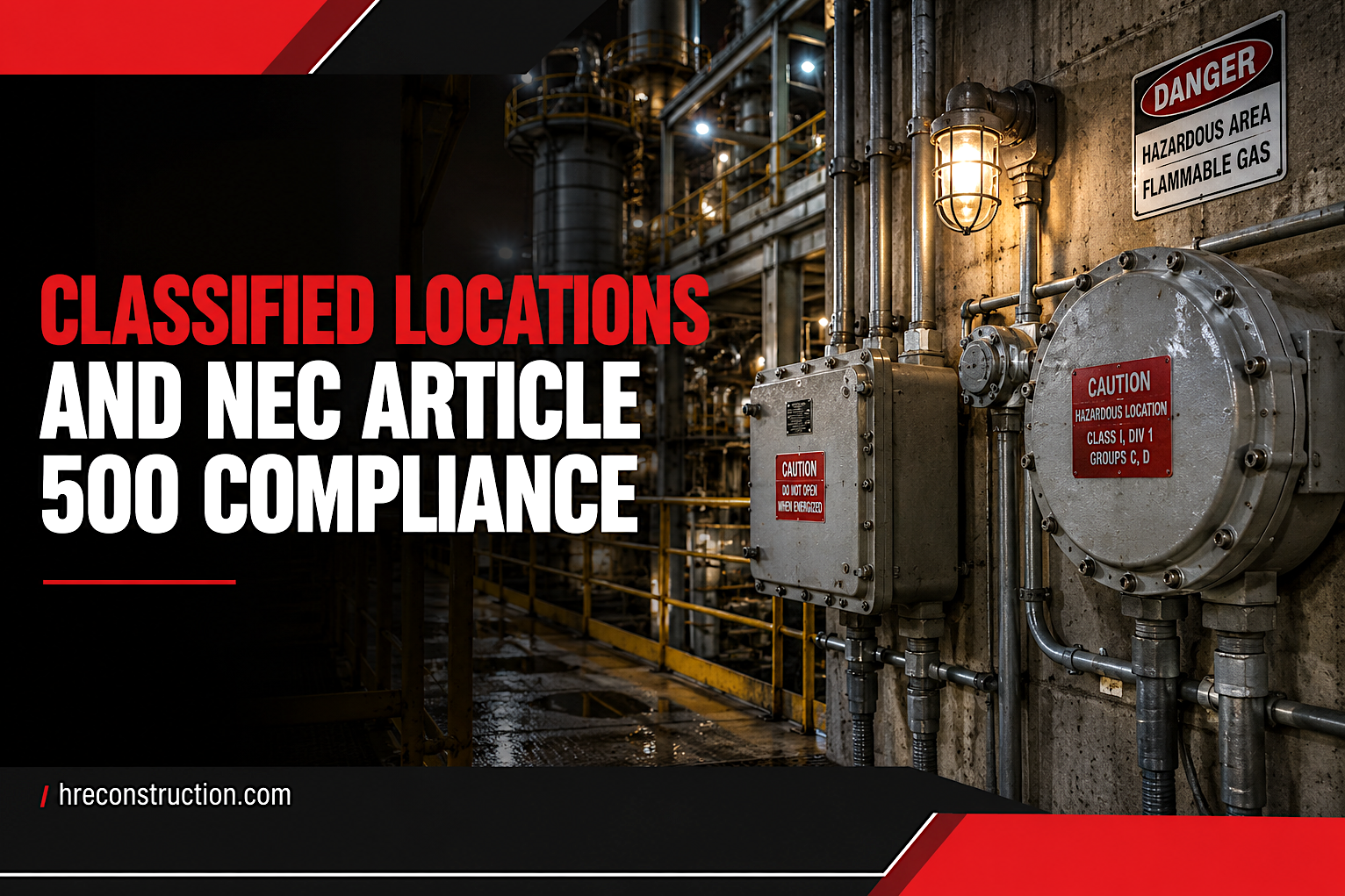
Most electrical work in a manufacturing plant is judged against the same standard you'd find in any commercial building. Then you get to the paint booth, the grain handling area, the solvent storage room, or the process area near a wellhead, and the rules change completely. In these spaces, an ordinary light switch or motor starter isn't just an inconvenience if it fails. It's a potential ignition source in an atmosphere that can burn or explode.
That's the world NEC Article 500 was written for. If your facility handles flammable gases or vapors, combustible dust, or ignitable fibers anywhere in its operations, understanding classified locations isn't optional. It determines what equipment can legally go in the ground, how it has to be installed, and how much liability sits on the table if it's done wrong. Get it wrong and you're not just risking a code violation. You're risking the kind of arc flash event that classified equipment is specifically designed to prevent from becoming an ignition source.
What Makes a Location "Classified"
A hazardous, or classified, location is any area where flammable or combustible material is present in a form and quantity that could create a fire or explosion hazard around electrical equipment. The NEC organizes these areas into three classes based on the physical form of the hazard:
- Class I covers flammable gases and vapors, common in facilities that handle solvents, fuels, or process chemicals, including oil and gas operations.
- Class II covers combustible dust, relevant to grain handling, sugar and food processing, woodworking, and metal fabrication.
- Class III covers ignitable fibers and flyings, found in textile, cotton, and certain fiber processing operations.
Within each class, the location is further split into divisions based on how often the hazard is actually present. A Division 1 location is one where the hazardous atmosphere exists under normal operating conditions. A Division 2 location is one where the hazard is only present under abnormal conditions, such as equipment failure or a process upset. That distinction matters a great deal, because Division 1 areas require more robust protection and typically cost more to equip than Division 2 areas covering the same material.
Article 500 also breaks materials down into groups, which refine the classification further based on how easily a specific gas, vapor, or dust ignites. Common hydrocarbons and industrial solvents fall into less severe groups, while materials like hydrogen and acetylene sit in more severe ones. Equipment rated for one group isn't automatically suitable for another, which is why area classification has to happen before equipment gets specified, not after.
Why This Isn't a One-Size-Fits-All Rule
A facility can have classified areas covering only a small footprint, like the immediate vicinity of a solvent dip tank, while the rest of the plant operates under ordinary rules. Getting the boundaries right requires an area classification study that looks at what materials are present, how they're handled, ventilation, and how likely a release is. Guessing wrong in either direction creates a problem: underclassifying leaves an ignition risk uncontrolled, while overclassifying drives up equipment and labor costs for protection the space doesn't actually need.
This is also where the NEC gives some flexibility. It's often possible to lay out equipment so that motor control centers, panels, and other gear sit in a reduced classification or entirely outside the classified boundary, cutting down how much specialized equipment the project actually requires. That kind of layout planning is exactly why custom electrical solutions outperform standard builds in classified environments, and it's where experienced classified-area electrical contractors save clients real money without cutting corners on safety.
What Changes for Equipment and Installation
Once an area is classified, the NEC requires equipment and wiring methods to be protected using one or more recognized techniques, including:
- Explosionproof enclosures, built to contain an internal explosion and prevent it from igniting the surrounding atmosphere
- Intrinsically safe systems, designed to limit electrical energy so it can't provide enough spark or heat to cause ignition
- Purged and pressurized enclosures, which use a controlled internal atmosphere to keep hazardous gases out of equipment housings
- Dusttight enclosures, appropriate for combustible dust environments
- Combustible gas detection systems, which in some industrial settings with restricted access and qualified maintenance staff can serve as a recognized protection method
Conduit sealing is another area where classified work differs sharply from standard commercial installations. Seals are required at specific points to prevent gases or vapors from migrating through conduit runs between classified and unclassified areas, and getting seal placement wrong is one of the more common violations inspectors flag in industrial facilities.
The NEC also permits an alternative zone-based classification system in place of the traditional division system for some installations, which is more common in facilities designed to international standards or built by companies operating in both the US and abroad. Which system applies is a design decision made early, not something to change mid-project, and it's one more reason to review classified area requirements against the current NEC update before finalizing a design. This is also where instrumentation selection matters just as much as wiring methods, since sensors and control devices installed in a classified area need the same protection rating as the surrounding electrical equipment.
Why This Matters Beyond Passing Inspection
Classified area violations don't usually show up as a spark and a headline. More often they show up as a failed insurance claim, a citation during an OSHA or fire marshal inspection, or a documentation gap that surfaces years later when a facility is sold or expanded. Article 500 requires documentation of classified and unclassified areas, including classification drawings, and that paperwork needs to be available to anyone designing, installing, inspecting, or maintaining electrical equipment in the space going forward. Facilities that skip this step, or inherit a plant where it was never done properly, often don't find out until an audit or an expansion forces the question.
For facilities in industries like petrochemical processing, grain and food handling, or fiber and textile production, this isn't a rare edge case. It's baseline plant infrastructure that needs to be right from day one and reviewed any time a process changes.
Frequently Asked Questions
Does my facility need a formal hazardous location classification study?
If your operations involve flammable gases or vapors, combustible dust, or ignitable fibers anywhere on site, even in a limited area like a solvent storage room or dust collection point, you need documented classification for that area. Facilities that have never had a study done are often out of compliance without realizing it.
What's the difference between Division 1 and Division 2 in a classified area?
Division 1 means the hazardous atmosphere is present under normal operating conditions. Division 2 means it's only present if something goes wrong, like a leak or equipment failure. Division 1 areas require more robust and typically more expensive protection than Division 2 areas covering the same material.
Can I use standard electrical equipment anywhere in a classified area?
Not in the classified zone itself. Equipment inside a Class I, II, or III boundary has to use a recognized protection technique, such as explosionproof enclosures or intrinsically safe design. In many cases equipment can be relocated just outside the classified boundary through smart layout planning, which reduces cost without compromising safety.
How often should classified area documentation be reviewed?
Any time a process, material, or piece of equipment changes in or near a classified area, the classification should be reviewed. Documentation that was accurate five years ago may not reflect what's actually happening on the floor today.
How HRE Can Help
HRE Construction works with industrial and manufacturing facilities across our licensed service area to classify hazardous locations correctly and install electrical systems that meet Class I, II, and III requirements from the ground up. That includes area classification review, explosionproof and intrinsically safe equipment installation, conduit sealing, and the documentation your facility needs on hand for inspections, insurance, and future expansion. Whether you're bringing a new process online or reviewing an existing plant that's never had a formal classification study, our team can help you understand exactly where the boundaries are and what equipment belongs inside them.
Get a Classified Location Assessment
If your facility handles flammable materials, combustible dust, or ignitable fibers anywhere in its operations, don't wait for an inspection to find out whether your electrical systems are compliant. Contact HRE Construction to schedule a classified location assessment for your facility.