HRE Construction / Industrial Electrical
What Is Arc Flash? Causes, Dangers, and Prevention
April 21, 2026 · 9 min read · By HRE Construction
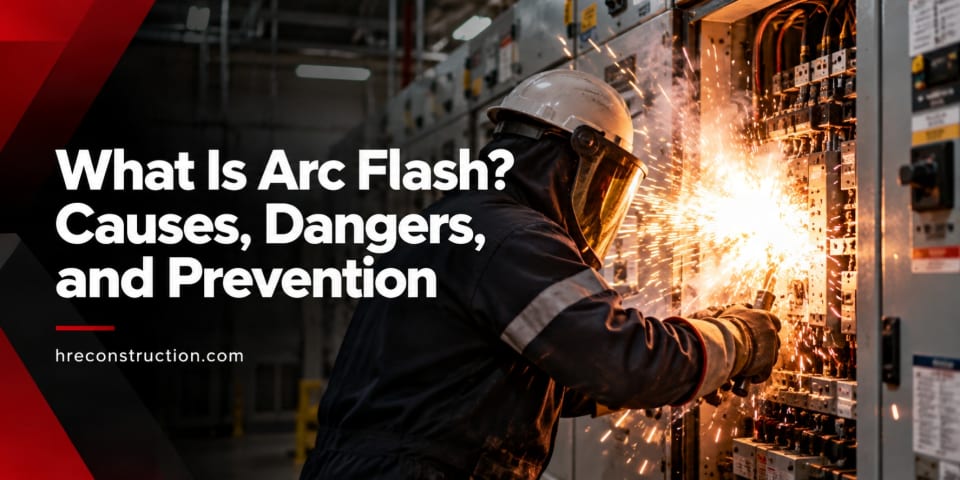
An arc flash is a burst of energy released when electric current jumps through the air between conductors, or from a conductor to ground. In a fraction of a second, the arc can reach temperatures of around 35,000°F, close to four times the temperature of the surface of the sun. It vaporizes metal, ignites clothing, and throws out a pressure wave strong enough to knock a person down.
For anyone who works on or near energized electrical equipment, arc flash is one of the most serious hazards on the job. The good news is that it is also one of the most studied. Its energy can be calculated, its boundaries can be marked, and its severity can be reduced. This guide explains what an arc flash is, what causes it, why some equipment is far more dangerous than other equipment, and what facilities can do about it.
What Is an Arc Flash?
In normal operation, current flows through conductors and insulation keeps it there. An arc flash happens when that path breaks down and current crosses an air gap instead. The air ionizes and becomes conductive, and the arc keeps feeding itself until a protective device opens the circuit.
That last point matters. An arc flash lasts exactly as long as it takes the breaker or fuse upstream to clear the fault. That might be a few cycles, or it might be a full second or more if the protection is slow or poorly maintained.
Arc Flash vs. Arc Blast vs. Shock
These three hazards often get grouped together, but they are different:
- Arc flash is the thermal hazard: intense heat and light that cause burns and eye injuries, often at a distance.
- Arc blast is the pressure hazard from the same event. Rapidly expanding air and vaporized metal (copper expands many times in volume when it vaporizes) create a concussive wave, deafening sound, and flying shrapnel.
- Electric shock comes from current passing through the body through direct or indirect contact.
NFPA 70E treats shock and arc flash as separate hazards with separate boundaries, and a task can carry one, both, or neither.
What Causes an Arc Flash?
Arc flash incidents usually start with one of two things: something a person does to energized equipment, or a condition inside the equipment that finally fails.
Work on or near energized equipment
- Opening covers or doors on energized gear
- Racking breakers in or out
- Inserting or removing motor control center buckets
- Voltage testing and troubleshooting with the equipment live
- Dropped tools, loose hardware, or test leads that bridge two phases
Equipment condition
- Loose or overheated connections
- Deteriorated or damaged insulation
- Dust, moisture, corrosion, or contamination inside enclosures
- Rodents and other animals
- Overcurrent devices that no longer operate as designed
- Improper installation, modifications, or wrong-rated parts
Because so many incidents happen during energized work, the most effective prevention is also the simplest: de-energize the equipment whenever possible.
Why Some Arc Flashes Are Far Worse Than Others
Arc flash severity is measured as incident energy, the heat energy that reaches a person at a given distance, expressed in calories per square centimeter (cal/cm²). Several factors drive it.
- Available fault current. How much current the system can deliver to the arc.
- Clearing time. How long the upstream protective device takes to open. This is often the biggest single factor. Doubling the arc duration roughly doubles the energy.
- Working distance. How close the worker is to the arc. Energy drops quickly with distance.
- Equipment configuration. Enclosed equipment focuses energy toward the opening, so an arc inside a cabinet can be much worse than one in open air.
- System voltage. Higher voltage sustains arcs more easily, but 480 V equipment produces many of the most severe incidents.
One counterintuitive point: lower available fault current does not always mean a smaller arc flash. If the fault current drops below the instantaneous trip point of the upstream breaker, the breaker may take much longer to clear, and the incident energy can go up. That is why arc flash calculations have to look at both fault current and protective device timing together.
For reference, the threshold for a second-degree burn on bare skin is commonly set at 1.2 cal/cm². That number defines the arc flash boundary, explained below.
The Standards Behind Arc Flash Safety
OSHA requires employers to protect workers from electrical hazards. OSHA has not formally adopted NFPA 70E, but it commonly looks to it as the recognized practice for meeting those requirements.
NFPA 70E, Standard for Electrical Safety in the Workplace, is the main document for how work is done. It requires an arc flash risk assessment before energized work, establishes the electrically safe work condition (de-energized, locked out, and verified), limits when energized work is justified, and sets rules for PPE and equipment labeling. The arc flash risk assessment must be reviewed when the system changes and at least every five years. Changes coming in the next edition are covered in our post on the 2027 NFPA 70E changes.
The National Electrical Code (NEC) covers how equipment is installed. It requires arc flash warning markings on equipment likely to be examined or serviced while energized, and Section 240.87 requires an arc energy reduction method on circuit breakers rated or adjustable to 1200 A or higher.
IEEE 1584 is the engineering guide used to calculate incident energy and arc flash boundaries. The 2018 edition significantly changed the calculation model, so studies done under older methods may no longer reflect actual hazard levels.
NFPA 70B now makes electrical equipment maintenance a requirement, which ties directly to arc flash: a poorly maintained breaker that clears slowly raises the incident energy at every point downstream. See our post on NFPA 70B.
Arc Flash Studies, Boundaries, and Labels
The Arc Flash Study
An arc flash study models your electrical system and calculates the incident energy at each piece of equipment. It is built on a short-circuit study and a protective device coordination study, which is why the three are usually done together. Our post on short-circuit and coordination studies explains how those pieces fit.
The Arc Flash Boundary
The arc flash boundary is the distance from exposed energized parts where incident energy equals 1.2 cal/cm². Anyone inside that boundary needs arc-rated protection. It is separate from the shock approach boundaries, and it can be inside or outside them.
The Arc Flash Label
Under NFPA 70E, an arc flash label must show:
- The nominal system voltage
- The arc flash boundary
- At least one of the following: the available incident energy and working distance, or the arc flash PPE category (not both); the minimum arc rating of clothing; or a site-specific level of PPE
Labels are only as good as the study behind them. When equipment, settings, or the utility supply change, the labels may no longer be accurate.
Arc Flash PPE Categories
When a facility uses the NFPA 70E table method instead of calculated incident energy, PPE is selected by category
| PPE Category | Minimum Arc Rating |
|---|---|
| 1 | 4 cal/cm² |
| 2 | 8 cal/cm² |
| 3 | 25 cal/cm² |
| 4 | 40 cal/cm² |
PPE is the last line of defense. It is designed to make injuries survivable, not to make energized work safe. It also does not protect against everything the arc blast can do, such as pressure and flying debris.
How Facilities Reduce Arc Flash Risk
NFPA 70E requires employers to follow a hierarchy of risk controls, starting with eliminating the hazard. In practice, that looks like this.
1. De-energize first. Put equipment in an electrically safe work condition with lockout/tagout and verification of absence of voltage. Energized work should be the exception, justified and permitted. Our lockout/tagout guide covers the program side.
2. Reduce the energy. Since clearing time drives so much of the hazard, faster protection makes a large difference:
- Energy-reducing maintenance switches that temporarily speed up a breaker's trip while people work downstream
- Zone-selective interlocking between breakers
- Differential relaying
- Active arc flash mitigation systems
- Protective device setting changes identified in the study
3. Move people away from the arc. Remote racking devices, remote switching, and infrared viewing windows let workers operate or inspect equipment from outside the arc flash boundary.
4. Upgrade equipment where it makes sense. Arc-resistant switchgear is designed to direct arc energy away from the operator. Older gear with no arc energy reduction may be a candidate for retrofit or replacement.
5. Maintain protective devices. Breakers and relays that are tested and maintained clear faults as designed. Regular switchgear maintenance and testing and infrared inspections catch the loose connections and worn parts that start many incidents.
6. Train qualified workers. Workers need to understand the hazards, read labels, select PPE, and know when to stop and de-energize. Our post on industrial electrical safety compliance covers training and program requirements.
How HRE Can Help
HRE Construction works on industrial power distribution, switchgear, and motor control equipment every day, and arc flash safety is part of how we plan every job. We can help your facility:
- Coordinate arc flash, short-circuit, and coordination studies, and act on their recommendations
- Install and update arc flash labels after studies or system changes
- Implement arc energy reduction, including maintenance switches and protective device setting changes
- Test and maintain breakers, relays, and switchgear so protection clears faults as designed
- Plan outages so more work can be done de-energized
- Upgrade older distribution equipment when retrofitting is no longer practical
Learn more about our testing and startup services.
Know Your Hazard Before Someone Opens the Door
If your labels are missing, out of date, or based on a study that is more than five years old, your workers may not know what they are facing. Talk to HRE Construction about reviewing your arc flash program and reducing the hazard at the source. Request a quote today.
Frequently Asked Questions
What is an arc flash?
An arc flash is a release of heat and light caused by electric current traveling through the air between conductors or to ground. It can reach about 35,000°F and cause severe burns, eye injuries, and fires in a fraction of a second.
What causes an arc flash?
Most arc flashes start during work on energized equipment, such as opening covers, racking breakers, or testing, or from equipment problems like loose connections, damaged insulation, contamination, and protective devices that fail to clear a fault quickly.
What is the difference between an arc flash and an arc blast?
The arc flash is the thermal hazard from heat and light. The arc blast is the pressure wave from the same event, created by rapidly expanding air and vaporized metal, which can throw workers and send shrapnel through the area.
How often does an arc flash study need to be updated?
NFPA 70E requires the arc flash risk assessment to be reviewed whenever the electrical system changes and at least every five years. Changes such as new equipment, protective device settings, or utility supply changes can make existing labels inaccurate.
Related Services
Related Posts
 MCC Retrofit vs. Replacement: How to Choose
November 4, 2026
Upgrading a motor control center? Compare retrofit buckets, partial rebuilds and full replacement, plus the SCCR, UL 845 and...
 Electrical Safety Compliance Checklist for Industrial Facilities
August 3, 2026
A practical electrical safety compliance checklist for industrial facilities covering NFPA 70E, arc flash labeling,...
 What the 2026 NEC Update Means for Industrial Facilities
July 9, 2026
The 2026 NEC is out, and it brings real changes for industrial facilities, from more detailed arc flash labeling requirements...