Electrical Safety Compliance Checklist for Industrial Facilities
August 3, 2026 | Samantha Mariano
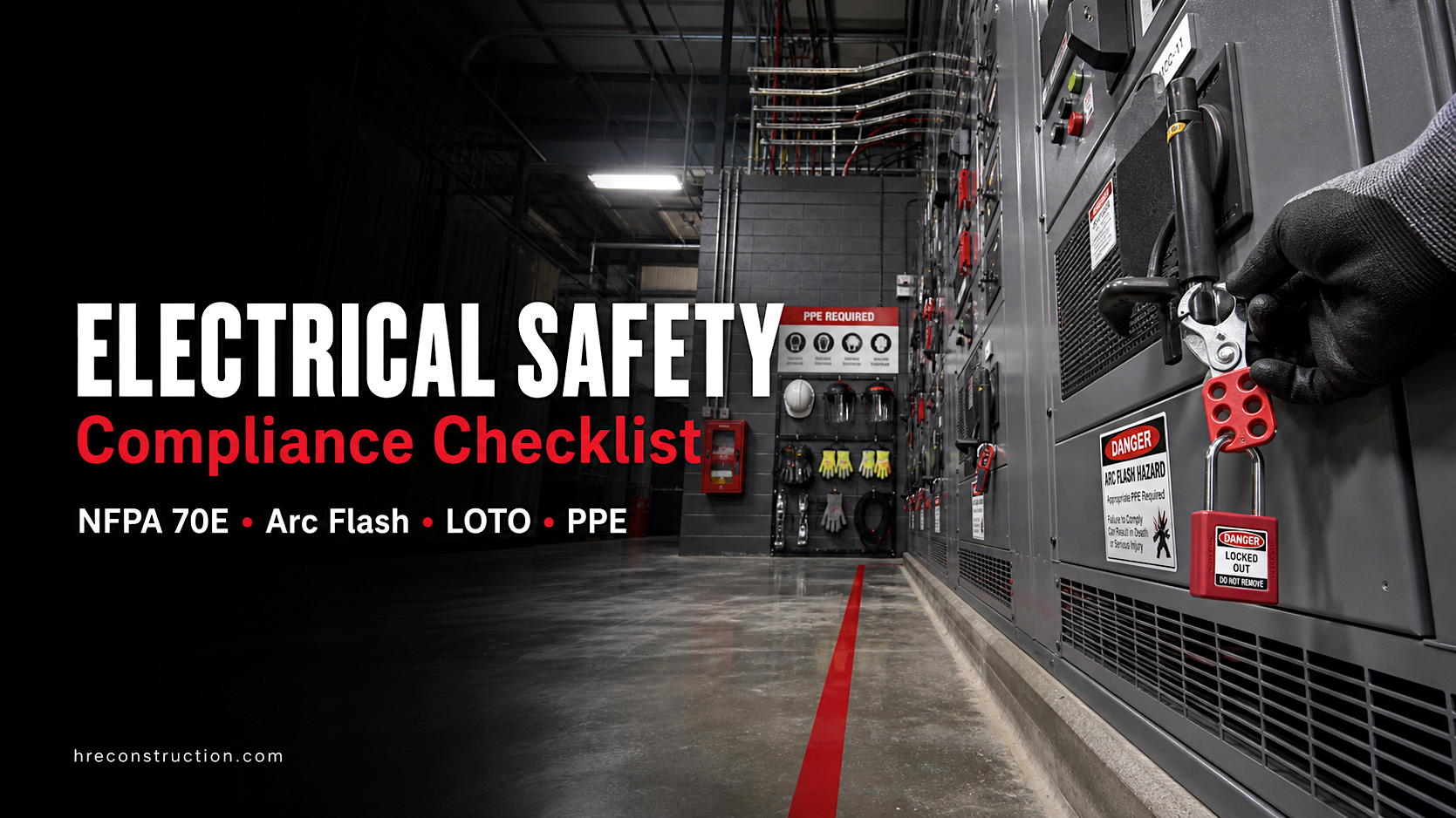
Electrical safety compliance in an industrial facility is not a single inspection or a binder that sits on a shelf. It is an ongoing program that has to hold up to OSHA scrutiny, protect your workforce, and keep pace with equipment changes on your floor. Facility managers are often the ones held accountable when a compliance gap surfaces, whether that gap shows up during an audit, an insurance review, or worse, after an incident.
This checklist walks through the core pieces of an industrial electrical safety compliance program: risk assessment, labeling, lockout/tagout, and PPE. It is meant as a starting point for evaluating where your facility stands, not a substitute for a full audit by a qualified electrical contractor.
Start With a Documented Arc Flash Risk Assessment
Every task performed on or near energized electrical equipment should be covered by a documented risk assessment under NFPA 70E, the consensus standard for electrical safety in the workplace. The current edition strengthened the documentation requirement so that a risk assessment cannot simply recommend a PPE category. It has to show the hierarchy of risk controls that was considered first, starting with elimination and working down through substitution, engineering controls, awareness, administrative controls, and PPE as the last line of defense.
For incident energy analysis, the industry standard method is IEEE 1584, which calculates the thermal energy a worker could be exposed to at a given working distance from specific equipment. That calculation drives which PPE category applies to a task, and it is not something that should be estimated by rule of thumb. Facilities with aging one-line diagrams or equipment that has changed since the last study are at particular risk of working from labels that no longer reflect actual conditions on the equipment.
Arc flash risk assessments should be reviewed for accuracy at intervals not exceeding five years, and sooner if the electrical system has changed, such as new transformers, modified breaker settings, or added loads.
Confirm Arc Flash Labeling Is Current
Arc flash warning labels on switchgear, motor control centers, and panelboards need to reflect the most recent incident energy analysis, not whatever was printed when the equipment was installed. The National Electrical Code addresses labeling requirements for service equipment likely to require examination while energized, and a facility with mismatched labels and studies is exposed on two fronts: workers may be underprotected, and the paper trail will not hold up if OSHA asks for it.
A quick way to spot a problem: pull the most recent arc flash study date and compare it against the dates on the physical labels in the field. If they do not match, or if some equipment has no label at all, that is a gap worth closing before it becomes a citation or, more importantly, before it becomes an injury.
Keep the Lockout/Tagout Program Current
OSHA's lockout/tagout standard, 29 CFR 1910.147, requires a documented energy control program for equipment that could unexpectedly energize, start up, or release stored energy during service or maintenance. For industrial facilities running motor control centers, PLC-driven production lines, and multiple energy sources per machine, this is often the single most cited compliance gap during OSHA inspections nationally.
A functional LOTO program needs machine-specific procedures, not a generic company-wide policy. Each piece of equipment with more than one energy source, electrical, pneumatic, hydraulic, or stored mechanical energy, needs its own documented isolation steps. Annual periodic inspections of the program, along with training records for authorized and affected employees, are part of what an auditor will ask to see.
Build a Real PPE Program, Not Just a PPE Closet
Having arc-rated clothing on site is not the same as having a PPE program. A compliant program ties specific PPE requirements to the task-based risk assessment described above, not to a single blanket category applied across the whole facility. Categories range from lower-risk tasks like some infrared thermography work up through higher incident energy tasks that require heavier arc-rated protection, and the correct category for a given task comes from the incident energy analysis, not from habit.
It is also worth confirming that arc-rated (AR) clothing is genuinely arc-rated, not simply flame-resistant (FR). The two terms get used interchangeably on the floor, but not all FR clothing is tested and rated for arc flash protection, and the distinction matters if OSHA or an insurer ever reviews an incident.
How HRE Can Help
HRE Construction performs electrical testing, commissioning, and arc flash hazard analysis and labeling for manufacturing plants, processing facilities, and industrial operations across our licensed territory. Our field teams work under NFPA 70E and OSHA electrical safety standards on every project, and we can help your facility close the gap between what your labels say and what your equipment actually looks like today.
If it has been more than a few years since your last arc flash study, or if your facility has added equipment, expanded a line, or changed breaker settings since the last review, it is worth having that assessment refreshed before it becomes a problem during an audit or an incident investigation.
Ready to get your facility's electrical safety documentation current? Contact HRE Construction to schedule an arc flash risk assessment or discuss your compliance program.
Frequently Asked Questions
How often does an arc flash risk assessment need to be updated?
NFPA 70E calls for a review at intervals not exceeding five years, and sooner if the electrical system has changed in ways that would affect available fault current or incident energy, such as new transformers, modified breaker or relay settings, or added electrical loads.
Is lockout/tagout only required for large equipment?
No. OSHA's LOTO standard, 29 CFR 1910.147, applies to any equipment that could unexpectedly energize, start up, or release stored energy during servicing or maintenance, regardless of size, if it has more than one energy source or the potential for stored energy release.
Does a 120V circuit really need an arc flash assessment?
Yes. NFPA 70E applies to all voltages, including 120V and below. Under certain conditions, such as high available fault current or slow clearing times, even low-voltage circuits can produce a meaningful arc flash hazard, and assuming otherwise has led to real injuries in the field.
What is the difference between arc-rated and flame-resistant clothing?
All arc-rated (AR) clothing is flame-resistant, but not all flame-resistant (FR) clothing is arc-rated. AR clothing has been specifically tested for arc flash protection and carries a rated incident energy value, while FR clothing alone may not provide that documented level of protection.