NFPA 70B Is Now Mandatory: What Facilities Need to Know
August 31, 2026 | Samantha Mariano
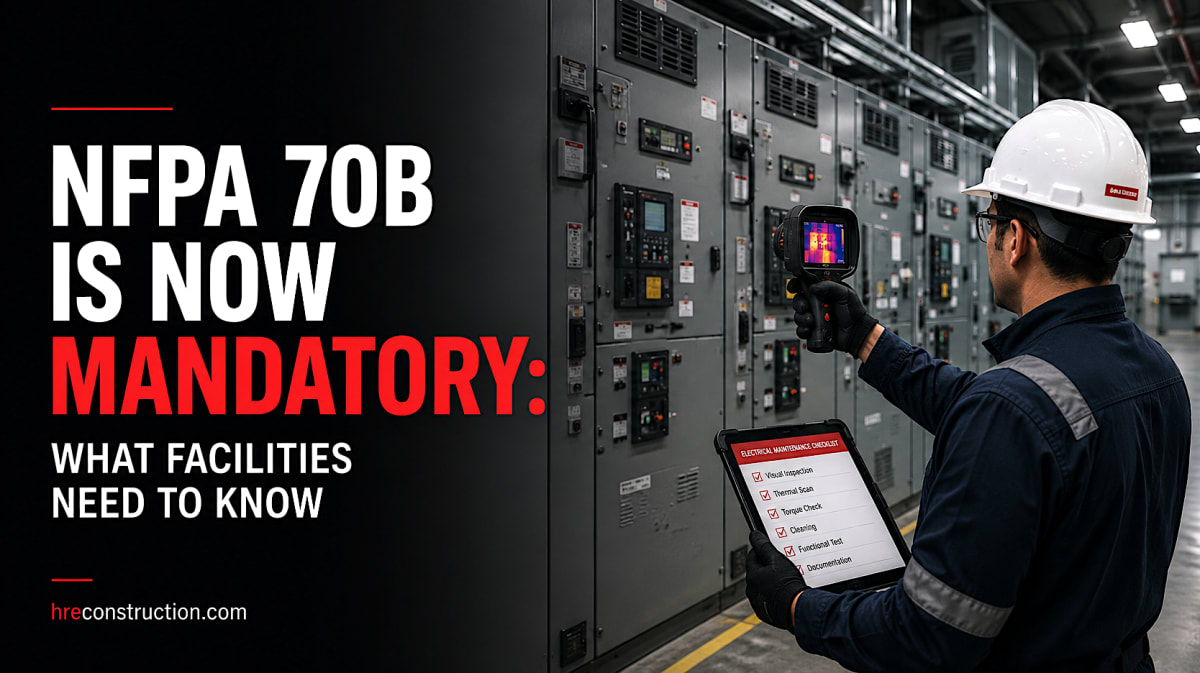
NFPA 70B Is Now Mandatory: What Industrial Facilities Need to Know
For decades, NFPA 70B told facilities how electrical maintenance should be done. It was guidance, not a requirement, and plenty of industrial operations treated it that way. That changed with the 2023 edition. NFPA 70B is no longer a recommended practice. It is a standard, and standards carry mandatory language.
If your facility has not looked at its electrical maintenance program since that shift, now is a good time.
What Actually Changed
The core difference comes down to a single word. Older editions of NFPA 70B were full of "should." The current edition is full of "shall." That is not a small distinction. "Should" leaves room for interpretation. "Shall" does not.
This matters because NFPA 70B is a consensus standard, not a law like the National Electrical Code. But insurance carriers, authorities having jurisdiction, and OSHA can all point to it as the accepted industry benchmark for what a reasonable electrical maintenance program looks like. When equipment fails and an investigation follows, "we didn't have a documented maintenance program" is a much harder position to defend now than it was under the old recommended practice.
Equipment Condition Assessments Now Drive Maintenance Intervals
The updated standard moves away from generic, calendar-based maintenance schedules. Instead, Chapter 9 lays out required scopes of work and intervals by equipment type, but those intervals are adjusted based on an Equipment Condition Assessment, or ECA.
An ECA looks at three factors for each piece of equipment:
- Physical condition – wear, corrosion, damage, age
- Criticality – how much production or safety exposure depends on that equipment staying online
- Operating environment – heat, dust, moisture, vibration, and other conditions the equipment sits in
Whichever of those three factors is in the worst condition sets the maintenance frequency for that piece of equipment. A newer transformer in a clean, climate-controlled room gets a different interval than an older one exposed to heat and vibration on a production floor, even if both are the same make and model. This is a more realistic approach for industrial facilities, where equipment condition varies widely across a single site, but it also means a documented assessment process is now expected, not optional.
Predictive Maintenance Gets More Weight
The 2023 edition leans harder into condition-based and predictive maintenance techniques than earlier versions did. Thermal imaging, partial discharge testing, and vibration analysis all get more detailed treatment as tools for catching problems before they cause a failure, rather than waiting for a fixed calendar date to roll around. Facilities already running an infrared thermal imaging program are ahead of the curve here. Facilities that are not may find it is time to start.
Why This Matters Beyond Compliance
Improperly maintained electrical equipment is a documented contributor to arcing faults, and arcing faults are how arc flash incidents happen. NFPA 70E already ties "condition of maintenance" into how work practices and PPE requirements are determined on a piece of equipment. If equipment cannot be shown to be properly maintained, NFPA 70E requires it to be treated as though it has exposed live parts, which raises the PPE category and the risk for anyone working on or near it.
In other words, this is not just paperwork. A documented, risk-based maintenance program under NFPA 70B directly supports the safety case your facility is already required to make under NFPA 70E.
What Facilities Should Do Now
A few practical steps for facility managers who have not revisited their maintenance program since the 2023 shift:
- Confirm you have a documented Electrical Maintenance Program. Informal or tribal-knowledge maintenance does not meet the current standard.
- Run Equipment Condition Assessments on critical gear. Start with switchgear, MCCs, and transformers that would cause the most disruption if they failed.
- Build predictive maintenance into the schedule. Thermal scans and testing catch problems while they are still cheap to fix.
- Review maintenance records against Chapter 9 intervals. Where records are missing or intervals have slipped, that is your priority list.
- Keep NFPA 70E alignment in mind. Maintenance condition and PPE requirements are connected, not separate conversations.
Facilities that already have a structured preventive maintenance program in place have a head start, but it is worth checking that program against the current standard rather than assuming it still lines up.
How HRE Can Help
HRE Construction works with industrial facilities across 11 states to build and run electrical maintenance programs that hold up to current standards, not outdated ones. That includes Equipment Condition Assessments, thermal imaging and testing, switchgear inspection and maintenance, and documentation that gives facility managers a clear, defensible record of what has been done and when.
Whether you need a maintenance program built from scratch or an existing one reviewed against the current NFPA 70B standard, our team can help you close the gap before it becomes a problem.
Ready to get your electrical maintenance program up to standard? Contact HRE Construction to talk through what your facility needs.