New NEC Article 624: What It Means for Your Forklift Fleet and Charging Infrastructure
July 23, 2026 | Samantha Mariano
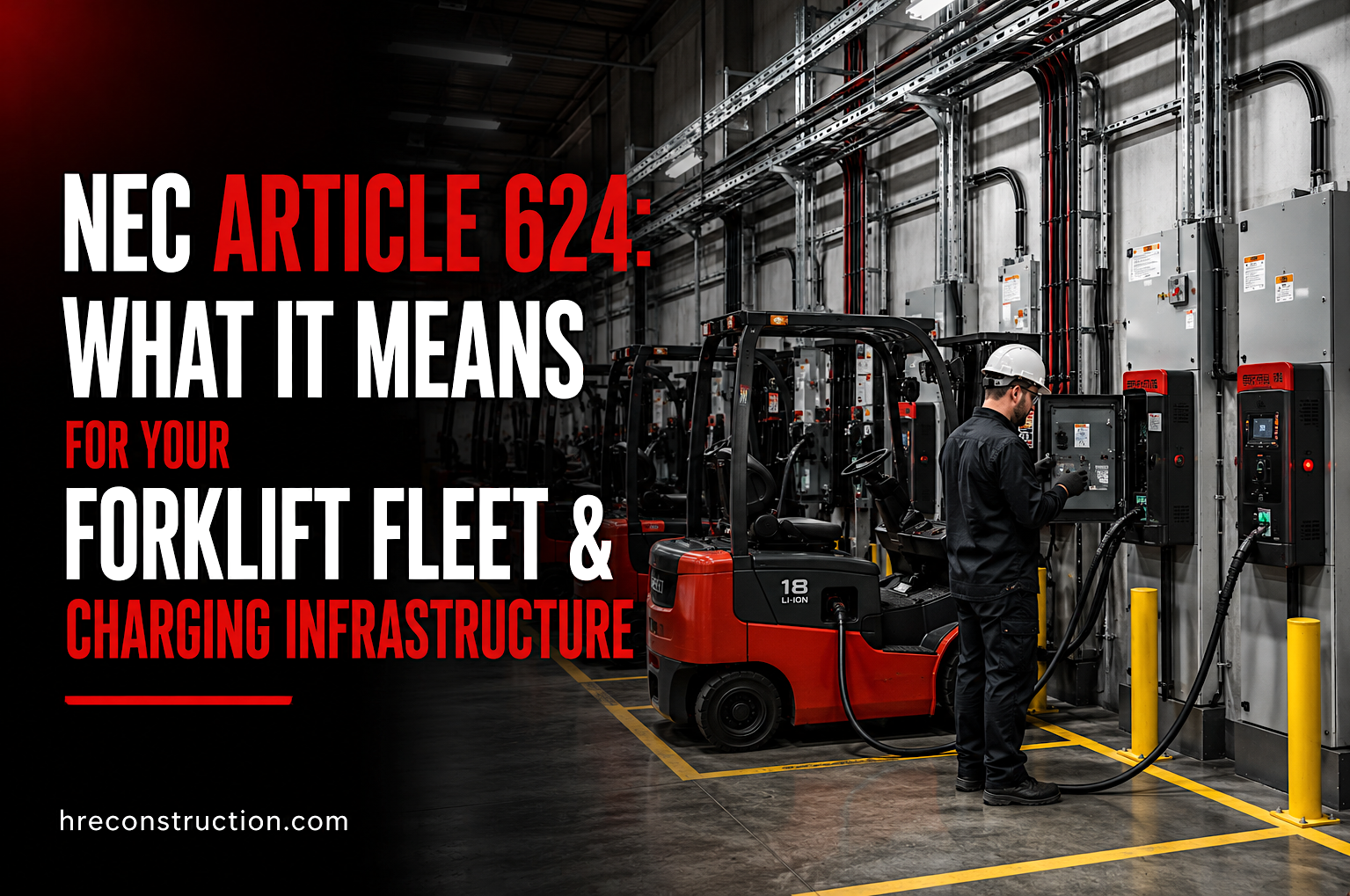
Most of the talk around the 2026 NEC and electric vehicles has centered on passenger cars and commercial parking lots. If your facility runs electric forklifts, automated guided vehicles (AGVs), scissor lifts, or airport ground support equipment, that conversation has been missing the point. A new section of the code was written specifically for you.
A Gap the Code Finally Closed
Electric forklifts and AGVs have been standard equipment on warehouse and manufacturing floors for years, but the NEC never had a clean answer for how their charging infrastructure should be regulated. Article 625 covers electric vehicles, but it is written for on-road vehicles like passenger cars and trucks. Anything that moves under battery power but never touches a public road, think forklifts, tuggers, scissor lifts, golf carts, and airport ground equipment, fell into a gray area.
The 2026 NEC closes that gap with new Article 624, Electric Self-Propelled Vehicle Power Transfer Systems. It introduces a new defined term, Electric Self-Propelled Vehicle (ESV), covering battery-powered equipment other than on-road EVs, and lays out installation requirements for the equipment that charges them. This is one of several structural changes in the 2026 NEC affecting industrial facilities this cycle.
What Counts as an ESV
Under the new Article 100 definition, an ESV is a vehicle or marine vessel other than an on-road electric vehicle that is primarily powered by an electric motor drawing from a battery, fuel cell, or similar source. In practice, this covers a wide range of equipment already common on industrial sites:
- Electric forklifts and tuggers
- Automated guided vehicles (AGVs)
- Scissor lifts and aerial work platforms
- Airport ground support equipment
- Golf carts and utility vehicles
If it runs on battery power and it is not licensed for the road, Article 624 is very likely the section that now governs how it gets charged.
What Article 624 Actually Requires
Article 624 largely mirrors the structure of Article 625, adapted for this equipment category. Charging equipment and power transfer systems for ESVs need to be listed, use appropriate cords and receptacles for the application, and in many cases require a dedicated branch circuit rather than sharing a circuit with other loads. For facilities running multiple charging stations along a warehouse wall or in a dedicated charging room, that has real implications for panel capacity and circuit planning, and it is worth reviewing alongside selective coordination requirements if those charging circuits are sharing panel space with other critical loads.
The Related Change in Article 625: SPGFCI Protection
If your facility also runs on-road electric vehicles, delivery vans, or fleet trucks, a separate 2026 change is worth flagging. New Section 625.54 introduces special-purpose ground-fault circuit interrupter (SPGFCI) requirements for EV charging equipment where the voltage to ground exceeds 150 volts, with some provisions phasing in through 2029. Standard GFCI protection remains the baseline for lower-voltage receptacles, but higher-voltage EVSE will need equipment built to the SPGFCI standard. Adoption dates and enforcement will vary by state, so this is one to watch rather than something with a single hard deadline everywhere. It follows the same pattern we covered in our GFCI protection changes for industrial HVAC post: expanded ground-fault protection is a running theme across the 2026 code cycle, not an isolated change.
Why This Matters Now, Not Later
If you are planning a dedicated charging room as part of this upgrade, it is also worth revisiting working space and egress clearance requirements for that space while the layout is still on paper.
Facilities are electrifying material handling equipment faster than most electrical infrastructure was originally designed to support. A charging setup that was fine for two forklifts on a shared circuit can become a compliance and safety problem once that fleet grows to eight or ten units. Article 624 gives inspectors and facility managers a clear standard to design against, which is good news, but it also means charging installations that predate the new article may need a second look once your jurisdiction adopts the 2026 NEC.
How HRE Can Help
HRE Construction works with industrial and commercial facilities across the Southeast and beyond to design and install compliant electrical infrastructure, including charging systems for forklift fleets, AGVs, and other self-propelled equipment. Whether you are planning a new charging room, expanding an existing fleet, or want an audit of your current setup against the incoming code changes, our team can walk your facility and tell you exactly where you stand.
Ready to get ahead of the 2026 NEC changes? Contact HRE Construction to schedule a facility electrical assessment.