GFCI Protection for Industrial HVAC: What Changes Under the 2026 NEC
July 15, 2026 | Samantha Mariano
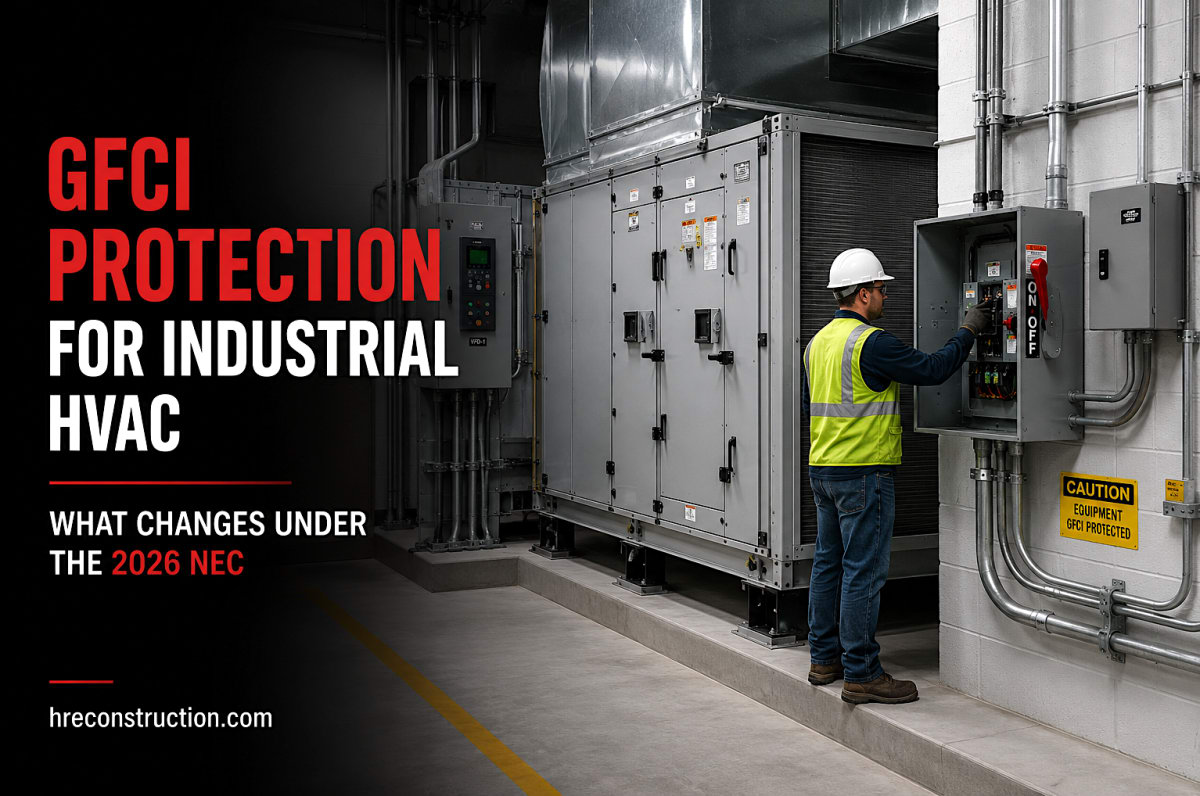
Industrial facilities run HVAC equipment most people never think about: rooftop units sized for a warehouse, process cooling systems, air handlers tied to variable frequency drives. As of September 1, 2026, a lot of that equipment falls under a GFCI requirement it didn't have before. If your facility has HVAC equipment coming up for replacement, retrofit, or new installation, the rule already applies to that work.
The Exception That Expired
Under NEC Section 210.8(F), listed HVAC equipment has had an exception exempting it from GFCI protection. That exception expired on September 1, 2026. Listed HVAC equipment covered by 210.8(F) now needs a GFCI protection path, one way or another. Keep in mind that enforcement depends on which NEC edition your state or local jurisdiction has adopted, so check with your AHJ before work is specified.
For a lot of industrial facilities, that raises an immediate problem: standard GFCI devices don't play well with variable frequency drives.
Why Standard GFCI Doesn't Work for VFD-Driven Equipment
Standard Class A GFCI devices are built to trip on relatively small ground-fault currents, which makes sense for personnel protection in most settings. But VFDs and inverters, common on industrial HVAC compressors, blowers, and pumps, produce high-frequency leakage current as a normal part of how they operate. Run that kind of equipment through a standard GFCI and you'll likely get nuisance tripping: the unit shuts down repeatedly for no actual fault, which isn't an electrical problem so much as a compatibility problem.
The Fix: Class C SPGFCI
The 2026 NEC addresses this directly. Exception No. 3 under 210.8(F) allows listed Class C Special-Purpose GFCI (SPGFCI) protection for listed HVAC equipment, as an alternative to standard GFCI protection.
Class C SPGFCIs are evaluated under UL 943C rather than the standard UL 943 used for typical Class A devices. They're designed to monitor the equipment grounding conductor for continuity and tolerate a defined amount of current on that conductor, rather than tripping on the smaller thresholds a Class A device would react to. Devices marked "HF" or "HF+" specifically address the high-frequency leakage current that VFDs and inverters generate, which is why they're the more practical choice for a lot of industrial HVAC applications.
This is also the first NEC cycle to formally define Class C, D, and E SPGFCIs as distinct device categories, rather than leaving special-purpose protection loosely defined. Knowing which class applies to which equipment type is now part of a compliant HVAC installation, not an afterthought.
The Labeling Requirement
If you use Class C SPGFCI protection instead of standard GFCI, the code requires the disconnect serving that HVAC equipment to carry a specific warning label identifying the protection method. Inspectors will be looking for it, and it needs to be there before final sign-off, not added after the fact.
What This Means for Planning
If you're specifying new HVAC equipment, retrofitting existing units, or working through a facility expansion where HVAC is part of the scope, this affects two decisions up front: which GFCI protection path fits the equipment you're installing, and whether the disconnect and labeling requirements are built into the submittal package from the start. Waiting until inspection to sort this out is the expensive way to find out your equipment and protection device don't match.
How HRE Can Help
HRE Construction works with facility owners and engineers to make sure electrical scope, including GFCI protection for HVAC and other VFD-driven equipment, is planned correctly before installation, not corrected after a failed inspection. Our electrical and instrumentation services cover everything from power distribution to process control panel fabrication and startup testing. If you have HVAC work coming up, contact us and we can help you sort out which protection path actually fits your equipment.
Frequently Asked Questions
Does the HVAC GFCI rule apply to equipment that's already installed?
Generally, NEC requirements apply to new installations, replacements, and modifications, not equipment already in service that passed inspection. Your local authority having jurisdiction makes the final call, so replacements and retrofits are where most facilities will run into it first.
What is Class C SPGFCI?
It's a special-purpose ground-fault protection device with a higher trip threshold than a standard Class A GFCI. It's meant for equipment like VFD-driven HVAC units, which would nuisance-trip a standard GFCI, and it comes with its own labeling requirement at the disconnect.