Selective Coordination: Why One Tripped Breaker Shouldn't Shut Down Your Whole Facility
July 7, 2026 | Samantha Mariano
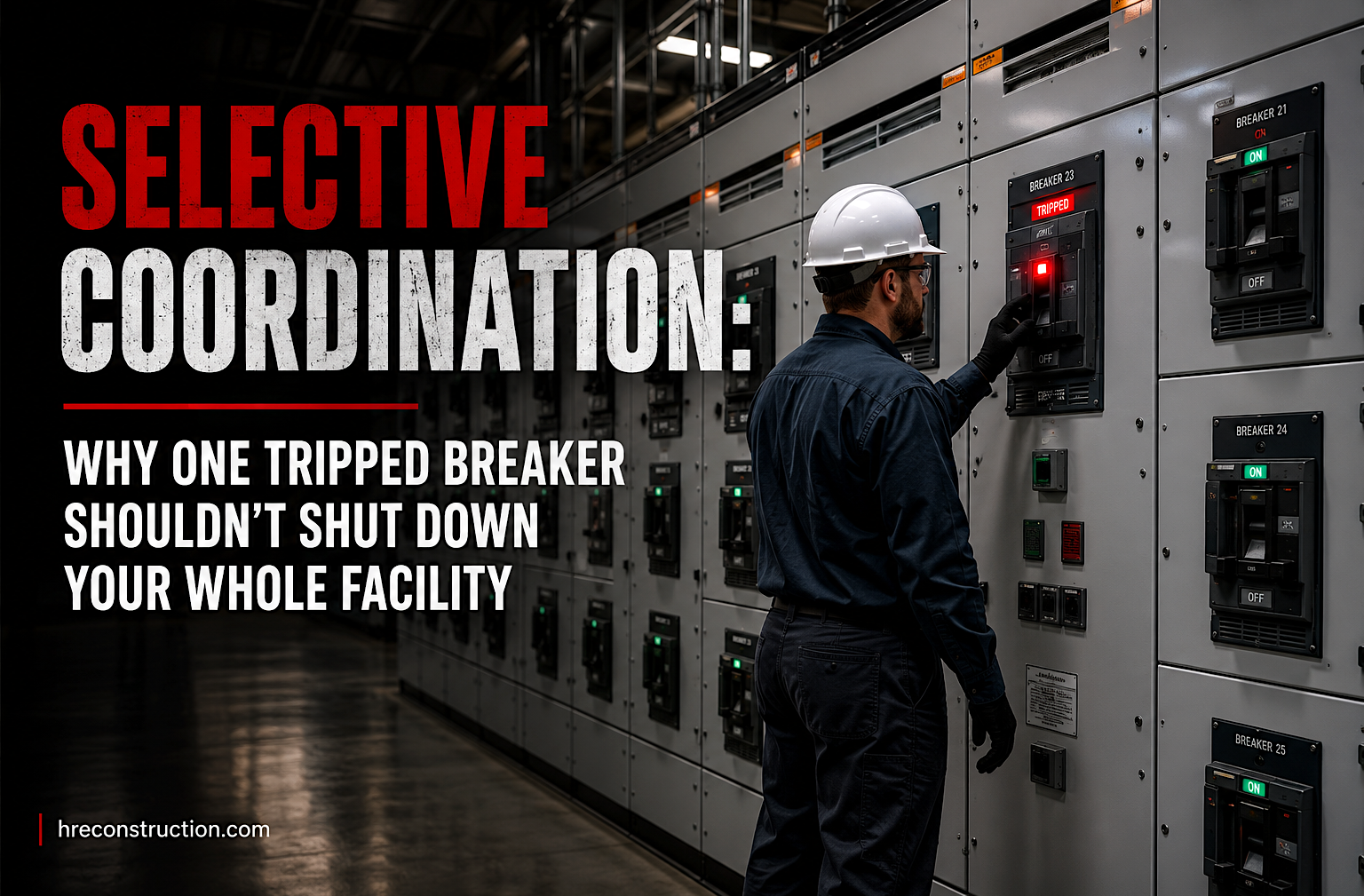
When a fault happens somewhere in your facility's electrical system, the goal is simple: only the breaker closest to the problem should trip. Everything else should keep running. That's selective coordination, and when it's missing, a single fault on one branch circuit can take down power to an entire building or process line, even though only one small piece of equipment actually failed.
What Selective Coordination Actually Means
The National Electrical Code defines selective coordination as choosing and installing overcurrent protective devices, breakers and fuses, so that the device nearest a fault opens first, across the full range of possible fault currents. In plain terms: if a motor branch circuit faults, only that branch's breaker should open. The feeder breaker upstream and the main breaker further upstream should stay closed and keep the rest of the facility powered.
Without it, faults can cascade upstream. A problem that should have stayed isolated to one machine or one panel instead trips a much larger breaker, and a much bigger section of the facility loses power than it needed to.
Where the NEC Requires It
Selective coordination isn't optional everywhere, but it is mandatory in specific situations where continuity of power protects people, not just equipment:
- Emergency power systems (generators and automatic transfer switches serving life safety loads)
- Legally required standby systems
- Elevators, where more than one elevator is fed from a single feeder
- Fire pump circuits
- Critical operations power systems
The 2023 NEC, the current edition, added a new section addressing this directly: if any feeder breaker fed by a service breaker is required to be selectively coordinated, every other feeder breaker on that same service must be coordinated too. It also tightened the emergency system requirements so that coordination has to be checked on both the supply side and the load side, and reevaluated any time a breaker gets replaced or the system is modified.
That last part matters more than it sounds like. A lot of facilities had a properly coordinated system when it was installed, then lost that coordination years later during a panel upgrade or equipment swap that nobody re-checked against the original study.
Why It's Not Just a Code Checkbox
Even where the NEC doesn't strictly require it, selective coordination is worth doing anywhere unplanned downtime is expensive. In an industrial facility, that's most places. A coordination failure on a single production line breaker shouldn't be able to shut down an entire building's electrical distribution, but without a proper coordination study, it can.
Coordination is evaluated using time-current curves for each breaker and fuse in series. If those curves overlap, especially in the higher fault-current range where breakers respond almost instantly, there's a real chance both devices will try to trip at the same time, and the wrong one wins that race.
What Facility Managers Should Ask
If you're not sure whether your facility's electrical system is selectively coordinated, a few questions are worth raising with your electrical contractor:
- Has a formal coordination study ever been performed on our system, and do we have the documentation?
- Has anything changed since that study, breaker replacements, panel additions, load changes, without a re-evaluation?
- Are our emergency and life safety circuits specifically confirmed coordinated, not just assumed to be?
If the answer to any of those is uncertain, that's a gap worth closing before a fault finds it for you.
How HRE Can Help
HRE Construction works with industrial facilities to evaluate existing electrical distribution systems, identify coordination gaps between breakers and fuses, and bring systems into compliance with current NEC requirements. Whether you need a first coordination study or a re-evaluation after equipment changes, our licensed electricians can walk your one-line diagram and tell you where the risk actually sits.
Concerned about how your facility would handle a fault today? Contact HRE Construction to schedule an electrical system assessment.