Industrial Lighting Upgrades: What LED Retrofits Actually Save and What NEC Compliance Requires
August 13, 2026 | Samantha Mariano
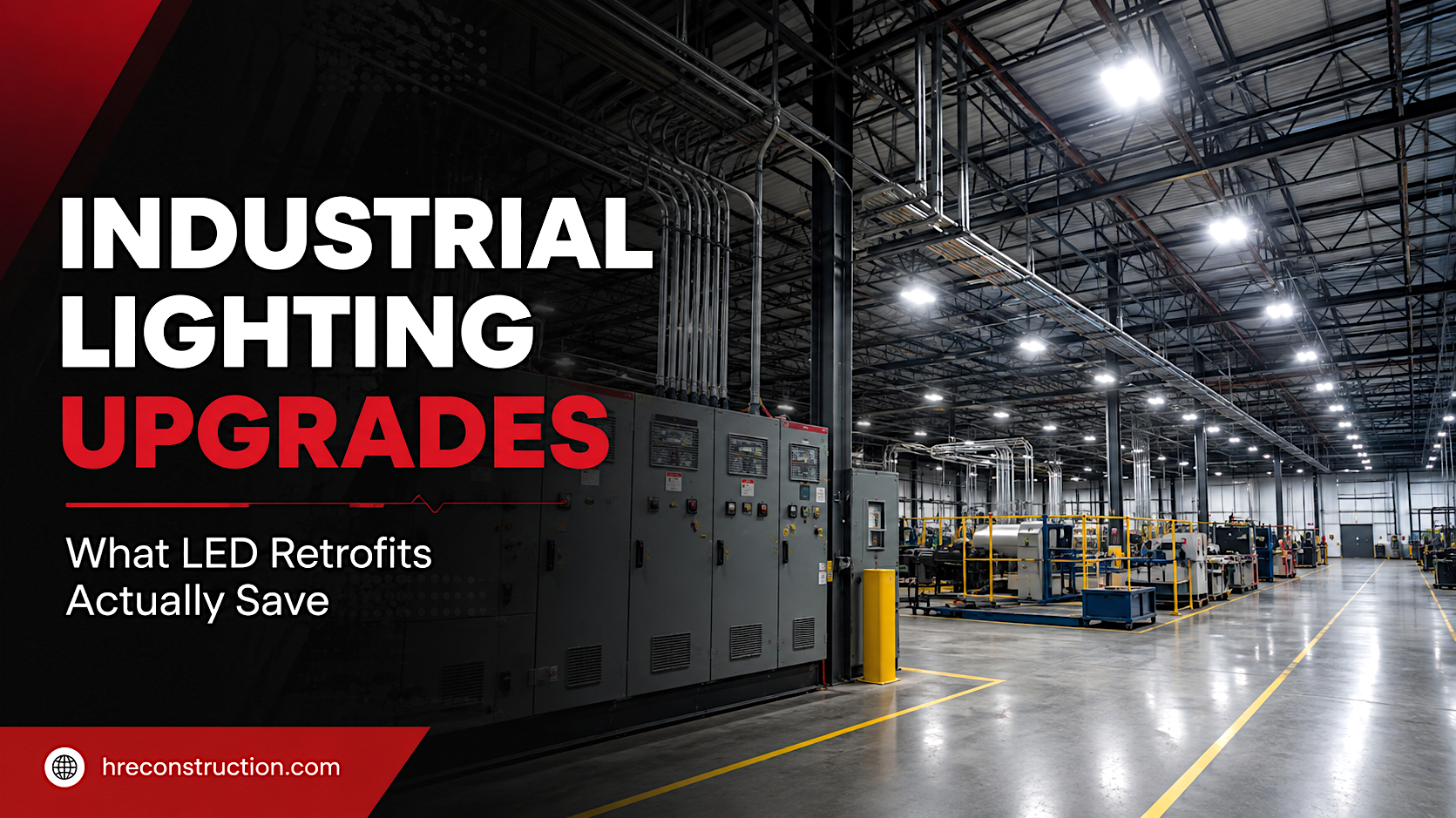
Lighting is one of the more overlooked line items on an industrial facility's power bill, right up until someone actually runs the numbers. For facilities still running metal halide high bays, fluorescent tubes, or older HID fixtures, a lighting upgrade is often one of the more straightforward ways to cut energy costs without touching production equipment. But it is not just a fixture swap. Depending on what is being replaced and where, an industrial lighting upgrade can also touch circuits, controls, and in some cases the facility's emergency and egress lighting system, which brings NEC Article 700 into the picture.
What LED Retrofits Actually Save
The energy savings from LED retrofits in industrial settings are well documented across independent case studies and facility audits, and the numbers are consistent: most industrial facilities see somewhere between 50 and 90 percent energy reduction on their lighting circuits after replacing older metal halide, high-pressure sodium, or fluorescent fixtures with LED equivalents. The exact figure depends heavily on what is being replaced. Older 1,000-watt metal halide high bays tend to show the largest gains, since they are among the least efficient fixture types still in common industrial use.
There are two secondary savings that often get missed in a basic energy calculation. First, LED fixtures produce significantly less waste heat than metal halide or HID lighting, which means less load on the facility's HVAC or cooling systems. This effect is more pronounced in temperature-controlled environments like cold storage or climate-sensitive manufacturing. Second, LED fixtures typically carry a rated life well beyond older lighting technology, which reduces relamping frequency and the associated labor cost, particularly in high-ceiling areas where fixture access itself is expensive.
None of this means every LED retrofit pays for itself instantly. Payback period depends on current energy rates, hours of operation, available utility rebates, and the condition of existing wiring and controls. A facility running fixtures 24/7 will see a faster return than one running a single shift.
Where NEC Article 700 Comes Into Play
Here is where lighting upgrades stop being a simple facilities decision and start requiring an electrical contractor. If any part of the facility's lighting serves egress paths, exit signage, or other life-safety functions, that lighting falls under NEC Article 700, which governs emergency systems required by code for life safety.
Article 700 sets specific requirements for how emergency lighting circuits are wired, not just what fixtures are used. Emergency and egress lighting must transfer to an alternate power source within 10 seconds of a normal power loss, and the wiring for emergency circuits generally has to remain independent of normal lighting and power circuits, with only limited exceptions. Illumination levels along egress paths are governed separately, under NFPA 101 and the applicable building code, which set minimum footcandle levels and require reasonably uniform lighting rather than isolated bright spots and dark gaps.
The practical effect for a facility planning a lighting retrofit: if the project includes any fixtures on the emergency or egress branch, that portion of the work needs to preserve the wiring independence and transfer requirements Article 700 sets out, not just get a brighter or more efficient fixture in the same location. This is also a good opportunity to confirm existing emergency lighting is actually still compliant, since older installations sometimes drift out of code over the years as spaces get reconfigured.
Planning a Lighting Upgrade the Right Way
A lighting retrofit that only looks at fixture cost and wattage tends to miss real considerations that affect both the outcome and the budget. Existing circuits and panel capacity need to be evaluated, since LED fixtures draw less current than what they are replacing, which can actually free up capacity elsewhere. Controls, including occupancy sensors and daylight harvesting where applicable, add to the savings picture but need to be specified and wired correctly. And any fixtures tied to the emergency or egress system need code review before, not after, installation.
How HRE Can Help
HRE Construction handles industrial lighting upgrades as part of our broader electrical energy management work, from fixture and circuit planning through installation, and we make sure any emergency or egress lighting affected by the project stays fully compliant with NEC Article 700 and applicable life safety codes.
Ready to see what a lighting upgrade could save your facility? Contact HRE Construction to get started.
Frequently Asked Questions
How much can an industrial facility actually save by switching to LED lighting?
Most industrial facilities see a 50 to 90 percent reduction in lighting energy use after an LED retrofit, with the exact figure depending on what fixtures are being replaced and how many hours the facility operates. Facilities also typically see secondary savings from reduced HVAC load and lower maintenance costs.
Does an LED retrofit affect emergency or egress lighting requirements?
It can, if the retrofit includes fixtures on the emergency or egress lighting branch. That portion of the work needs to meet NEC Article 700 requirements, including wiring independence from normal circuits and a 10-second transfer to backup power, not just match the wattage of the fixture being replaced.
What NEC article governs emergency lighting in industrial facilities?
NEC Article 700 covers emergency systems that are legally required for life safety, including exit lighting and egress illumination. Illumination levels along egress paths are set separately under NFPA 101 and the applicable building code.
Is an LED retrofit a simple fixture swap, or does it require electrical work?
It depends on the scope. A straightforward fixture-for-fixture swap on existing circuits can be relatively simple, but retrofits involving new controls, circuit changes, or emergency and egress lighting require an electrical contractor to keep the installation both safe and code compliant.