Emergency Lighting Testing: What NFPA 101 Requires
October 23, 2026
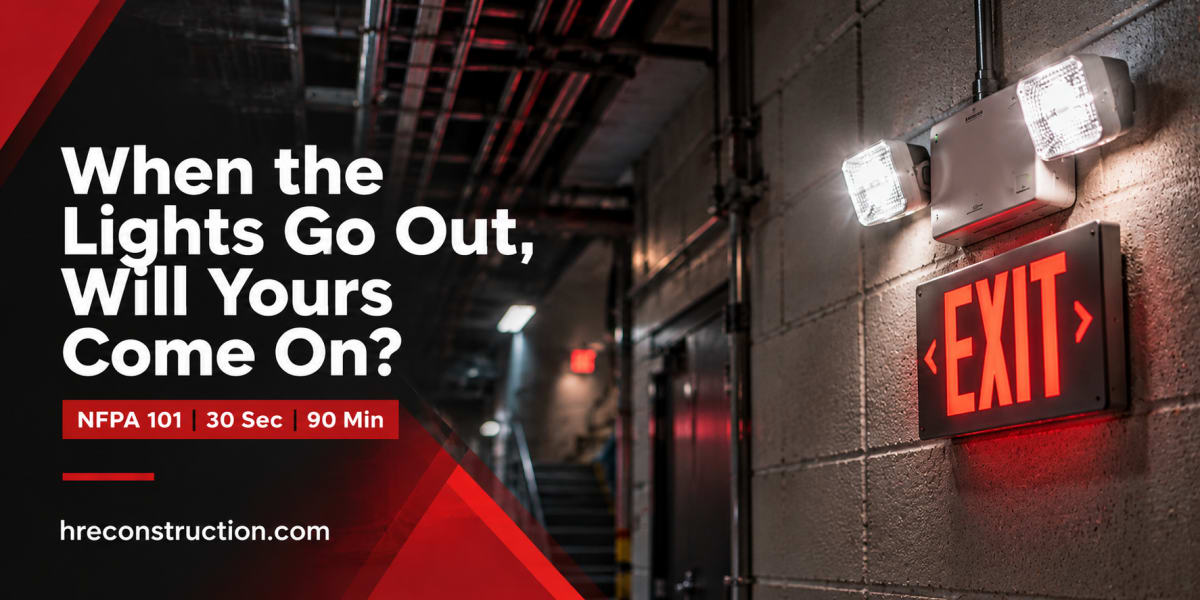
When the power drops in a plant, the first few seconds matter. Machines are winding down, the floor goes dark, and people need to find the nearest exit through aisles, mezzanines, and stairways they normally walk with every light on. Emergency lighting is what gets them there.
It is also one of the easiest systems to let slide. The units sit on the wall for years doing nothing, so nobody notices when a battery dies or a lamp head burns out. The only way to know they will work is to test them, and the Life Safety Code is specific about how and how often.
This guide covers what NFPA 101 requires for emergency lighting testing, what OSHA expects for exit routes, the problems testing turns up most often, and how to keep records that hold up to an inspection.
Who Sets the Rules
Three documents shape emergency lighting in most industrial facilities:
- NFPA 101, the Life Safety Code. Section 7.9 covers emergency lighting, including how long it must run, how bright it must be, and how it must be tested. Section 7.10 covers exit signs. Your local fire marshal or building official (the authority having jurisdiction, or AHJ) enforces the edition your jurisdiction has adopted, so the details can vary slightly by location.
- OSHA 29 CFR 1910.37. OSHA requires every exit route to be adequately lighted so an employee with normal vision can see along it, and it sets minimum requirements for exit signs.
- The National Electrical Code. NEC Article 700 governs how emergency system circuits and equipment are wired and installed. We covered where Article 700 comes into play in our post on industrial lighting upgrades and LED retrofits.
Is Emergency Lighting Required in Industrial Facilities?
In most cases, yes. NFPA 101's chapter on industrial occupancies requires emergency lighting in line with Section 7.9, with limited exceptions. One covers special-purpose industrial occupancies without routine human habitation. Another covers structures occupied only during daylight hours, where skylights or windows light every part of the egress path during those hours. Most working plants, warehouses, and processing facilities don't fit either exception, so assume the requirement applies and confirm the details with your AHJ.
What Emergency Lighting Has to Do
Before getting into testing, it helps to know what the test is proving. Under NFPA 101 Section 7.9, emergency lighting must:
- Come on automatically when normal lighting is interrupted, without anyone flipping a switch.
- Run for at least 1.5 hours (90 minutes).
- Provide enough light along the egress path. The initial level must average at least 1 foot-candle, with no point below 0.1 foot-candle, measured at the floor.
- Hold up to the end. At the end of the 90 minutes, illumination may drop, but not below an average of 0.6 foot-candle and a minimum of 0.06 foot-candle at any point.
- Stay reasonably even. The brightest point can't be more than 40 times the dimmest point, so people aren't walking from glare into darkness.
For exit signs, OSHA requires each sign to be illuminated to at least 5 foot-candles at its surface, with the word "Exit" in letters at least 6 inches high.
The Required Tests
NFPA 101 Section 7.9.3 lays out periodic testing for battery-powered emergency lighting. The same testing applies to exit signs that have battery backup.
| Test | How Often | How Long | What It Proves |
|---|---|---|---|
| Functional test | Monthly (about every 30 days) | At least 30 seconds | The unit switches to battery and the lamps come on |
| Full-duration test | Annually | At least 1.5 hours | The battery can carry the load for the full required time |
| Records | Every test | Kept on file | The testing actually happened, available to the AHJ |
The Monthly 30-Second Test
Each unit is switched to battery power, usually by pressing the test button or cutting power to the circuit, and the lamps must stay lit for at least 30 seconds. This catches dead lamps, failed transfer circuits, and batteries that are completely gone.
The Annual 90-Minute Test
Once a year, the units must run on battery for the full 1.5 hours and stay lit the whole time. This is the test that finds weak batteries. A unit can pass a 30-second test every month and still go dark 20 minutes into a real outage, because a worn battery has enough charge for a short burst but not the full duration.
The annual test also drains the batteries. Plan it for a time when the facility can live with reduced emergency capacity while units recharge, which can take many hours depending on the equipment.
Self-Testing and Computer-Based Units
NFPA 101 recognizes two alternatives to manual monthly testing:
- Self-testing, self-diagnostic units run their own 30-second test and diagnostic routine at least every 30 days and show a status light when something fails. Someone still has to look at those indicators monthly, and the annual 90-minute test is still required.
- Computer-based self-testing systems run the tests automatically and keep a history of tests and failures that can be pulled up at any time. The annual test still applies here too.
These systems can save a lot of labor in large facilities, but they only help if someone acts on the failures they report.
Generator-Backed Emergency Lighting
If your emergency lighting is fed from a generator instead of battery units, the testing shifts to the generator and transfer equipment. NFPA 110 covers that monthly and annual testing. Our posts on NFPA 110 load bank testing and emergency and standby power systems go into more detail.
What Testing Usually Turns Up
Emergency lighting tends to fail in a handful of predictable ways:
- Worn-out batteries. This is the most common failure. Battery life depends on the type and conditions. Sealed lead-acid batteries often last around 3 to 5 years and nickel-cadmium around 5 to 7, but heat, cold, and frequent discharges shorten that.
- Burned-out or damaged lamp heads. Lamp heads get knocked out of alignment by forklifts and stock, or simply fail.
- Units that were never connected right. A unit wired to the wrong circuit, or to a circuit that stays powered when the area lights go out, may never turn on in an actual outage.
- Lights blocked or out of place. Racking changes, new equipment, or relocated walls can leave an egress path in shadow, even when every unit works.
- Missing coverage after a remodel or retrofit. When a lighting upgrade or layout change goes in, emergency coverage needs to be rechecked. Fixtures that carried integral emergency battery packs need an equivalent in the new design.
- No records. The units may be fine, but without written test records there is no way to prove it to an inspector.
Hot, dusty, and wet production areas are hard on battery units. If your plant has those conditions, expect shorter battery life and check those areas closely during the annual test.
Keeping Records That Hold Up
NFPA 101 requires written records of emergency lighting tests, kept by the owner and available to the AHJ. A simple log for each test should include:
- The date of the test
- Which units or areas were tested
- The type of test (monthly 30-second or annual 90-minute)
- Pass or fail for each unit
- What was done about failures and when
Keep the records together and easy to pull up. Inspectors commonly ask to see recent history, and missing paperwork is a frequent finding even at facilities where the lights work fine. For a broader look at getting ready for a visit, see our post on how to prepare your industrial facility for an electrical inspection.
Building Emergency Lighting Into Your Maintenance Program
The simplest way to stay compliant is to stop treating emergency lighting as a separate chore:
- Put the monthly test on the same schedule as other routine walk-throughs, with a checklist that lists every unit by location.
- Schedule the annual 90-minute test during a planned shutdown or low-occupancy period, and line up replacement batteries before you start.
- Track battery ages so you can replace batteries on a plan instead of waiting for them to fail.
- Recheck coverage after any change to layout, racking, or lighting.
- Fold it into your electrical maintenance plan. Our industrial electrical maintenance checklist covers the other routine items worth tracking.
How HRE Can Help
HRE Construction's licensed electricians install, repair, and upgrade industrial lighting systems, including the emergency lighting and exit signs that protect your egress routes. As part of our industrial electrical services, we can help your facility:
- Walk your egress routes and identify units that are missing, blocked, or poorly placed
- Replace failed batteries, lamp heads, and emergency lighting units
- Correct wiring problems that keep units from switching on during an outage
- Add or upgrade emergency lighting as part of an LED retrofit, expansion, or layout change
- Set up a testing schedule and simple records your team can keep up with
We work around production schedules so emergency lighting work doesn't interrupt operations.
Frequently Asked Questions
How often does emergency lighting need to be tested?
Under NFPA 101, battery-powered emergency lighting needs a functional test of at least 30 seconds every month and a full 1.5-hour test once a year. Written records of both are required. Your AHJ enforces the edition adopted in your area, so confirm any local differences with them.
What is the 90-minute emergency light test?
It is the annual full-duration test. Each unit runs on battery for at least 1.5 hours and must stay lit for the whole time. It proves the battery can last as long as the Life Safety Code requires in a real power outage.
Do self-testing emergency lights still need to be checked?
Yes. Self-testing units run their own monthly test, but someone still has to visually check their status indicators every month and act on any failures. The annual 90-minute test is still required.
What does OSHA require for exit signs?
OSHA requires each exit sign to be illuminated to at least 5 foot-candles at its surface and to show the word "Exit" in letters at least 6 inches high. Exit routes must also be adequately lighted and kept free of obstructions.
Don't Wait for an Outage to Find Out
Emergency lighting only gets one chance to work, and it is usually in the middle of a real problem. A simple testing routine and a few replacement batteries are a small price to make sure your people can get out safely.
If your emergency lights haven't been checked in a while, or you're planning a lighting upgrade or layout change, HRE Construction can help. Call us at (803) 262-2615 or request a quote to get started.