Cable Sizing and Wire Management for Industrial Electrical Systems
July 13, 2026 | Samantha Mariano
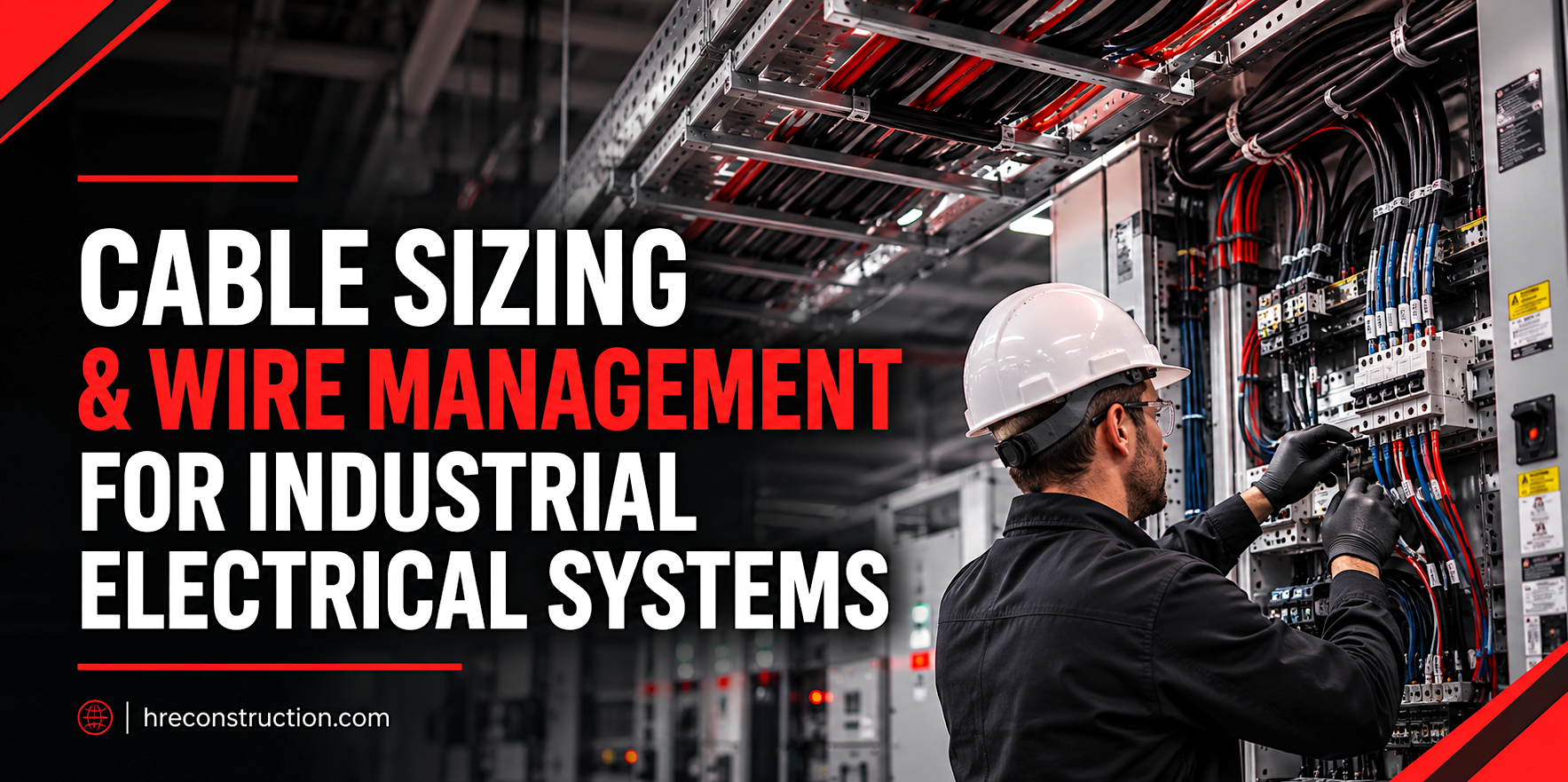
Industrial facilities run on power, and the conductors carrying that power are one of the most overlooked parts of an electrical system until something goes wrong. Undersized cable runs, poor conduit fill, and disorganized wire management don't just create inefficiency. They create heat, voltage loss, and long term reliability problems that are far more expensive to fix after the fact than to plan for up front.
Here's what facility managers and plant engineers should understand about proper cable sizing and wire management, and why it matters more in an industrial setting than almost anywhere else.
Why Cable Sizing Is More Than Picking a Wire Gauge
Every conductor has a maximum current it can safely carry without overheating, known as ampacity. The National Electrical Code lays this out in Table 310.16, which lists allowable ampacities for copper and aluminum conductors across different insulation temperature ratings.
But the table value is only the starting point. A few factors change the real world number:
Terminal temperature ratings. Under NEC 110.14(C), the ampacity you're allowed to use can't exceed the lowest temperature rating of any connected termination, even if the conductor itself is rated higher. A 90°C rated conductor landing on 75°C rated equipment terminals has to be sized using the 75°C column, not the higher one.
Ambient temperature. Table values assume a 30°C ambient. Conductors running through hot mechanical rooms, near furnaces, or in direct sun need a correction factor applied per 310.15(B)(1), which reduces the usable ampacity as temperatures climb.
Conductor bundling. When more than three current carrying conductors share a raceway or cable, heat has a harder time dissipating. NEC 310.15(C)(1) requires an adjustment factor in these cases, and it's one of the most commonly missed steps in industrial installations where multiple circuits are run together for efficiency.
Continuous loads. For loads that run three hours or more, conductors and overcurrent devices generally need to be sized at 125 percent of the continuous load rather than the nameplate value alone.
Skipping any one of these steps can leave a facility with conductors that look adequate on paper but run hot in practice, accelerating insulation breakdown and increasing the risk of nuisance trips or, in worse cases, failure at the termination point.
Voltage Drop: A Performance Issue Worth Planning For
Voltage drop isn't a strict NEC violation in most installations. It's addressed through Informational Notes following sections 210.19 and 215.2, which recommend keeping voltage drop to around 3 percent on branch circuits and feeders individually, with a combined total of about 5 percent from the service point to the farthest piece of equipment.
These are guidelines rather than enforceable code minimums, but ignoring them has real consequences on an industrial floor. Motors are especially sensitive. A voltage drop that seems small on paper can translate into a meaningfully larger drop in starting torque, which shows up as motors struggling to reach full speed or tripping under load. For long conductor runs feeding pumps, compressors, or production line equipment, sizing conductors with voltage drop in mind up front is almost always cheaper than diagnosing underperforming equipment later.
Wire Management: The Part That Gets Skipped
Correct sizing solves half the problem. How those conductors are organized, labeled, and protected solves the other half.
A few practices we consistently recommend for industrial facilities:
- Clear labeling at both ends of every run, tied to a circuit schedule that's kept current as equipment changes. Undocumented circuits slow down every troubleshooting call and every future modification.
- Cable tray and conduit fill limits respected, not just at installation but as circuits get added over time. Overfilled trays compound the heat dissipation problems that bundling already creates.
- Separation of power and control wiring where practical, to reduce interference with sensitive instrumentation and control systems.
- Physical protection for runs in high traffic areas, near moving equipment, or exposed to washdown, chemical exposure, or vibration common in industrial environments.
- Planning spare capacity, since retrofitting additional circuits into an already full tray or conduit run is disruptive and often more expensive than sizing for reasonable future growth from the start.
None of this is complicated in isolation. What makes it difficult is consistency across a facility that's been modified, expanded, or serviced by different contractors over the years. That's usually where problems accumulate.
How HRE Can Help
HRE Construction works exclusively with industrial facilities, and cable sizing and wire management are core to nearly every project we take on, whether it's new construction, an expansion, or troubleshooting an existing system that's outgrown its original design. We size conductors to the actual conditions of your facility, not just the nameplate load, accounting for ambient temperature, bundling, and continuous duty cycles common in industrial operations. We also document circuits clearly so your team isn't left guessing during the next expansion or repair.
If your facility has grown through multiple phases of electrical work, or if you're planning new equipment installations and want the wiring sized correctly the first time, we're glad to take a look.
Contact HRE Construction today at 803-262-2615 to schedule an assessment of your facility's electrical infrastructure.
See our services.