Motor Control Centers in Industrial Facilities: What They Do and When to Upgrade Them
June 24, 2026 | Samantha Mariano
Introduction
If your facility runs heavy machinery, production lines, pumps, compressors, or conveyor systems, your motor control center is doing a lot of work behind the scenes. Most facility managers know it is there. Far fewer know exactly what it does, how to spot problems early, or when an upgrade becomes necessary.
This post breaks it down.
What Is a Motor Control Center?
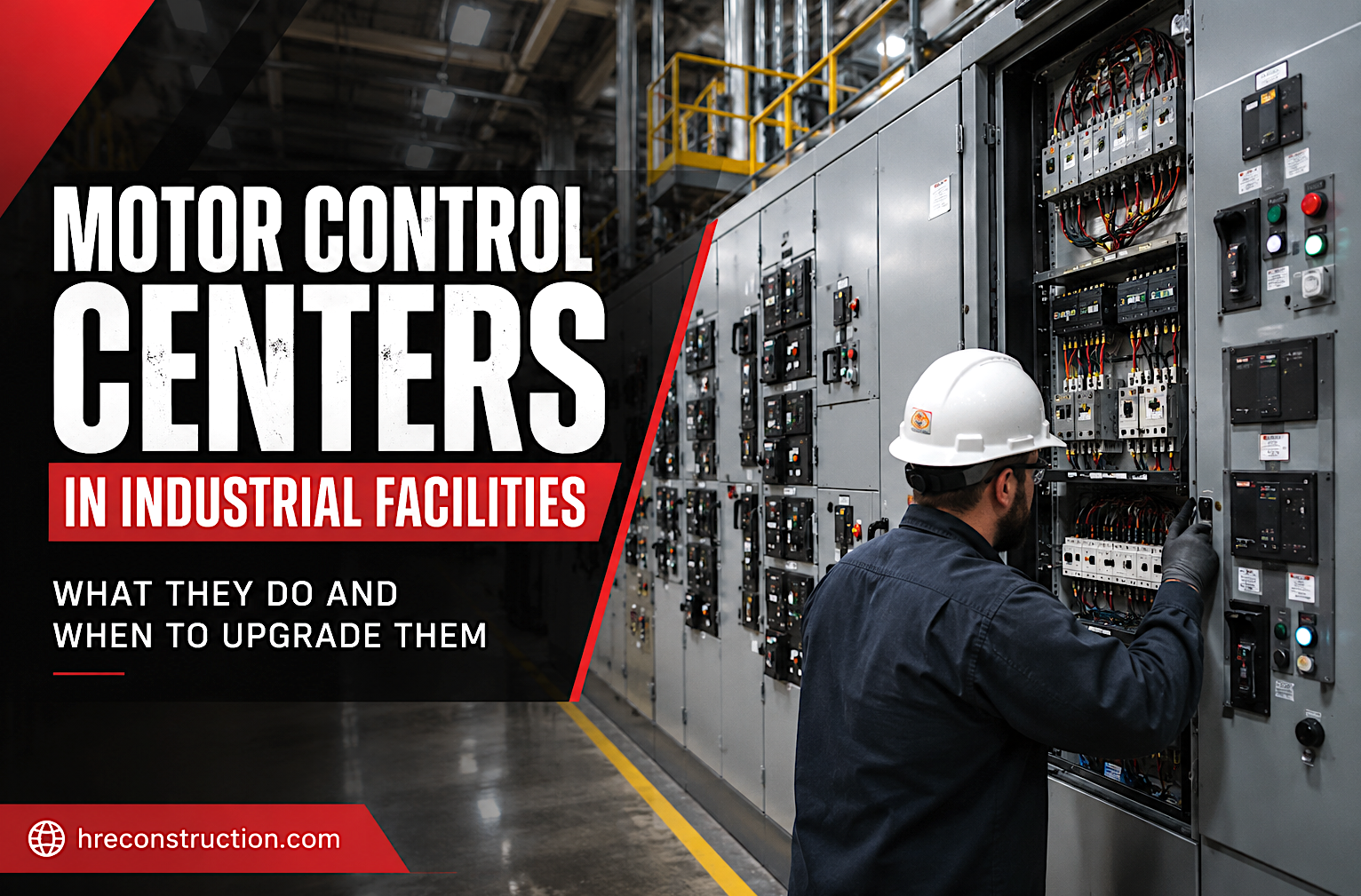
A motor control center, or MCC, is an assembly of one or more enclosed sections housing motor control units. It is essentially the command hub for all the electric motors in your facility. Instead of having individual starters and controls scattered throughout the building, an MCC consolidates everything into a single organized system.
Each bucket or compartment within the MCC typically contains a combination starter, overload relay, disconnect switch, and control wiring for a specific motor or piece of equipment. This makes troubleshooting faster, reduces wiring clutter, and gives maintenance teams a centralized point of control.
MCCs are standard in manufacturing plants, water treatment facilities, chemical processing operations, food and beverage plants, and any facility that depends on multiple motors running simultaneously.
What an MCC Actually Controls
The motors connected to an MCC can include:
- Pump motors for cooling systems, hydraulics, and process fluids
- Conveyor and material handling drives
- Compressor and blower motors
- HVAC and ventilation fans
- Mixers, agitators, and processing equipment
Each motor needs to be started, stopped, protected from overloads, and sometimes speed-controlled. The MCC handles all of that in a coordinated way. On modern systems, variable frequency drives are often integrated directly into MCC compartments to give additional speed control and energy efficiency.
Signs Your MCC Needs Attention
Motor control centers are built to last, but they are not maintenance-free. Here are the warning signs that something needs to be addressed:
Frequent nuisance tripping. If overload relays or breakers are tripping regularly without a clear load reason, it often points to aging components, loose connections, or undersized protection settings that no longer match current equipment demands.
Visible signs of heat damage. Discoloration, burnt insulation, or a persistent burning smell inside the MCC enclosure are serious red flags. Heat damage indicates either a sustained overload condition or a failing connection that is generating resistance.
Corrosion or contamination. Industrial environments are tough on electrical equipment. If moisture, dust, or process chemicals have found their way inside the enclosure, internal components are likely compromised. Corroded bus bars and terminals increase resistance and create failure points.
Outdated components. If your MCC is more than 20 years old, replacement parts may be difficult to source. Running a facility on equipment with no available spares is a risk that compounds over time.
Capacity no longer matches load. If your facility has added equipment, expanded production lines, or brought in larger motors since the MCC was originally sized, the existing system may be running at or beyond its rated capacity.
Lack of documentation. If your team cannot quickly identify which compartment controls which motor, or if as-built drawings are missing, you have an operational and safety problem regardless of the equipment age.
When an Upgrade Makes Sense
Not every MCC issue requires a full replacement. Sometimes a targeted repair or component swap is the right call. But a full upgrade is worth considering when:
- The existing MCC is beyond its service life and parts are unavailable
- Your facility is expanding and the current system cannot support additional loads
- You are integrating VFDs, smart controls, or remote monitoring into your operations
- Safety compliance requirements have changed and the existing equipment no longer meets current NEC or OSHA standards
- Repeated unplanned downtime is being traced back to MCC failures
Upgrading to a modern MCC also opens the door to better operational visibility. Newer systems support remote monitoring, real-time diagnostics, and integration with plant-wide SCADA or control systems, which reduces the time maintenance teams spend chasing problems manually.
How HRE Can Help
HRE Construction specializes in industrial electrical and instrumentation work, including motor control center installation, maintenance, and upgrades. Our team works in manufacturing plants, processing facilities, and heavy industrial operations where MCC reliability is not optional.
We assess your existing system, identify gaps between current equipment and actual load demands, and handle everything from individual compartment repairs to full MCC replacements. We also provide accurate as-built documentation so your team always knows what they are working with.
If your motor control center is showing any of the warning signs above, or if you are planning a facility expansion, contact HRE Construction at (803) 262-2615 or visit hreconstruction.com to discuss your project.