Surge Protective Devices for Industrial Facilities
July 2, 2026 | Samantha Mariano
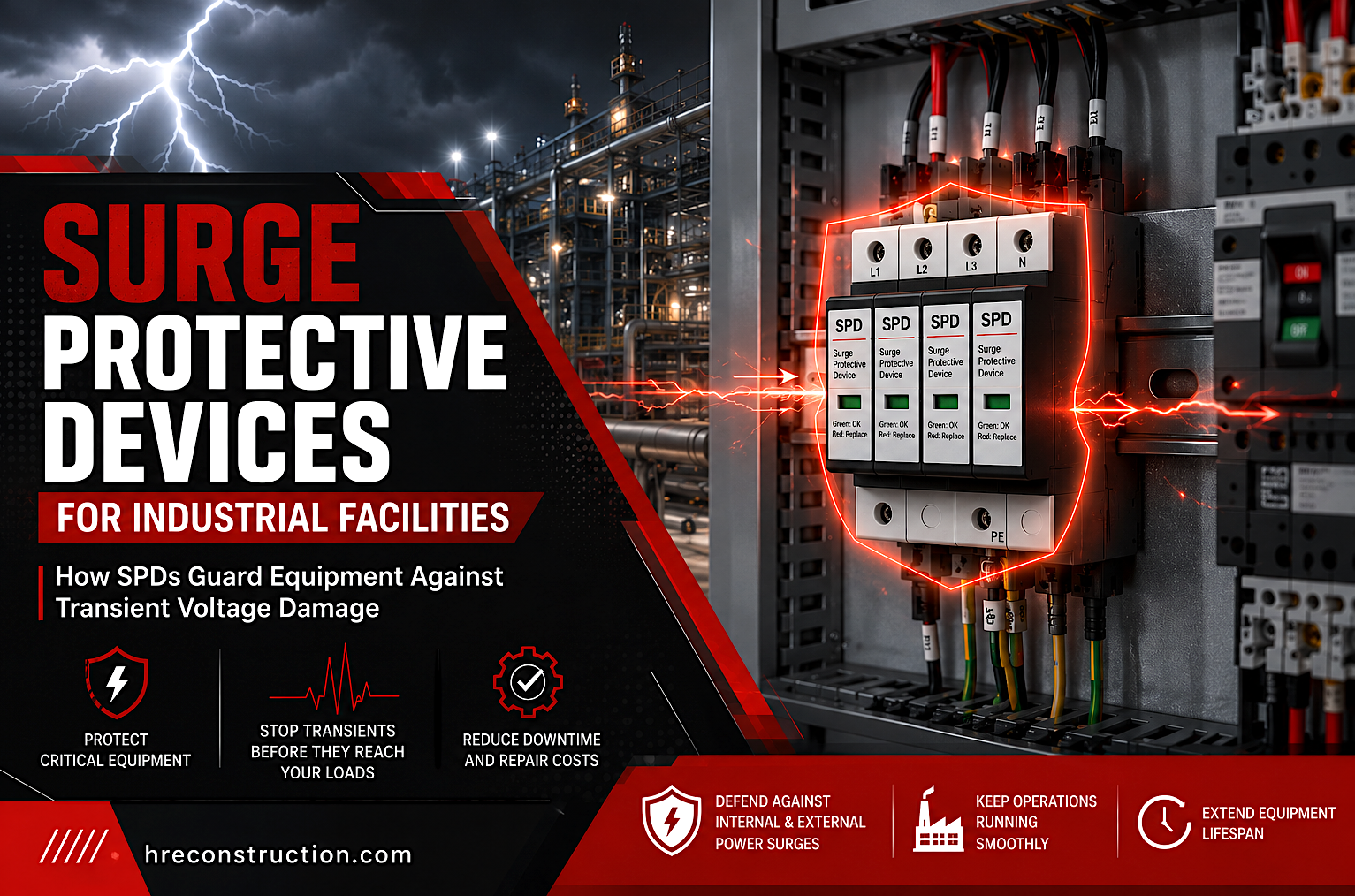
Ask most facility managers what causes a power surge and the first answer is usually lightning. Lightning is real, and it is destructive, but it is not the threat that damages industrial equipment most often. The bigger problem is invisible, it happens dozens of times a day, and it comes from inside your own plant.
These fast voltage spikes are called transients, and over time they degrade the electronic controls, drives, and instrumentation that keep a modern facility running. A surge protective device (SPD) is the piece of equipment built to intercept them. This post explains what SPDs actually do, the different types and where each one belongs, what the codes and standards require, and how a properly designed surge protection strategy protects both your equipment and your uptime.
What a transient actually is
A transient is a very short, very fast spike in voltage, often lasting only millionths of a second, that can reach thousands of volts on a system designed to carry 480 volts or less. That spike drives a corresponding surge of current into whatever equipment is connected downstream.
A single small transient rarely destroys anything outright. The damage is usually cumulative. Each spike chips away at the insulation and semiconductors inside power supplies, variable frequency drives, PLCs, and sensors. Equipment that fails "for no reason" months later has often been quietly worn down by transients the whole time.
Where surges come from in an industrial plant
Here is the part that surprises people. Industry studies consistently find that the majority of transient activity in a facility, commonly estimated between 60 and 80 percent depending on the study, is generated internally rather than by lightning or the utility.
The culprits are the everyday operations of an industrial environment:
- Motors and inductive loads starting and stopping
- Variable frequency drives switching at high frequency
- Capacitor bank switching for power factor correction
- Contactors, relays, and solenoids opening and closing
- Welding equipment and arc-based processes
Every time an inductive load switches, the collapsing magnetic field pushes a voltage impulse back onto the wiring, where it travels to other equipment on the same system. If your facility shares a utility transformer with neighboring businesses, their switching activity can reach your service as well.
External sources still matter. Lightning induced transients are comparatively rare, but they carry far more energy and pose the greatest risk of immediate, catastrophic damage. Utility switching, capacitor bank operations on the grid, and fault clearing also send transients down the line. A complete strategy has to account for both the frequent internal spikes and the rare but severe external ones.
What an SPD does, and what it does not do
A surge protective device limits transient voltage by diverting or shunting the excess surge current away from your equipment, then stopping the flow of current once the transient passes, all while staying ready to do it again on the next event.
Two points are worth being clear about:
An SPD limits transients, it does not eliminate them. It knocks the voltage down to a level your equipment can tolerate. It does not make the spike disappear entirely.
An SPD is not a lightning arrester. The two devices serve different roles at different voltage levels. SPDs handle systems at 1000 volts or less, while surge arresters are used above that threshold. Treating one as a substitute for the other is a design mistake.
The four SPD types and where each belongs
SPDs are classified by type based on where they are installed in the electrical system. Effective surge protection almost always uses more than one type in a layered, or cascaded, arrangement.
Type 1 devices are permanently connected and can be installed on the line side of the main service disconnect, between the utility transformer and the service equipment. They are built to take the largest hits, including energy from nearby lightning, and they do not require a separate overcurrent device. Type 1 units carry a nominal discharge current rating of 10 kA or 20 kA.
Type 2 devices are permanently connected on the load side of the service disconnect, including at branch and distribution panels. This is the workhorse of most facility protection schemes, catching what gets past the service entrance and absorbing the bulk of internally generated transients. Type 2 units are rated at 3, 5, 10, or 20 kA.
Type 3 devices are point of utilization protectors installed close to sensitive equipment, and they must sit at least 30 feet of conductor length away from the service. Think of these as the final layer, protecting individual critical loads. They only work properly as a supplement to a Type 2 device upstream, never on their own.
Type 4 devices are component assemblies designed into equipment by the manufacturer, often built around metal oxide varistors (MOVs). You will find these inside the power supplies of the very equipment you are trying to protect, which is exactly why upstream Type 1 and Type 2 protection matters so much. Those internal components are easily destroyed if a large transient reaches them unchecked.
The logic behind layering is straightforward. Each stage knocks the voltage down another step, so the branch circuit device never has to face the full force of the original transient. It only has to handle what the upstream devices passed along.
The standards and code you should know
Two documents govern surge protection in North America.
UL 1449 is the safety and performance standard for surge protective devices, now in its 5th edition. It defines the type classifications, the testing requirements, and the markings you see on a listed device. A device that meets the full standard is "listed," while a "component recognized" device has only met part of it and comes with conditions of acceptability. For a permanent facility installation, you want listed devices.
NEC Article 242, Overvoltage Protection, is where the installation rules live. This article was introduced in the 2020 National Electrical Code, combining and replacing the older Article 280 (surge arresters) and Article 285 (SPDs, formerly called TVSS). Part II covers SPDs rated 1000 volts or less, and Part III covers surge arresters above 1000 volts.
A few practical requirements from Article 242 are worth flagging:
- SPDs must be listed.
- Every SPD is marked with a short circuit current rating, and it cannot be installed where the available fault current exceeds that rating. Matching the SPD's rating to the fault current at its point of installation is not optional.
- The SPD's voltage rating must not be less than the maximum continuous operating voltage at that point in the system.
- Conductor routing affects performance. Keeping the leads short and avoiding sharp bends reduces impedance and lets the device do its job during a fast transient.
One important clarification for industrial facilities: the code's mandatory SPD requirements are targeted, not universal. The 2020 and 2023 NEC require SPDs on services supplying dwelling units and certain residential style occupancies, and SPDs are specifically required for fire pump controllers, emergency system switchgear, and fire alarm control panels. A general industrial plant is not blanket-mandated to install service entrance surge protection the way a new home is. For most industrial facilities, comprehensive surge protection is a best practice and an equipment protection investment rather than a code checkbox, though it becomes mandatory wherever those specific critical systems are present. Adoption of NEC editions also varies by state, so the exact rules that apply depend on your jurisdiction.
Why this matters for your bottom line
Surge protection is easy to overlook because a well protected system simply keeps running. The value shows up as an absence of problems: fewer unexplained drive failures, fewer control board replacements, less nuisance downtime, and longer equipment life. For a facility where an hour of downtime carries real cost, a comprehensive SPD strategy is one of the lower cost, higher return reliability investments available.
It also fits alongside the rest of a sound power quality program. Transients rarely travel alone. Facilities dealing with harmonic distortion, power factor problems, or frequent load switching are usually generating transients too, and addressing them together produces a cleaner, more stable electrical system overall.
Frequently Asked Questions
What is a power surge or transient?
A transient is a very short, very fast spike in voltage, often lasting only millionths of a second, that can reach thousands of volts on a system built to carry 480 volts or less. A single spike rarely destroys equipment outright, but repeated transients degrade the electronics inside drives, controls, and power supplies over time.
Where do most power surges in an industrial facility come from?
Not lightning. Industry studies estimate that somewhere between 60 and 80 percent of transient activity is generated inside the facility itself, mainly from switching inductive loads such as motors, variable frequency drives, capacitor banks, and contactors. Lightning and utility events are external and far rarer, but they carry much more energy and pose the greatest risk of immediate damage.
Does the electrical code require surge protection for industrial facilities?
Not as a blanket rule. The NEC mandates SPDs on services supplying dwellings and certain residential style occupancies, and specifically for systems like fire pump controllers, emergency system switchgear, and fire alarm control panels. For a general industrial plant, comprehensive surge protection is a best practice and an equipment protection investment rather than a code requirement, unless one of those specific systems is present. NEC adoption also varies by state.
My equipment already has built-in surge protection. Do I still need SPDs?
Yes. The built-in protection inside equipment, often metal oxide varistors, is a last line of defense and is easily destroyed if a large transient reaches it unchecked. Upstream Type 1 and Type 2 devices knock the voltage down first so those internal components only have to handle a small residual spike.
What is the difference between an SPD and a lightning arrester?
They protect at different voltage levels. Surge protective devices handle systems at 1000 volts or less, while surge arresters are used above that threshold. An SPD is not a substitute for a lightning arrester, and treating one as the other is a design mistake.
How many surge protective devices does a facility need?
Effective protection is layered rather than a single device. A common approach places a Type 1 or Type 2 device at the service entrance, Type 2 devices at distribution and branch panels, and Type 3 devices close to the most sensitive equipment. Each stage reduces the voltage further, so no single device has to absorb the full transient.
How HRE Construction Can Help
At HRE Construction, we design and install surge protection as part of a complete look at your facility's electrical system, not as a single device bolted onto a panel. Our team evaluates where transients are being generated in your plant, confirms the available fault current at each installation point so the SPD rating is correct, and builds a layered protection scheme that puts the right type of device in the right location, from the service entrance down to your most sensitive equipment.
Because we work with industrial facilities specifically, we understand the loads that make your environment tough on electronics, the drives, motors, and switching operations that quietly wear equipment down. We install listed devices to current UL 1449 and NEC Article 242 requirements, and we make sure the installation details that people often get wrong, conductor length, routing, and fault current coordination, are handled correctly.
If you have been chasing intermittent equipment failures, or you simply want to protect a facility full of expensive electronics before the next problem hits, we can help you put a real surge protection strategy in place.
Contact HRE Construction today to schedule an assessment of your facility's electrical protection.