Power Monitoring and Energy Management Systems for Industrial Facilities
August 5, 2026 | Samantha Mariano
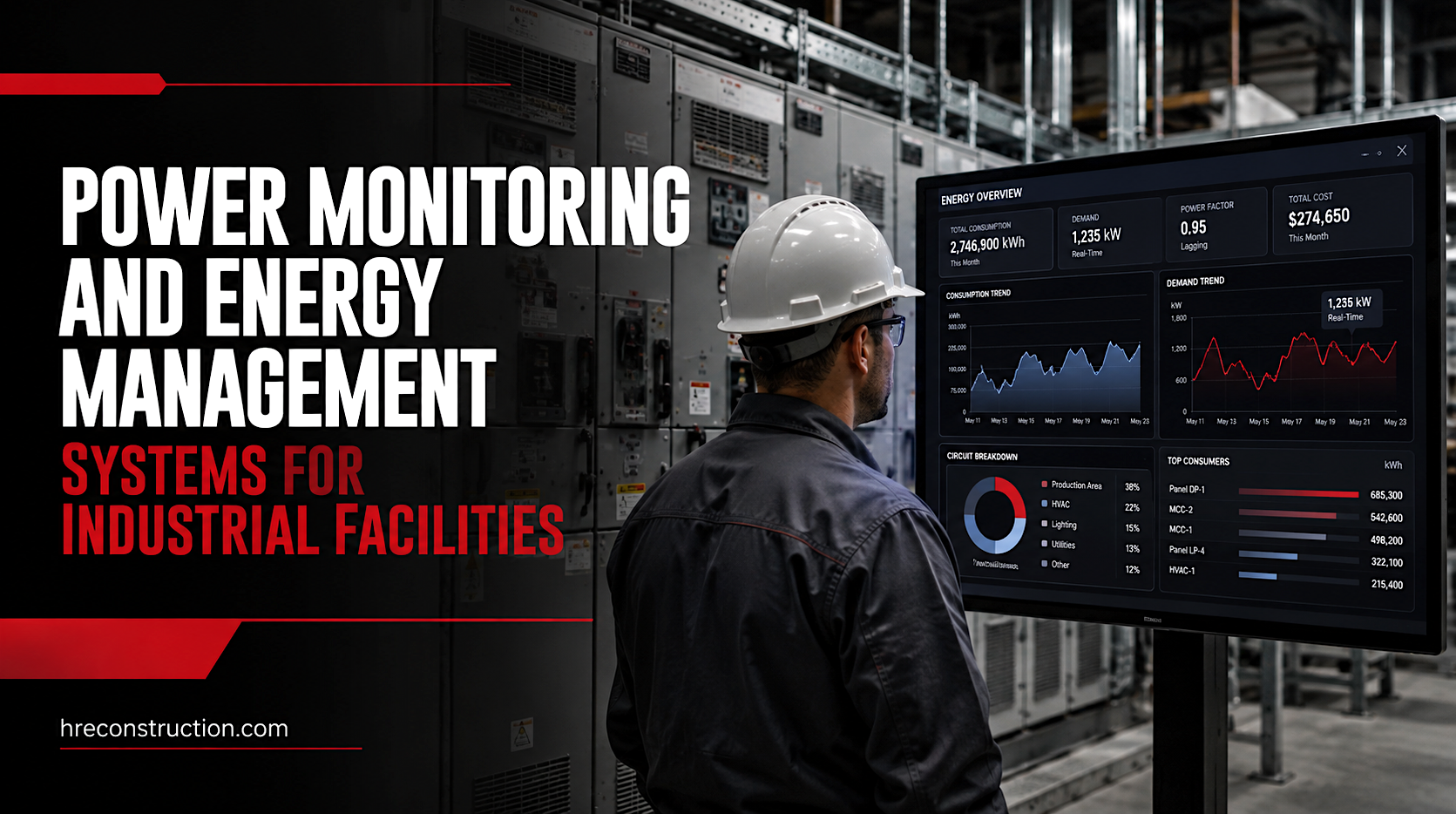
Most industrial facilities know their total electric bill down to the dollar. Far fewer know where that energy actually goes once it crosses the utility meter. Without visibility into how individual equipment, production lines, or shifts consume power, facility managers are left guessing at where waste is happening and reacting to demand charges after they have already hit the bill.
Power monitoring and energy management systems close that gap. They give facilities real-time data on voltage, current, power factor, and demand at every level of the distribution system, from the main service entrance down to individual branch circuits or machines. That data turns energy use from a fixed cost into something a facility can actually manage.
What a Power Monitoring System Actually Does
A power monitoring system uses metering devices installed at key points in the electrical distribution system to continuously measure electrical parameters like kW, kWh, power factor, and harmonic distortion. Depending on how the system is scoped, meters can sit at the main service, on individual panels, or on specific high-draw equipment like compressors, chillers, ovens, or large motors.
That data is collected over a communication network, typically Modbus RTU or Modbus TCP, and routed to a central platform where it can be viewed on dashboards, logged for trending, or set up to trigger alerts when readings move outside expected ranges. This is closely related to the kind of power quality monitoring facilities already use to catch voltage sags, harmonics, and other issues before they damage sensitive equipment, but energy management systems extend that visibility to cost and consumption, not just power quality events.
Submetering: Where the Real Value Shows Up
Submetering is the practice of installing additional meters beyond the main utility meter so consumption can be tracked by department, production line, or individual piece of equipment. For facilities running compressors, large motors, or continuous process equipment, this is usually where energy management systems pay for themselves fastest.
Once a facility can see that a specific compressor or line is drawing far more than its baseline, that information turns into a concrete maintenance or scheduling decision instead of a vague sense that "the bill went up." Submetering also generates the documentation many facilities need to justify capital upgrades, since it is much easier to make the case for replacing an inefficient piece of equipment when there is real consumption data behind the request.
Demand Charges and Peak Load Management
For many industrial facilities, demand charges, the portion of the utility bill based on the highest sustained load pulled during a billing period rather than total energy used, make up a significant share of the monthly bill. A single short-lived spike in demand, even if it only lasts a few minutes, can set the rate for the entire billing cycle.
Energy management systems help facilities see demand trends before they turn into a spike, and in some cases support automated load curtailment or scheduling that staggers equipment startup to avoid stacking multiple high-draw loads onto the grid at the same time. This kind of demand awareness pairs naturally with equipment already in use to manage load more efficiently, including variable frequency drives, which reduce the inrush current and demand spikes associated with motor starts.
Power Factor and Harmonics Visibility
Power monitoring systems also give facilities ongoing visibility into power factor and harmonic distortion, both of which affect efficiency and equipment life even when they are not obvious from the utility bill alone. A facility running power factor correction equipment benefits from being able to confirm that correction is actually holding steady over time rather than assuming it is working after the initial installation.
How HRE Can Help
HRE Construction works with industrial facilities to design and install power monitoring and energy management systems that fit the scale of the operation, whether that means metering at the main service entrance or a full submetering rollout across individual equipment and production lines. We coordinate the metering hardware, wiring, and integration with your facility's electrical infrastructure so the data you get back is accurate and actionable, not just another dashboard nobody looks at.
Ready to get real visibility into your facility's energy use? Contact HRE Construction to talk through a power monitoring setup that fits your operation.
Frequently Asked Questions
Do we need submetering on every piece of equipment, or just the big ones?
Most facilities see the strongest return by starting with high-draw equipment, compressors, large motors, HVAC systems, and continuous process equipment, rather than metering every circuit. A facility assessment can help identify which loads are worth submetering first.
Will a power monitoring system actually lower our utility bill?
The system itself does not reduce consumption, but the visibility it provides is what allows facility managers to identify waste, adjust scheduling around demand charges, and justify targeted equipment upgrades. The savings come from the decisions the data makes possible.
Can power monitoring data integrate with equipment we already have, like VFDs or power factor correction systems?
Yes. Power monitoring systems are typically installed alongside existing electrical infrastructure and can provide ongoing visibility into how that equipment is performing over time, rather than replacing it.
How disruptive is installation for an operating facility?
Installation scope depends on how many metering points are involved, but work is planned around your production schedule to minimize disruption, similar to other electrical upgrades.