Motor Control Centers in Industrial Facilities: What Facility Managers Need to Know
July 29, 2026 | Samantha Mariano
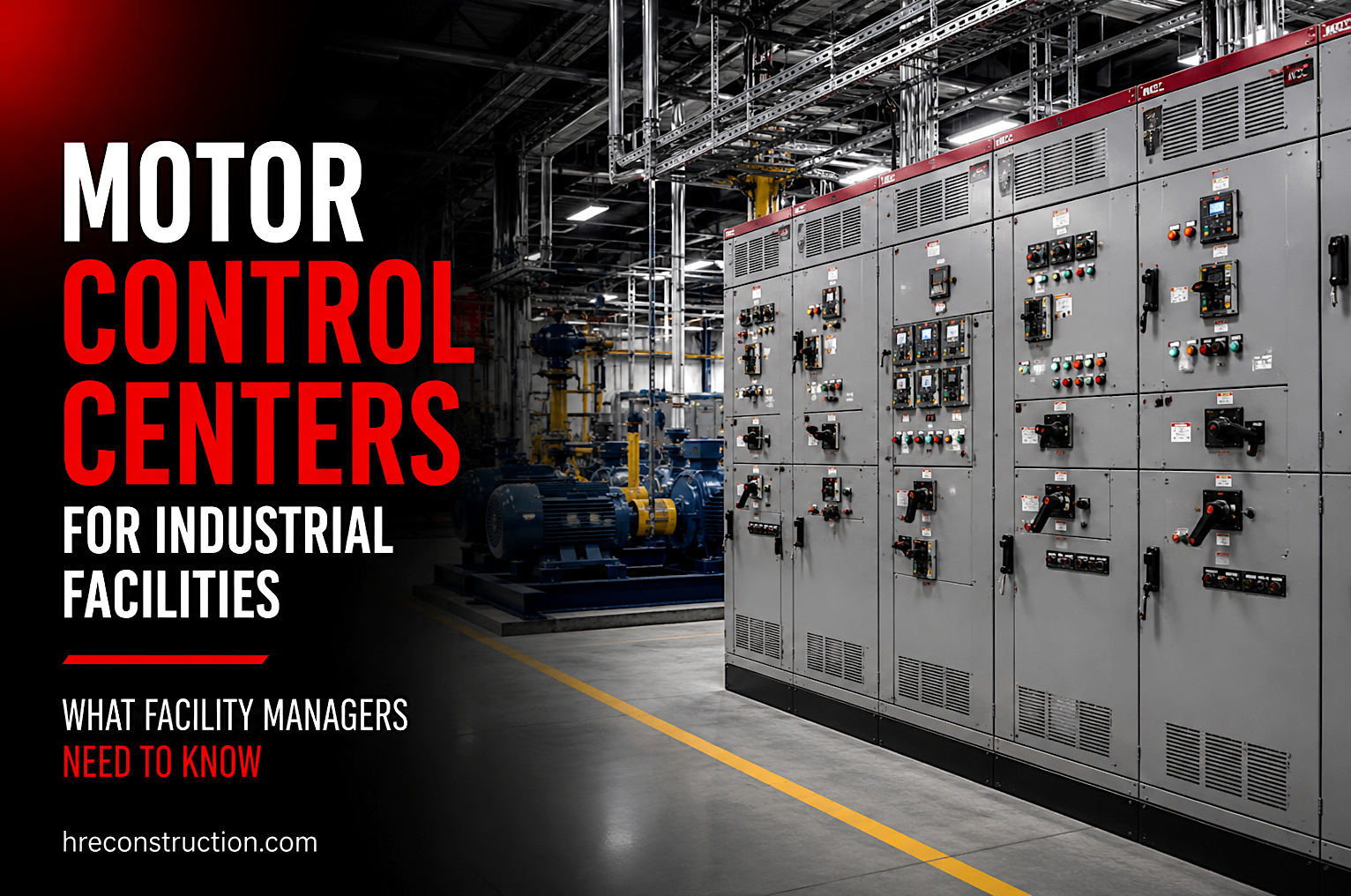
If your facility runs more than a handful of motors, chances are those motors don't each have their own standalone starter tucked away in a random electrical closet. Instead, they're likely organized into a motor control center, or MCC, a single enclosure that groups the starters, disconnects, and protective devices for multiple motors into one coordinated system. For plant managers and maintenance teams, understanding how an MCC works, what standards govern it, and how to keep it maintained can mean the difference between smooth operations and an unplanned shutdown.
What Is a Motor Control Center?
A motor control center is a factory-assembled enclosure made up of one or more vertical sections, each containing individual motor control units. These units can include full-voltage or reduced-voltage starters, variable frequency drives, and other solid-state industrial controllers, along with the incoming-line equipment such as main lugs, fusible switches, or circuit breakers that feed power into the assembly. Rather than wiring each motor's controls separately across a facility, an MCC centralizes the distribution, protection, starting, and monitoring for many motors in one location.
This distinction matters. A switchboard is primarily built to distribute power to a wide range of downstream equipment, while an MCC is purpose-built to manage motor loads specifically. In a typical industrial layout, a switchboard feeds power into an MCC, and the MCC then divides that feed among individual motor circuits and manages how each motor operates.
The Standards Behind Every MCC
Motor control centers aren't built to a single company's preference. They're manufactured and installed according to two main references that work together.
UL 845 is the primary product standard for motor control centers in North America. It governs the construction, testing, and labeling of MCCs, covering single- and three-phase AC and DC units rated up to 1,000 volts. UL 845 requires extensive short-circuit and temperature-rise testing before a unit can carry the UL label, and it also requires that every MCC be marked with its short-circuit current rating, listed as amps, RMS symmetrical, and maximum voltage.
NEC Article 430 governs how motors, motor circuits, and controllers are installed once that MCC reaches the field. This includes requirements for motor branch-circuit conductors, short-circuit and ground-fault protection, motor controllers, and disconnecting means. Part IX of Article 430 specifically requires a disconnecting means capable of isolating each motor and its controller from the circuit, and in most cases that disconnect must be located within sight of the controller.
Together, these standards exist for a practical reason. An MCC concentrates a lot of electrical energy in one place, and if it isn't rated, installed, and marked correctly, a fault in one section can escalate into a much larger safety event. Every MCC HRE Construction installs is built and labeled to meet these requirements, with SCCR markings that match the actual available fault current at that location, not a generic default. Getting these ratings right also ties directly into how the protective devices feeding an MCC are coordinated with the rest of the facility's electrical system, which we cover in more depth in our post on selective coordination in industrial electrical systems.
Common Applications in Industrial Facilities
MCCs show up anywhere a facility runs multiple motor-driven processes from a central point. That includes:
- Conveyor and material handling systems
- Pumping and process fluid systems
- HVAC and industrial ventilation equipment
- Compressors and process air systems
- Mixing, blending, and agitation equipment
In manufacturing plants, processing facilities, and distribution centers across our service territory, MCCs are often the backbone that ties automation and process control together, working alongside PLCs and process instrumentation to keep production lines running.
Why MCC Maintenance Can't Be an Afterthought
An MCC that was installed correctly five years ago isn't guaranteed to still be safe and reliable today. Connections loosen from thermal cycling, contactors wear from repeated switching, and dust or moisture intrusion can degrade insulation over time. NFPA 70B, the standard for electrical equipment maintenance, lays out the preventive maintenance framework that applies to equipment like MCCs in industrial and institutional facilities, and it exists precisely because reactive maintenance, waiting until something fails, is the most expensive and disruptive way to manage electrical equipment.
A sound MCC maintenance program typically includes periodic infrared thermal scanning to catch loose or overheating connections before they fail, torque checks on lug and bus connections, visual inspection for signs of arcing or discoloration, and functional testing of protective devices. For facilities running critical processes, these checks are usually scheduled around planned downtime windows rather than left until a motor trips unexpectedly.
Signs Your MCC May Need Attention
- Breakers or starters that trip intermittently without a clear cause
- Visible discoloration, pitting, or heat damage on bus bars or connections
- Unusual humming, buzzing, or odor from the enclosure
- Nameplate or SCCR markings that are missing, damaged, or don't match current equipment
- An MCC that predates recent facility expansions and may no longer match actual available fault current
If any of these sound familiar, it's worth having a qualified electrical contractor evaluate the MCC before it becomes an unplanned outage.
How HRE Can Help
HRE Construction designs, installs, and services motor control centers for manufacturing plants, processing facilities, and large-scale industrial operations across our eleven licensed states, including South Carolina, North Carolina, Georgia, Ohio, West Virginia, Texas, Kentucky, Arkansas, Arizona, Louisiana, and Mississippi. Our teams work with all major MCC and PLC platforms, and we handle everything from new MCC installation and integration with existing power distribution systems to preventive maintenance programs and troubleshooting for equipment that's already in the field. Whether you're planning a new production line or need to get more life out of equipment that's been running for years, our crews bring the same documentation and testing rigor to every project.
Ready to talk through your motor control center project? Request a quote from HRE Construction today.
Frequently Asked Questions
How is a motor control center different from a switchboard?
A switchboard distributes power broadly to many types of downstream equipment. An MCC is purpose-built to distribute, protect, and control power specifically for multiple motors, combining starters, disconnects, and protective devices for each motor into a single coordinated assembly.
What does SCCR mean, and why does it matter?
Short-circuit current rating, or SCCR, is the maximum fault current an MCC and its components are rated to withstand. NEC 430.98 requires MCCs to be marked with this rating so electricians and inspectors can confirm the equipment is safe for the actual fault current available at that location.
How often should an MCC be inspected?
Inspection frequency depends on the facility's operating environment, duty cycle, and criticality of the equipment served, but most industrial facilities benefit from at least an annual infrared scan and visual inspection, with more frequent checks for high-duty or environmentally harsh applications.
Can an existing MCC be expanded as a facility grows? In many cases, yes. Additional vertical sections can sometimes be added to an existing MCC lineup, though this requires verifying that the existing bus, incoming service, and SCCR ratings can support the added load safely.