SCCR on Industrial Control Panels: What NEC 409 Requires
October 8, 2026 | Samantha Mariano
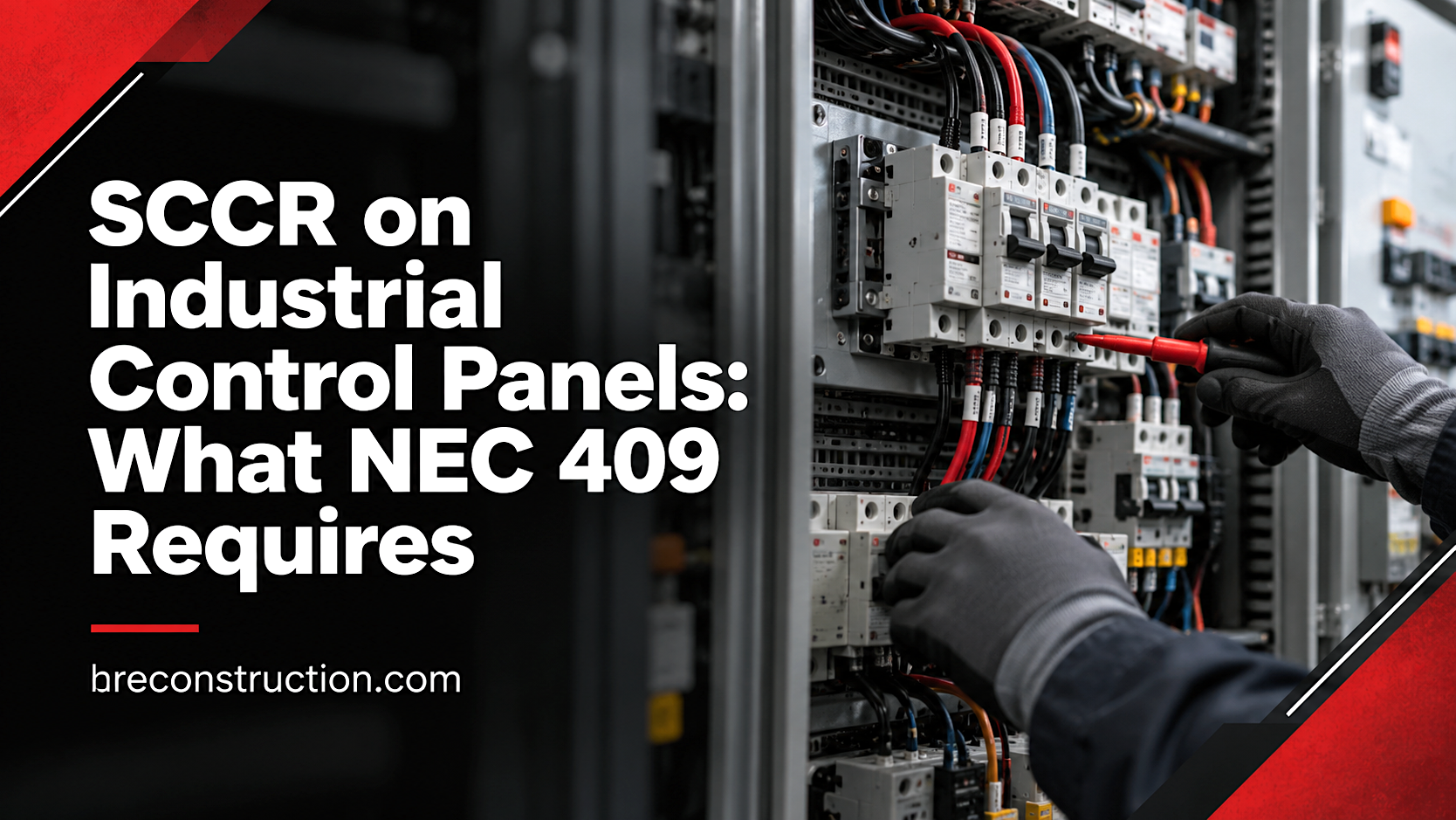
Every industrial control panel has a number on its nameplate that most people never look at: the short-circuit current rating, or SCCR. It tells you how much fault current the panel can safely handle if something goes wrong. The number on the nameplate matters less than how it compares to the fault current actually available at the spot where the panel is installed.
If the available fault current is higher than the panel's SCCR, the panel isn't protected the way its listing assumes. That's a code problem, and it's also a safety problem, because a panel that can't withstand a fault can fail violently.
It's also one of the easier issues to miss. The panel worked fine for years. Then the utility upgraded a transformer, or the plant added a new service, and nobody went back to check the panels.
What SCCR Actually Means
SCCR is the maximum fault current a component or an assembly can safely withstand at a given voltage, when it's protected by a specified overcurrent device. It's usually expressed in kA (thousands of amps).
It's easy to confuse with interrupting rating, but they're different:
- Interrupting rating applies to an overcurrent device like a breaker or fuse. It's how much fault current that one device can safely clear (NEC 110.9).
- SCCR applies to a component or a whole assembly, like a control panel, and covers everything inside it that the fault current flows through (NEC 110.10).
A panel can contain a breaker with a high interrupting rating and still have a low SCCR, because one other part in the power circuit is the weak link.
What the NEC Requires for Industrial Control Panels
NEC Article 409 covers industrial control panels. A few requirements matter most:
- Marking (409.110). Industrial control panels have to be marked with their SCCR. The main exception is a panel that contains only control circuit components, meaning nothing that feeds motors, lighting, heating, or other loads.
- Installation (409.22). A panel can't be installed where the available fault current is higher than its marked SCCR.
- Documentation (409.22). Since the 2017 NEC, the available fault current at the panel, and the date it was calculated, have to be documented and available to the inspector.
The same idea shows up elsewhere in the code. Industrial machinery under Article 670, HVAC equipment under Article 440, and motor controllers under Article 430 all have SCCR marking or installation requirements. Robotics and automated machinery fall under NFPA 79 as well, which we covered in our post on NFPA 79 and robotics cells.
Section numbers can shift between NEC editions, so check the edition your state or local jurisdiction enforces.
How a Panel's SCCR Gets Set
Most industrial control panels are built and labeled using UL 508A, Supplement SB, which the NEC recognizes as an approved method for determining SCCR. In plain terms, it works like a chain:
- Every component in the power circuit has a rating, either from the manufacturer's testing or from a conservative default table in the standard.
- The panel's SCCR is generally limited by the lowest-rated component in the power circuit.
- Certain current-limiting devices, like specific fuse classes or listed current-limiting breakers, can raise the rating of the components downstream of them when the conditions in the standard are met.
That's why a panel full of good equipment can still carry a low rating. One terminal block, power distribution block, or contactor without a tested high rating can pull the whole panel down to a low number. Default ratings for unmarked components are conservative by design, and many older panels carry ratings of only a few kA as a result.
Where This Goes Wrong in Real Plants
In our experience, SCCR problems usually come from something changing around the panel, not from the panel itself.
The available fault current went up. A new or larger utility transformer, a service upgrade, or added generation can all raise the fault current available at your panels. Panels that were fine before may not be anymore. If you're planning an expansion, our guide to electrical capacity planning covers why this should be checked early.
The panel moved. Equipment relocated from another plant, or bought used, gets installed without anyone comparing its SCCR to the new location.
The panel was modified. Swapping a component for one that's "close enough," adding a circuit, or replacing a breaker with a different model can lower the SCCR or affect the panel's listing. This comes up a lot during PLC and controls upgrades.
Nobody knows the available fault current. If there's no current short-circuit study, there's nothing to compare the nameplate against.
How to Check Your Panels
- Get the available fault current. This comes from a short-circuit and coordination study. If yours is more than a few years old, or your system has changed since, it may need updating.
- Walk the panels and record each nameplate SCCR. Include control panels, machinery with built-in panels, and packaged equipment.
- Compare the two. Any panel where the available fault current is higher than its SCCR needs attention.
- Document it. Record the available fault current and the date it was calculated. Inspectors can ask for it, and it's useful the next time something changes. Our post on preparing for an electrical inspection covers what else inspectors look for.
What to Do If a Panel Comes Up Short
There's no single fix. The right one depends on the panel and how far apart the numbers are. Common options include:
- Upgrading the weak-link components to parts with higher tested ratings
- Adding current-limiting protection ahead of the panel, such as specific fuse classes, where the standard allows it to raise the rating
- Working with the panel manufacturer to re-evaluate or re-label the panel, since field changes can affect a UL 508A listing
- Replacing the panel when it's old, heavily modified, or already due for a controls upgrade
Don't just relabel a panel with a higher number. The rating has to be backed by the components inside and the method used to determine it.
How HRE Can Help
HRE Construction works on industrial electrical, instrumentation, and controls systems for manufacturing and processing facilities across South Carolina and the 10 other states where we're licensed. For SCCR concerns, that includes:
- Walking your facility to record control panel and equipment nameplate ratings
- Coordinating with your engineer or study provider on available fault current
- Identifying panels where the available fault current exceeds the marked SCCR
- Installing current-limiting protection, component upgrades, and replacement panels, coordinated with the panel builder where the listing is involved
- Controls and panel work through our instrumentation services, plus testing and startup when the work is done
We'll show you which panels are fine, which ones need work, and what the options are.
Know Your Numbers Before Something Changes
If you're planning a service upgrade, adding equipment, or haven't compared your panels against your available fault current recently, now is a good time. It's a lot easier to fix on paper than after a fault.
Contact HRE Construction to schedule a panel review or request a quote.
Frequently Asked Questions
What does SCCR mean on a control panel?
SCCR stands for short-circuit current rating. It's the maximum fault current the panel can safely withstand at its rated voltage when protected by the specified overcurrent device. You'll find it on the panel's nameplate, usually in kA.
Is SCCR the same as interrupting rating?
No. Interrupting rating applies to a single overcurrent device and describes how much fault current it can clear. SCCR applies to a component or a whole assembly, like a control panel, and covers everything the fault current passes through.
What happens if available fault current is higher than the panel's SCCR?
The installation doesn't meet NEC 409.22, and the panel isn't protected the way its rating assumes. During a fault, components can be damaged or fail violently. The fix is to raise the panel's rating, add current-limiting protection where allowed, or replace the panel.
Do control panels without motors or other loads need an SCCR?
Panels that contain only control circuit components are generally exempt from the SCCR marking requirement in NEC 409.110. Any panel that feeds power to motors, lighting, heating, or other loads needs to be marked.