Obsolete PLCs: Plan Your Upgrade Before They Fail
September 30, 2026 | Samantha Mariano
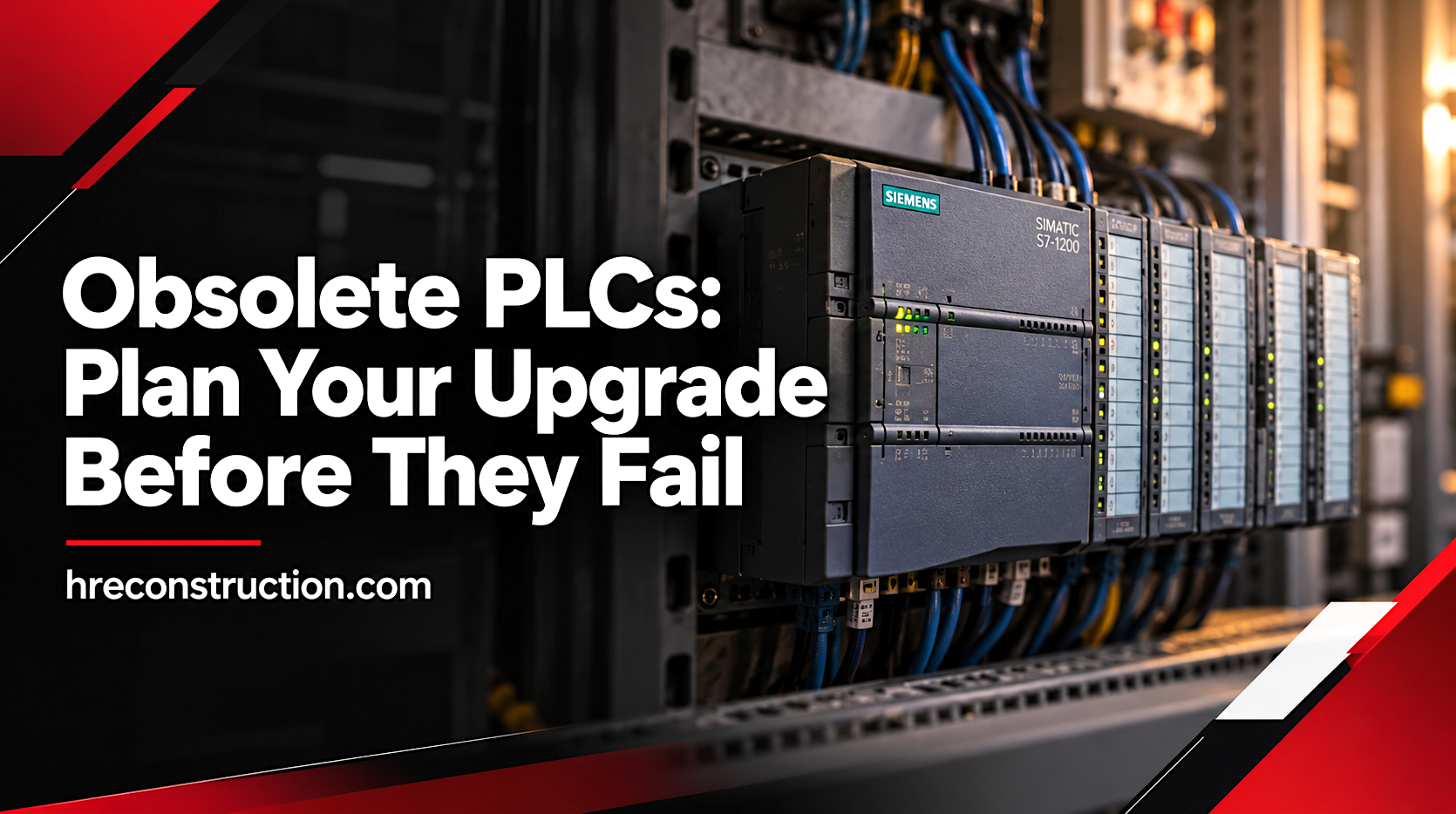
Almost every industrial facility has at least one controller nobody wants to touch. It has been running the same line for twenty-plus years, the program lives on one laptop in the maintenance office, and the spare processor on the shelf was bought used. As long as it keeps running, it stays off the budget.
The trouble is that PLC obsolescence doesn't come with a warning light. It shows up the morning a processor doesn't come back after a power bump and the replacement part can't be ordered anymore. At that point, the upgrade happens on the failure's schedule instead of yours.
This fall is a good time to get ahead of it. On November 1, 2026, Siemens begins phasing out the first generation of its S7-1200 controllers. The older S7-300 platform stopped taking new orders in October 2025. Rockwell has already discontinued the PLC-5 and a number of SLC 500 catalog numbers, and points customers toward CompactLogix 5380. With 2027 budgets being set and year-end shutdowns coming up, now is when a controls upgrade plan should get on paper.
What PLC Obsolescence Actually Means
An obsolete PLC isn't a broken PLC. Plenty of discontinued controllers are still running production every day without a problem. Obsolescence means the manufacturer has moved the product through its lifecycle, typically from active sales, to a phase-out period, to discontinued, and eventually to spare parts only.
Once a product is discontinued, you can't buy it new. Your supply becomes whatever spare parts the manufacturer still stocks, repair services, and the surplus market. Prices tend to climb and quality gets harder to verify, especially with refurbished cards pulled from other plants.
It's also rarely just the processor. A single control panel might hold I/O cards, communication modules, power supplies, an HMI, and drives from several different product generations. On top of the hardware, you need the programming software, a computer that can still run it, a current copy of the program, and accurate drawings. If any one of those pieces is missing, recovery takes longer.
The Platforms to Check First
Every facility is different, but these are the platforms that come up most often right now.
Siemens S7-300 and ET 200M
Siemens announced the phase-out of the S7-300 and ET 200M I/O in October 2023, and new orders ended on October 1, 2025. Spare parts are planned to remain available until at least 2033. Siemens recommends the S7-1500, S7-1200, or ET 200SP families as successors, depending on the application.
Siemens S7-1200 (First Generation)
This is the newest item on the list and the reason many facilities are revisiting their plans this fall. The first-generation S7-1200 enters phase-out on November 1, 2026. New units can still be ordered until October 31, 2027, and spare parts are planned into the mid-2030s. Siemens launched the S7-1200 G2 in December 2024 as the replacement and offers a migration tool within TIA Portal.
The important thing to know is that November 1 isn't a shutdown date. Your G1 controllers won't stop working. It's simply the start of the clock on parts availability.
Allen-Bradley PLC-5 and SLC 500
The PLC-5 line has been discontinued, and Rockwell has discontinued several SLC 500 bulletin numbers while recommending migration to CompactLogix 5380. Some SLC components are still available, so it's worth checking your specific catalog numbers rather than assuming the whole platform is in the same position.
Both Rockwell and Siemens offer online lifecycle status lookups by catalog number. That's the most reliable way to confirm where your installed hardware actually stands.
Signs Your Control System Is Living on Borrowed Time
A few warning signs tend to show up well before a failure does:
- Spares come from surplus sites. If your backup plan for a processor or I/O card depends on finding one online, you're already exposed.
- One person knows the program. When a single technician or retired integrator is the only one who understands the logic, that knowledge is a single point of failure.
- Nobody is sure the backup matches. The offline copy on the laptop may not match what's actually running in the processor.
- The software needs an old computer. Some legacy programming packages only run on older operating systems, and that laptop won't last forever either.
- The network can't talk to newer equipment. Legacy networks like Data Highway Plus, Universal Remote I/O, and older fieldbus setups make it harder to connect to modern drives, SCADA, and plant data systems.
- Small changes take days. Adding an input or changing a sequence shouldn't require workarounds, but on older platforms it often does.
- The drawings are out of date. If the panel has been modified over the years without updated drawings, troubleshooting takes longer and migrations carry more risk.
None of these means you need to rip everything out this quarter. They do mean it's time to know where you stand.
A Practical PLC Obsolescence Plan in Four Steps
1. Inventory What's Installed
Walk every control panel and record the processor, I/O, communication modules, power supplies, HMIs, and drives by catalog number and firmware version. Note what each system controls. Then check each item's lifecycle status. This one step turns a vague worry into a list you can act on.
2. Rank by Criticality
Not every controller needs the same urgency. Ask what stops if each system goes down, how long production can tolerate being down, and whether there's a tested way to restore it within that window. A discontinued PLC running a critical process line belongs at the top of the list. One running a noncritical conveyor with spares on hand can usually wait.
3. Protect What You Can't Replace Yet
For systems that won't be upgraded right away, reduce the risk in the meantime. Take a verified backup of every program and store copies in more than one place. Build a spares strategy for the most critical components. Update drawings so they match what's actually in the panel.
4. Choose a Migration Path and Schedule It
Upgrades don't have to happen all at once. A phased approach often replaces the processor and communications first, then the I/O during later planned outages. Both Rockwell and Siemens offer conversion hardware and tools designed to reduce rewiring and code conversion work, and in some cases existing field wiring can stay in place.
Tie each phase to a real shutdown window, whether that's a holiday shutdown or a scheduled turnaround. And don't wait on long-lead items. Controls hardware is generally easier to source than large power equipment, but if your upgrade also touches distribution equipment, transformer and switchgear lead times can stretch well beyond a single budget year.
Why the Electrical Side Matters as Much as the Code
Program conversion gets most of the attention in a PLC upgrade, and it deserves it. Moving from an SLC 500 to CompactLogix, for example, isn't copy and paste. The SLC uses a fixed file structure while Logix controllers are tag-based, so the logic has to be converted and then tested carefully.
But a controls upgrade is also an electrical project. The I/O has to be mapped and terminated correctly. Panel modifications need to account for component ratings, power supplies, and grounding, and a modified industrial control panel's short-circuit current rating should be reviewed rather than assumed. If the panel serves machinery, NFPA 79 requirements come into play as well.
Instruments tied to the new controller need to be verified, since an upgrade is a good time to catch transmitters that have drifted out of calibration. And before anything goes back into production, every point should be checked through a proper commissioning and startup process so the first real test isn't the first shift back.
Newer platforms also include security features that many older controllers simply weren't built with. That alone isn't a reason to replace a working system, but it's worth factoring into the plan if your plant is connecting more equipment to its network.
How HRE Can Help
HRE Construction is an industrial electrical and instrumentation contractor, and control system work is a natural part of what we do. We work in operating plants, so we understand that the goal is to upgrade your controls without disrupting production.
Here's where we can support your PLC obsolescence plan:
- Panel walkdowns and inventory to document what's installed and where your biggest risks are
- Control panel upgrades and rewiring, including I/O termination and panel modifications
- Instrumentation services, including calibration and verification of the field devices your controller depends on
- Testing and startup planned around your shutdown windows, so equipment comes back online the way it should
- Coordination with your controls team or integrator so the electrical and programming sides of the project stay aligned
We support industrial facilities across South Carolina, North Carolina, Georgia, and the other states in our electrical services footprint.
Get Ahead of Your Next Controls Upgrade
The best time to plan a PLC upgrade is while the old system is still running. You control the schedule, you can budget for it properly, and you're not making decisions with a line down and a plant manager waiting for answers.
If you have legacy controllers in your facility and aren't sure where they stand, HRE can help you figure out what needs attention first. Request a quote or reach out to our team to talk through your plant.
Frequently Asked Questions
How long does a PLC last?
Many PLCs run reliably for 15 to 20 years or longer. Age alone isn't the deciding factor, though. The better question is whether you can still get parts, programming software, and support for the platform you have.
Will our Siemens S7-1200 controllers stop working on November 1, 2026?
No. November 1, 2026 is the start of Siemens' phase-out for the first-generation S7-1200, not an end-of-operation date. New units remain orderable until October 31, 2027, with spare parts planned into the mid-2030s. It's a good time to start planning, not a reason to panic.
Can we upgrade our PLC without a long shutdown?
Often, yes. Many facilities use a phased approach, replacing the processor and communications first and moving the I/O during later planned outages. Careful prep work, including verified backups, updated drawings, and pre-tested logic, keeps the cutover window as short as possible.
Do we have to rewire the whole panel to upgrade?
Not always. Manufacturers offer conversion hardware designed to reuse existing field wiring in many migrations. Whether it works for your system depends on the platforms involved and the condition of the existing panel, which is why an on-site assessment comes first.