Transformer and Switchgear Lead Times Are Stretching
August 20, 2026 | Samantha Mariano
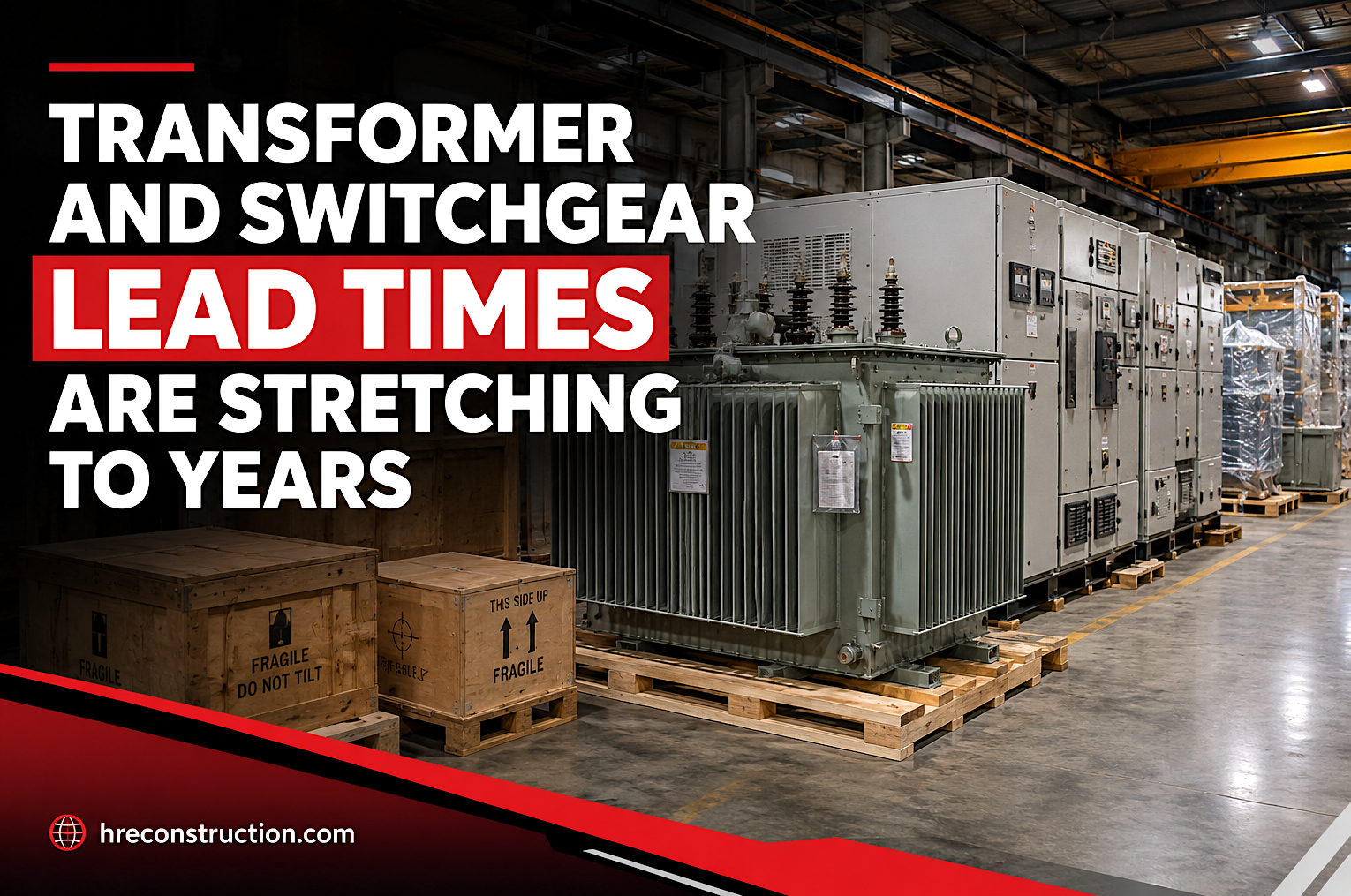
A few years ago, ordering a new power transformer or a switchgear lineup was a procurement task, not a scheduling risk. A facility manager planning an expansion or a service upgrade could reasonably expect equipment to show up within a matter of months. That is no longer how this works.
Lead times for large power transformers now commonly run two to four years, and in some cases longer. Medium-voltage switchgear is facing multi-year backlogs of its own, with some manufacturers effectively sold out well into 2028. For any industrial facility planning an expansion, a service upgrade, or a new production line, the equipment itself, not the construction work, has become the thing most likely to determine your timeline.
Why This Is Happening
The short version is that demand has surged faster than manufacturers can build capacity. Generator step-up transformer demand has grown roughly 274% since 2019, and demand for substation-class power transformers has grown around 116% to 119% over the same period. AI data center construction, large-scale electrification of industrial processes, aging grid infrastructure that needs replacing, and grid modernization programs are all pulling from the same limited pool of manufacturers at the same time.
The bottleneck is not just a matter of factory capacity. It runs down into raw materials. Transformer cores require grain-oriented electrical steel, a highly engineered material with specific magnetic properties, and the United States has only one domestic producer of it. Copper supply has been under similar pressure. Add in a limited number of qualified suppliers for high-voltage bushings and on-load tap changers, and a single constrained component can hold up an entire transformer build regardless of how far along the rest of it is.
Prices have moved along with the delays. Power transformer prices are up roughly 60% to 80% since 2019 and 2020 depending on the class of equipment, and some segments of the distribution transformer market have seen even steeper increases.
What This Means for Your Next Project
If your facility is planning a service upgrade or expansion, a new production line, or a switchgear replacement, the equipment order is now the long pole in the schedule, not the electrical work itself. A project that used to be sequenced as design, then permitting, then equipment order, then installation now needs the equipment order moved to the very front of that sequence, often before the design is even finalized in detail.
Waiting until a project is fully engineered and permitted before contacting a supplier can add years to a timeline that used to take months. This is true whether the driver is a planned expansion, a piece of failing equipment that needs replacement, or new production capacity coming online.
The Domestic Manufacturing Response Is Real, But It Will Not Fix This Soon
Transformer manufacturers are responding with real investment. Siemens Energy, Hitachi Energy, Virginia Transformer, Prolec GE, and others have collectively committed billions of dollars to new and expanded manufacturing capacity across the country, including a $185 million Siemens facility recently announced in Jackson County, Georgia, expected to bring around 1,400 jobs. Virginia Transformer is separately expanding its own Georgia operation to boost output by roughly 70%.
That investment matters, but most of the new capacity is projected to come online by 2027 or 2028. Projects that need equipment between now and then are still competing in the market as it exists today. Domestic capacity expansion is the long-term fix. It is not a reason to delay ordering equipment for a project that needs to move forward this year or next.
What Facilities Should Do Now
- Engage your electrical contractor early, well before final permitting or financial approval, so equipment procurement can start in parallel with design instead of after it
- Finalize technical specifications as early as possible. Standard, widely used specs (common voltage ratios and vector groups, for example) let manufacturers use pre-engineered designs, which tends to move faster than heavily customized equipment
- Avoid unnecessary customization unless the application genuinely requires it. Every non-standard requirement is another point where your order can get pushed further back in a manufacturer's queue
- Have your contractor assess whether existing equipment can be refurbished, uprated, or kept in service longer while new equipment is on order, rather than treating replacement as the only option. Regular switchgear maintenance and testing and sound transformer maintenance practices are what make extending the life of existing equipment a safe option in the first place
- Build lead time into the project timeline from day one, not as a contingency line added after the schedule slips
How HRE Can Help
HRE Construction works with industrial facilities to plan electrical projects around the realities of today's equipment market, not the assumptions of a few years ago. We assess your facility's current and future capacity needs early, help you finalize specifications that avoid unnecessary delays, and get equipment orders moving in parallel with design, permitting, and electrical commissioning planning instead of waiting until a project is fully engineered to start the clock. Where it makes sense, we also evaluate whether existing transformers or switchgear can be safely extended in service while new equipment works its way through a manufacturer's backlog.
Planning an expansion or facing a transformer or switchgear replacement? Contact HRE Construction to start your equipment planning now, before the lead time becomes the problem.
Frequently Asked Questions
How long are transformer lead times right now?
Large power transformers are commonly running two to four years depending on size, voltage class, and manufacturer. Some highly specialized units have been reported at closer to four years. Distribution-class transformers have improved somewhat but remain constrained in many markets.
Is it just large transformers, or is switchgear affected too?
Both. Medium-voltage switchgear is facing its own multi-year backlogs, with capacity at some manufacturers effectively committed well into 2028. Any project depending on new switchgear should plan procurement on the same early timeline as transformers.
What can I do if my project needs equipment sooner than current lead times allow?
Start by having a qualified electrical contractor assess whether your existing equipment can be safely refurbished, uprated, or kept in service longer while new equipment is on order. In some cases a phased approach, upgrading what can be upgraded now while the highest-lead-time components are on order, keeps a project moving instead of stalling entirely.
Will the new domestic manufacturing investment fix this soon?
Not in the near term. Most of the announced capacity expansions are projected to come online around 2027 to 2028. That will help going forward, but projects that need equipment before then are still working within today's constrained market, which is exactly why early procurement matters now.