HRE Construction / Industrial Electrical
Corrosion in Industrial Electrical Systems: Causes and Fixes
October 26, 2026 · 11 min read · By HRE Construction
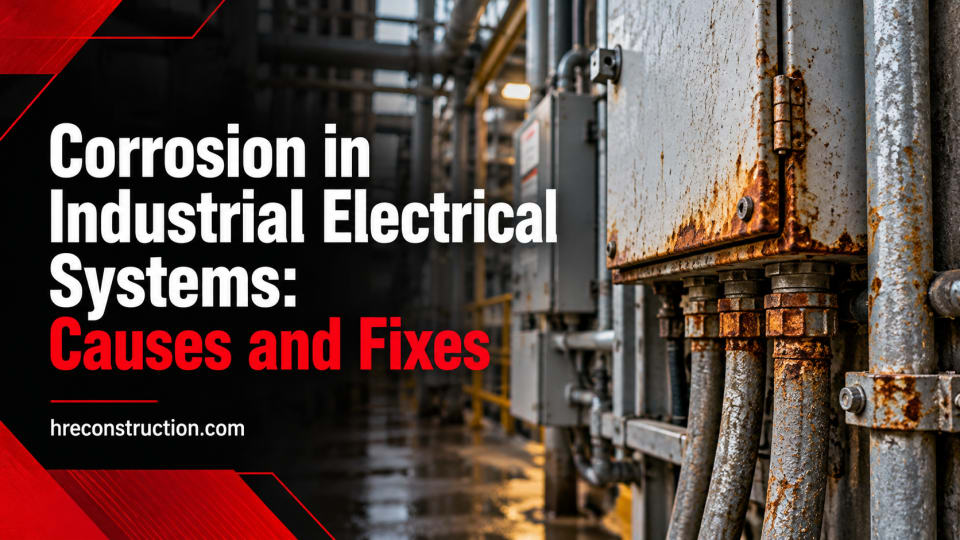
Walk through a pulp mill, a wastewater plant, or a chemical process area and you can usually spot it without opening a single panel. Rust bleeding from conduit where it meets the slab. A white crust on fittings. Enclosure doors that no longer seal. Open the panel and you may find green or black film on copper lugs and terminal strips.
Corrosion tends to get filed under housekeeping. In an industrial facility it is an electrical reliability and safety problem, and it is one of the most common reasons equipment fails years earlier than it should.
This post covers what drives corrosion in industrial plants, what the NEC expects, how to choose materials that hold up, and how to catch damage before it turns into a failure.
Why Corrosion Is an Electrical Problem
Corrosion does more than make equipment look old. It changes how the electrical system behaves.
- Hot terminations. Corroded connections have higher resistance. Higher resistance means heat, and heat speeds up the corrosion. That cycle ends in a failed connection or a burned lug.
- Lost ground paths. Metal raceway often serves as the equipment grounding conductor. When couplings and fittings corrode through, the fault return path can be compromised without anyone noticing until a fault happens.
- Defeated enclosure ratings. A rusted hinge, a hardened gasket, or a corroded door seal lets in the moisture and dust the enclosure was rated to keep out.
- Electronic failures. PLC cards, drives, and instruments are especially sensitive to corrosive gases. Failures often look random because nothing visibly burned.
What Drives Corrosion in Industrial Plants
Most corrosion problems trace back to a few sources, and many facilities deal with more than one at a time.
Moisture and Condensation
Water is the starting point for almost every type of corrosion. In plants it shows up as washdown spray, process steam, outdoor exposure, and condensation inside enclosures when temperatures swing between day and night or between running and idle equipment.
Corrosive Gases
Some of the most damaging corrosion comes from gases you cannot see:
- Hydrogen sulfide (H2S), common around pulp and paper processes, wastewater treatment, and some chemical processes, attacks copper and silver. That makes it hard on circuit boards, connectors, and contacts.
- Chlorine and chlorides, found in water treatment, bleaching processes, and coastal air, are hard on many metals, including aluminum and some stainless steels.
- Ammonia can attack copper alloys such as brass.
Chemicals and Process Splash
Acids, caustics, and cleaning chemicals break down protective coatings quickly. Galvanized steel generally performs well in environments with a pH from about 4 to 12.5, while aluminum is more limited at roughly 4 to 9, according to IAEI Magazine. Outside those ranges, standard materials can fail fast.
Dissimilar Metals
When two different metals touch in the presence of moisture, galvanic action can corrode the less noble one. Mixing stainless steel with galvanized steel or aluminum in a severe environment is a classic example, and it is why stainless components often need to be isolated from galvanized boxes and fittings.
Concrete-to-Soil Transitions
Steel raceway that runs through concrete and then into soil sees very different conditions on each side of that transition, and that point is a known trouble spot. Conduit manufacturers recommend supplementary protection extending at least 4 inches on each side of the point where the raceway emerges, according to The Steel Tube Institute.
What the NEC Expects
The National Electrical Code addresses corrosion in a few key places.
NEC 110.11, Deteriorating Agents. Equipment and conductors exposed to gases, fumes, vapors, liquids, or other agents that can damage them must be identified for that environment. In other words, the material has to match the location, not just the load.
NEC 300.6, Protection Against Corrosion and Deterioration. Raceways, cable trays, boxes, fittings, and supports must be made of materials suited to the environment they are installed in. A few practical requirements stand out:
- Field-cut threads. Where corrosion protection is needed, threads cut in the field must be coated with an approved, electrically conductive, corrosion-resistant compound. Cutting threads on galvanized or PVC-coated conduit and leaving them bare is one of the most common shortcuts in the field.
- Indoor wet locations. In places like dairies, laundries, canneries, and areas where walls are frequently washed, exposed wiring systems generally must be mounted with at least 1/4 inch of airspace from the wall or supporting surface so moisture does not sit trapped behind them. NEC 312.2 has a similar rule for cabinets in damp and wet locations, with allowances for nonmetallic enclosures on concrete and masonry.
Raceway articles and supplementary protection. The raceway articles (such as Article 344 for rigid metal conduit) allow steel raceway in corrosive areas when it is protected by corrosion protection approved for the condition. UL guidance notes that supplementary protection is generally not needed for rigid conduit in contact with soil unless the soil is especially corrosive, such as soil with resistivity below 2,000 ohm-centimeters. Where the environment is severe, the authority having jurisdiction makes the final call.
Choosing Materials That Hold Up
The right material depends on what the area is actually exposed to. Here is a practical starting point:
| Environment | Main Threat | Materials That Usually Hold Up Better |
|---|---|---|
| Washdown and food processing | Hose-directed water, cleaning chemicals | NEMA 4X stainless or nonmetallic enclosures, sealed fittings, airspace from washed walls |
| Chemical and water treatment | Chlorine, chlorides, acids, caustics | PVC-coated rigid conduit, 4X nonmetallic or stainless enclosures, stainless hardware |
| Pulp, paper, and wastewater | Hydrogen sulfide | Sealed, pressurized, and filtered control rooms; electronics rated for the environment |
| Coastal and outdoor sites | Salt air, rain, temperature swings | PVC-coated or properly protected conduit, 4X enclosures, enclosure heaters |
| Concrete-to-soil transitions | Moisture and soil chemistry | Supplementary coating or tape at the transition, PVC-coated sections |
A few enclosure points cause a lot of confusion. NEMA defines each enclosure type in its NEMA 250 standard (summarized here):
- Type 4 protects against windblown dust and hose-directed water, but it does not include corrosion protection.
- Type 4X adds an additional level of protection against corrosion. If an area is both washed down and chemically aggressive, this is usually the starting point.
- Type 12 is an indoor industrial enclosure for dust and dripping water. It does not include corrosion protection, so it is a poor fit for chemical areas.
- Types 7 and 9 are for hazardous (classified) locations. Corrosion resistance is a separate question. If your area is both classified and corrosive, both requirements have to be met. Our post on Classified Locations and NEC Article 500 Compliance covers the classification side.
PVC-coated rigid conduit is a common choice for severe areas, but it only works if the coating stays intact. Installers should use the proper tools, such as strap wrenches and coated-conduit benders, and touch up any nicks with the manufacturer's patch compound. A damaged coating can trap moisture against bare steel and make things worse.
Protecting Control Electronics: ISA 71.04
Corrosive gases are especially hard on PLCs, drives, and instrumentation. The ISA 71.04 standard classifies how aggressive an environment is for electronics by placing copper and silver test coupons in the area, typically for 30 days, and measuring how much corrosion film builds up. The 2013 edition added silver as a required measurement, and the overall rating is set by whichever metal shows the higher reactivity, according to Purafil.
| Severity Level | Description | Copper Reactivity (per 30 days) |
|---|---|---|
| G1, Mild | Corrosion is not a factor in reliability | Less than 300 angstroms |
| G2, Moderate | Effects are measurable and may affect reliability | Less than 1,000 angstroms |
| G3, Harsh | High probability of corrosive attack | Less than 2,000 angstroms |
| GX, Severe | Only specially designed and packaged equipment is expected to survive | 2,000 angstroms or more |
Copper levels per Lawrence Berkeley National Laboratory. Many electronics manufacturers specify an environmental limit for their equipment, so check the documentation before installing controls in a harsh area.
If control equipment keeps failing in a mill or treatment plant with no obvious electrical cause, corrosive gas is worth testing for. Common fixes include:
- Moving electronics into a sealed control room kept under positive pressure with filtered air
- Adding chemical filtration to the air supply where gas levels are high
- Keeping enclosure and control room doors closed and gaskets in good condition
- Choosing equipment designed for the measured severity level
This is also worth considering during a controls upgrade. If you are planning one, our post on Obsolete PLCs covers how to plan the migration.
Condensation: The Corrosion Source Inside a Sealed Box
A tightly sealed enclosure can still corrode from the inside. When warm, humid air inside a panel cools below its dew point, moisture condenses on components and terminals. This happens often in outdoor panels, in equipment that cycles on and off, and in idle motors.
Common ways to control it:
- Enclosure heaters. Keeping the inside of an enclosure about 9 degrees F (5 degrees C) warmer than the surrounding air helps prevent condensation, according to North American Clean Energy.
- Hygrostat control. A hygrostat turns the heater on based on humidity, often around 65 percent relative humidity, instead of running it on temperature alone. That usually saves energy compared to a thermostat-only setup.
- Motor space heaters. Many larger motors have built-in space heaters meant to run while the motor is idle. Make sure they are actually wired and energized.
- Breathers and drains. Listed drain and breather fittings let trapped moisture escape without compromising the enclosure rating.
With winter approaching, this is a good time to check heaters along with other cold-weather systems. Our post on heat trace readiness covers the freeze protection side.
Catching Corrosion Early
Corrosion is slow, which makes it easy to ignore and easy to catch if someone is actually looking. A good inspection routine in corrosive areas includes:
- Terminations and lugs. Look for green, black, or white residue and discoloration from heat.
- Conduit at slabs, walls, and low points. These are where water collects and coatings wear first.
- Enclosure gaskets, hinges, and latches. If the door no longer seals, the enclosure rating is gone.
- Grounding connections. Check ground connections and raceway continuity, since corrosion can quietly break the fault return path. Our post on Grounding and Bonding explains why that path matters.
- Thermal imaging. Corroded connections often run hot before they fail. Infrared electrical inspections can find them while the equipment is running.
- Insulation resistance testing. Moisture and contamination show up as falling readings over time. See our guide to insulation resistance testing.
Corrosive locations should also factor into your maintenance intervals. NFPA 70B ties maintenance frequency to equipment condition, and equipment in harsh environments often needs attention sooner. Our post on NFPA 70B covers how condition assessments work.
For minor damage to galvanized surfaces, zinc-rich paint is a common field repair. For anything structural, such as pitted enclosures, rusted-through couplings, or failed grounding paths, repair usually is not enough.
When to Repair and When to Replace
Touch-up coatings, new gaskets, and cleaned terminations can buy time. Replacement is usually the better call when:
- Conduit or fittings are pitted or rusted through
- Raceway can no longer be trusted as a ground path
- Enclosures no longer seal or have holes
- Electronics in the same area keep failing
- The original materials were never suited to the environment
When you replace, match the material to the environment instead of repeating what failed. Our post on aging electrical infrastructure covers how to prioritize upgrades.
How HRE Can Help
HRE Construction works in industrial facilities where corrosion is part of daily operations, including chemical, paper, water treatment, and manufacturing environments. Our team can help you:
- Inspect corrosive areas and identify connections, raceway, and enclosures at risk
- Use thermal imaging and testing to find damage before it causes a failure
- Recommend materials suited to your environment, from NEMA 4X enclosures to PVC-coated conduit
- Replace failed raceway, enclosures, and terminations with code-compliant installations
- Add enclosure heaters, hygrostats, and condensation control
- Plan control system upgrades with the operating environment in mind
Frequently Asked Questions
What NEMA enclosure rating is best for corrosive areas?
NEMA Type 4X is usually the starting point, because it adds corrosion protection to the dust and hose-directed water protection of Type 4. Material still matters. Stainless steel and nonmetallic 4X enclosures behave differently depending on the chemicals present, so match the material to what the area is exposed to.
Does galvanized rigid conduit need extra corrosion protection?
Not always. Listed galvanized rigid conduit has factory corrosion protection and is generally suitable in concrete and most soils. Supplementary protection is often needed in severely corrosive areas, very corrosive soil, and where conduit transitions from concrete to soil. The authority having jurisdiction makes the final determination.
Why do control boards keep failing in paper mills and wastewater plants?
Hydrogen sulfide and other corrosive gases attack the copper and silver in circuit boards and connectors. ISA 71.04 coupon testing can measure how severe the environment is. Common fixes include pressurized and filtered control rooms and equipment rated for the measured severity level.
How often should electrical equipment in corrosive areas be inspected?
There is no single interval for every facility. NFPA 70B ties maintenance frequency to equipment condition, and equipment in harsh environments often needs more frequent attention. A condition assessment is the best way to set a schedule that fits your plant.
Protect Your Equipment Before Corrosion Wins
Corrosion does not stop on its own. The longer it runs, the more it costs to fix. If you are seeing rust, residue, or unexplained failures in your process areas, HRE Construction can help you find the cause and choose a fix that lasts.
Request a Quote to schedule a corrosion and electrical condition assessment for your facility.
Related Services
Related Posts
 SCCR on Industrial Control Panels: What NEC 409 Requires
October 8, 2026
Your control panel's SCCR has to be higher than the fault current available where it's installed. Here's what NEC 409 requires...
 Electrical Prefabrication for Industrial Projects
November 2, 2026
Electrical prefabrication moves panel, rack and conduit work off the plant floor. What it speeds up, where it falls short, and...
- Common Electrical Issues in Manufacturing and How to Prevent Them
March 12, 2026
Manufacturing facilities rely heavily on reliable electrical systems to keep operations running efficiently. From heavy...