HRE Construction / Industrial Electrical
Electrical Prefabrication for Industrial Projects
November 2, 2026 · 10 min read · By HRE Construction
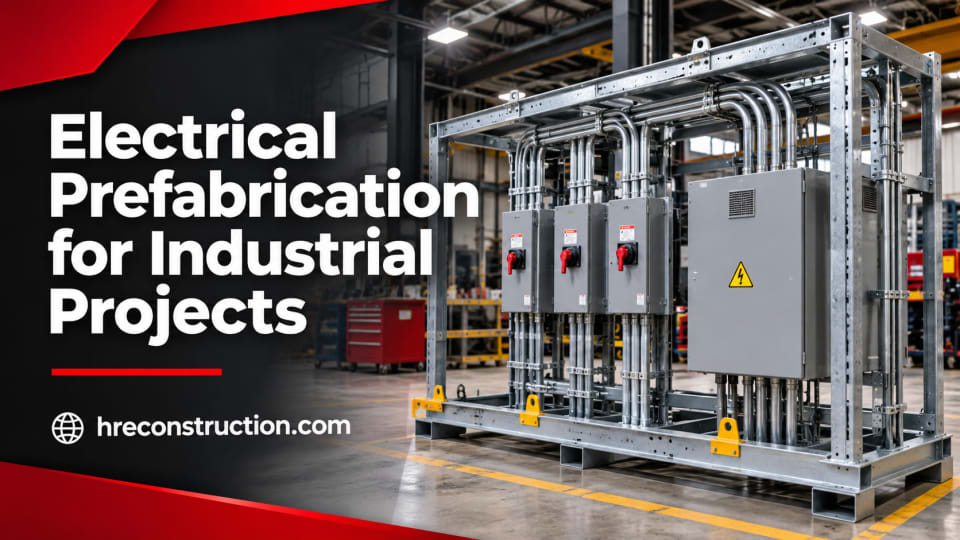
Most industrial electrical projects don't fail because the work is hard. They slip because the window to do the work is small. A line gets a two-day shutdown, an expansion has to tie in over a holiday weekend, or a new building is ready for power months before the electricians can finish inside it. Every hour spent bending conduit, mounting strut and wiring devices on the plant floor is an hour taken out of that window.
Electrical prefabrication moves as much of that work as possible somewhere else: a shop, a staging area, or a factory. What reaches the plant is closer to finished, so the time on site goes to setting, connecting and testing instead of building from scratch.
It isn't new, and it isn't magic. Done well, it shortens outages and tightens quality. Done badly, it ships a perfectly built assembly that doesn't fit. Here is how it works on industrial projects, where it pays off, where it doesn't, and what the code and the inspector expect.
What Electrical Prefabrication Means
Electrical prefabrication is building electrical assemblies ahead of time, away from their final location, and then installing them as a unit. That can mean a few conduit bends made on a bench in the staging area, or an entire electrical building assembled and tested in a factory hundreds of miles away.
The industry treats it as a discipline of its own now. NECA 5-2022, Recommended Practice for Prefabrication of Electrical Installations for Construction, is the first ANSI-approved standard written specifically for electrical prefab. It covers planning, procurement, scheduling, production, quality control and installation. In other words, the process around the work, not only the work itself.
What Gets Prefabricated on Industrial Projects
Not everything is a candidate, but more is than most facility teams expect.
| Assembly | Where It's Usually Built | Why It Helps in a Plant |
|---|---|---|
| Conduit racks and multi-conduit bends | Shop or on-site staging area | Less layout and bending at height, consistent spacing and offsets |
| Equipment racks (disconnects, VFDs, junction boxes on strut frames) | Shop | Arrives mounted, labeled and wired between devices, so field work is mostly landing feeders and loads |
| Device and lighting kits (boxes, whips, fixture kits) | Shop | Fewer trips to the material cage, less sorting on the floor |
| Control panels and marshalling cabinets | UL 508A panel shop, or built to client specification | Wired and checked before they ship |
| Packaged process skids | OEM or skid builder | Equipment and local wiring arrive as one unit, leaving field interconnects |
| E-houses and power distribution centers | Equipment manufacturer's factory | Switchgear, MCCs, drives, controls and HVAC delivered in one tested building |
At the large end, an e-house (also called a power distribution center) is a prefabricated, environmentally controlled building that houses medium and low voltage switchgear, motor control centers and automation cabinets. The manufacturer builds and tests it, then ships it to site to be set on a foundation and connected. At the small end, prefab can be as simple as kitting the boxes and whips for a lighting retrofit so the crew isn't sorting parts on a scissor lift.
Why It Matters More in Industrial Facilities
Commercial builders use prefab to save labor. Plants have a few more reasons.
Outage windows are fixed
A shutdown has a start time and an end time, and production planning is built around both. Work that can be done before the outage, without touching anything energized, is work that can't run the outage long. Pre-built racks and pre-wired panels turn a multi-day field build into a set-and-connect job during the window itself.
Plant floors are poor workshops
An operating plant has forklift traffic, process heat, dust, washdown areas and limited laydown space. Building on a bench in a controlled area is safer and more consistent than building overhead next to a running line. It also cuts down the time crews spend working at height, which is one of the main safety arguments NECA and the trade press make for prefab.
Quality is easier to control on a bench
In a shop it's easier to hold consistent workmanship: correct torque on terminations, clean wire management, and labels that match the drawings. It's also easier to check. A control panel can be point-to-point checked and powered up before it ever leaves the shop, so wiring errors get found where they are cheap to fix.
Labor is tight
Associated Builders and Contractors estimates the construction industry needs to bring in about 349,000 net new workers in 2026 and about 456,000 in 2027, with retirements driving much of that demand. Prefab doesn't replace electricians. It lets the same crew get more done, with less of it in conditions that slow everyone down.
Work can happen in parallel
Racks and panels can be built while the steel, concrete or mechanical work is still being finished. Long-lead items are a separate problem (we covered that in our post on transformer and switchgear lead times), but prefab keeps the electrical scope from becoming the last thing waiting on everything else.
Where Prefabrication Falls Short
Prefab is a planning decision, and it has real limits.
- It needs a frozen design. Assemblies get built from drawings. If the design is still moving, every change either reworks a finished assembly or gets made in the field anyway, and the time savings disappear.
- Existing plants rarely match their drawings. In a retrofit, every pre-built rack depends on field-verified dimensions. A missed beam, a pipe that isn't on the drawings or a housekeeping pad in the wrong spot can make a finished assembly useless until it's modified.
- One-off work doesn't always justify it. The payoff comes from repetition and from moving work out of hard conditions. A single small tie-in may be faster to just build in place.
- Shipping and rigging are part of the job. Large assemblies need a route into the building, a way to lift them, and protection from damage and weather while they wait to be set.
- Material decisions come earlier. Buying for prefab means committing to materials sooner. With metal prices where they are (see our post on copper prices in 2026), that can work in your favor or against you.
Code, Listing and Inspection: What Doesn't Change
This is the part that catches people off guard. Building something somewhere else doesn't take it out of the code or out of the inspection.
Approval still comes from the AHJ. NEC 110.2 says conductors and equipment are acceptable only if approved, meaning approved by the authority having jurisdiction. That rule applies whether the work was assembled in the field, in a staging area or in a shop across the state.
Listed equipment is treated differently from field-built assemblies. Under NEC 90.7, the factory-installed internal wiring of listed equipment generally doesn't need to be inspected again at installation, except to check for damage or alterations. An assembly your contractor builds from listed parts is not the same thing. The conduit, boxes and devices may each be listed, but the assembly isn't, so the inspector still has the right to look at how it was put together.
Concealed work needs a plan. If a prefabricated assembly will hide wiring or connections once it's installed, talk to the inspector before it's built. Some AHJs will inspect in the shop. Others want access on site. Finding out after the assembly is closed up is how prefab turns into rework.
Control panels have their own path. An industrial control panel built in a UL 508A listed panel shop can carry a listing mark for the whole assembly. A panel built outside that program may need a field evaluation by a testing laboratory before some AHJs will accept it. Using all listed or recognized components does not, by itself, make the panel listed. Industrial control panels also have to be marked with a short-circuit current rating under NEC 409.110, and that rating has to suit the available fault current where the panel is installed. Our motor control center post explains why SCCR matters for MCCs too.
Installation rules still apply on arrival. A prefabricated tray section still has to meet the support, fill and bonding rules in NEC Article 392 once it's hung. Our cable tray installation post walks through those.
How to Plan a Prefab Scope That Works
If you're considering prefab for an upcoming expansion, outage or new line, these are the decisions that make or break it.
- Decide early. Prefab belongs in design and preconstruction, not two weeks before the shutdown.
- Field-verify everything the assembly touches. Dimensions, elevations, existing equipment locations and access routes. In older plants, consider a laser scan or a dedicated walkdown.
- Freeze the design for each assembly before it's built. Track any change after that point and decide whether it's built in or handled in the field.
- Talk to the AHJ first. Agree on listing, field evaluation and inspection points, especially for concealed work and custom panels.
- Test before it ships. Point-to-point checks, insulation resistance where it applies, and I/O checkout on panels. Problems found on the bench cost far less than problems found during startup.
- Label to the drawings. Labels on the assembly should match the drawings the field crew and the maintenance team will use.
- Plan delivery, storage and setting. Know the route, the rigging and where assemblies will sit, protected, until they go in.
- Finish with real verification. Prefab doesn't skip startup. Every loop still needs to be checked (see our post on loop checks), and the system still needs electrical commissioning before it's turned over to production.
How HRE Can Help
HRE Construction is an industrial electrical and instrumentation contractor, which means we see prefab from both sides: the assemblies being built and the plant they have to fit into.
- Prefab planning: We review the scope early and help sort out which pieces are worth building ahead and which are better built in place.
- Field verification: Walkdowns and measurements on existing plants before anything is fabricated.
- Control panels and marshalling cabinets: Through our instrumentation services, we fabricate custom panels built to UL 508A or client-specified standards, with wiring schematics, terminal labeling and as-built documentation.
- Installation: Setting and connecting prefabricated racks, panels, skids and equipment, plus the conduit, tray and feeders that tie them together, through our industrial electrical installation crews.
- Testing and startup: Loop checks, functional testing and startup through our testing and startup services, planned around your production schedule.
Frequently Asked Questions
What is electrical prefabrication?
It's building electrical assemblies, such as conduit racks, equipment racks, device kits, control panels or even complete electrical buildings, ahead of time and away from their final location, then installing them as finished units. The goal is less work on the plant floor and more consistent quality.
Does prefabricated electrical work still need to be inspected?
Yes. The NEC requires equipment and installations to be approved by the authority having jurisdiction, wherever they were built. Factory wiring inside listed equipment usually isn't re-inspected except for damage or alterations, but assemblies built from listed parts are still subject to inspection. Agree on inspection points with the AHJ before anything is built, especially if wiring will be concealed.
Is prefabrication worth it on a small retrofit?
Sometimes. It pays off when there is repetition, when the work would otherwise happen at height or near running equipment, or when an outage window is short. For a single small tie-in, building in place is often faster. Accurate field measurements decide whether a retrofit prefab scope works.
What's the difference between a prefabricated assembly and a UL listed control panel?
A UL listed control panel has been built in a UL 508A listed shop and carries a listing mark for the whole assembly. A prefabricated assembly built from listed parts isn't listed as a unit, so the inspector evaluates how it was assembled. Some panels built outside a listing program get a field evaluation from a testing laboratory to satisfy the AHJ.
Plan the Prefab Before the Outage
If you have a shutdown, expansion or new line coming up, the best time to decide what can be built ahead is now, while the design can still be shaped around it. Contact HRE Construction to talk through your project or request a quote.
Related Services
Related Posts
 Corrosion in Industrial Electrical Systems: Causes and Fixes
October 26, 2026
Corrosion quietly eats panels, conduit, and controls in chemical, paper, and water plants. Learn the causes, the NEC rules, and...
 Why Industrial Facilities Need Custom Electrical Solutions vs. Standard Builds
June 19, 2026
Standard electrical builds often fall short in industrial settings. Learn why custom electrical and instrumentation solutions...
 PLC Cybersecurity: What the 2026 CISA Alerts Mean
October 5, 2026
Federal agencies warn of active attacks on Rockwell and Siemens PLCs. Here's what industrial plants should check on the plant...