Loop Checks: The Step That Makes or Breaks Startup
October 1, 2026 | Samantha Mariano
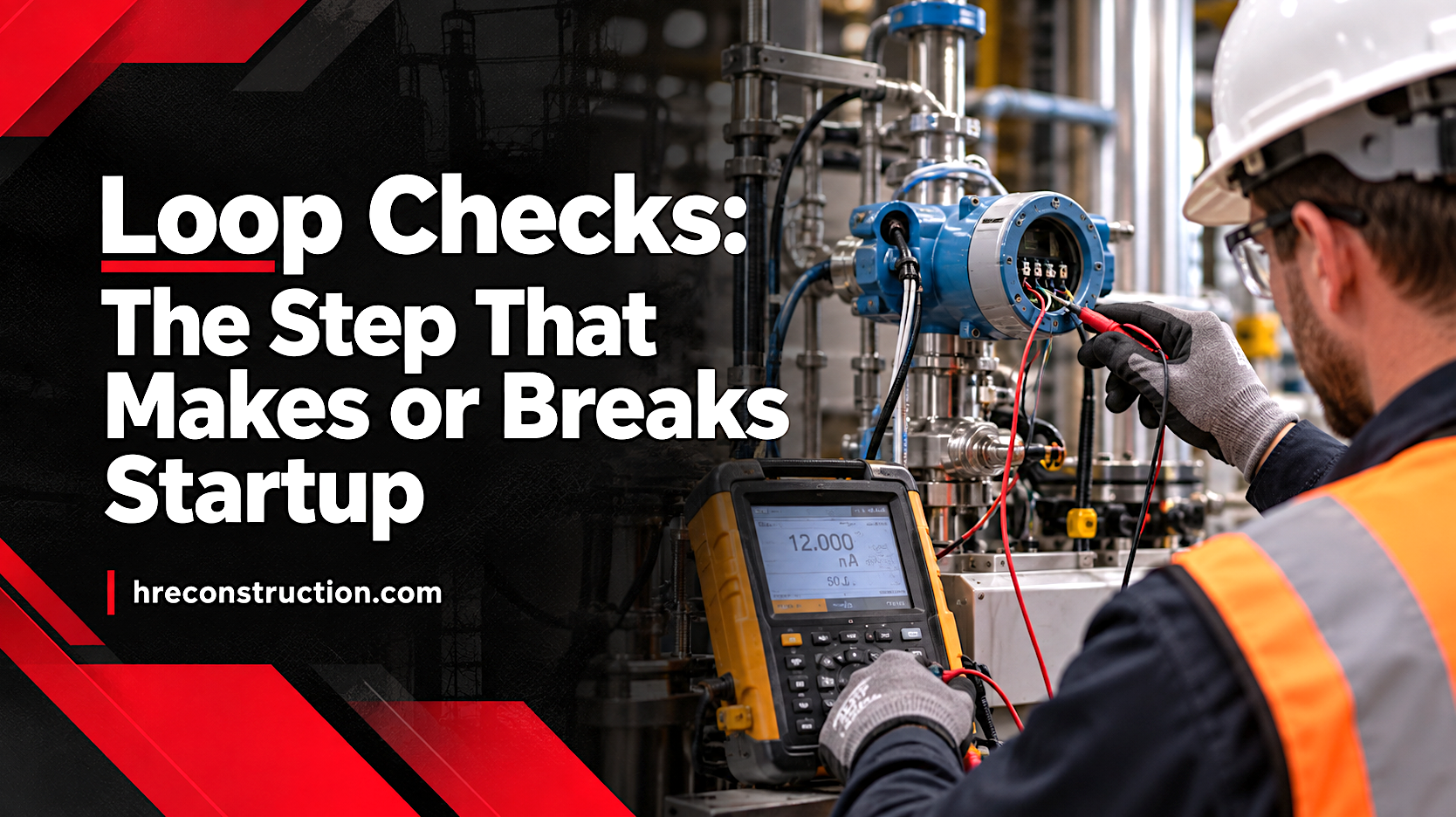
Picture the first morning of startup on a new process line. Operators are in the control room, product is staged, and the plant manager wants to see the line running by lunch. Then a level reading on the HMI shows the tank is empty when anyone standing next to it can see it's half full. Someone swapped two wires at a junction box three weeks ago, or the transmitter range doesn't match what was programmed into the PLC. Either way, startup stops while a technician traces the loop by hand.
Most of those surprises are preventable. The step that catches them is the loop check, and it's one of the most overlooked parts of an instrumentation project until it gets skipped or rushed.
What a Loop Check Actually Is
An instrument loop is the full path a signal travels: the field device (a transmitter, switch, or valve), the wiring and junction boxes, the marshalling or I/O terminals, the input or output card, and finally the tag and display in the control system. A loop check proves that whole path works as one system.
The international standard for this work is IEC 62382, Control systems in the process industry: Electrical and instrumentation loop check. Its current edition was published in 2024. The standard places loop checking between the end of loop construction, including installation and point-to-point wiring checks, and the start of cold commissioning. It applies to new plants and to expansions and retrofits in existing plants, covering PLC, DCS, panel-mounted, and field instrumentation.
The standard defines what needs to be tested, not exactly how to test it, because the equipment varies so much from one facility to the next. That leaves room for each project to set its own procedure, which is also where things tend to get skipped when a schedule gets tight.
Why Checking Each Piece Separately Isn't Enough
A transmitter can be perfectly calibrated on the bench. The wiring can pass a continuity test. The PLC program can be correct. And the loop can still be wrong.
Some of the most common problems only show up when the pieces are tested together:
- Swapped or crossed wires at a junction box or marshalling panel, so the signal lands on the wrong input
- Range mismatches, where the transmitter is set to 0 to 150 psi but the control system is scaled for 0 to 100
- Reversed action, where the device and the control logic disagree about whether a rising signal means more or less
- Tag errors, where the right signal shows up under the wrong name on the operator screen
- Alarm and interlock setpoints that were never tested against a real signal
- Valve and actuator problems that don't show up until the valve is actually commanded to move
Each of these can turn a smooth startup into a long day of troubleshooting with operators waiting.
Cold Loop and Hot Loop Checks
Many projects split loop checking into two passes. The names vary from site to site, but the idea is consistent.
The cold loop check happens with the system de-energized. Technicians verify wiring continuity, polarity, terminations, and tag numbers at the instrument, the junction box, and the control panel. It's about confirming the physical installation matches the drawings.
The hot loop check happens with the system energized. A known signal is applied and the response is confirmed all the way through to the control system. For a typical 4 to 20 mA transmitter loop, the common practice is a five-point check at 0, 25, 50, 75, and 100 percent of range, which works out to 4, 8, 12, 16, and 20 mA. The reading in the control system is recorded at each point and compared against the tolerance listed on the instrument data sheet or project specification. Alarms, interlocks, and valve strokes are tested the same way, with a technician in the field and someone watching the control system.
Some teams also confirm that the system responds correctly to a failed signal. Many modern transmitters follow the NAMUR NE 43 recommendation, which uses signals below about 3.6 mA or above 21 mA to indicate a device failure. It's worth confirming the control system alarms on those conditions instead of displaying a believable but wrong value.
The Loop Sheet Is the Roadmap
Every good loop check starts with accurate loop sheets. Instrument loop diagrams, which follow the guidance in ANSI/ISA-5.4, show each device in the loop along with cable numbers, terminal points, junction boxes, the calibrated range, and the direction of action.
When the loop sheets don't match what's actually installed, the loop check is where that gets caught. Every correction should go back into the drawings, so the next person troubleshooting that loop at two in the morning isn't working from the wrong information.
The results belong in the project record too. A completed loop check form for each loop, signed off by the people who performed and witnessed it, is part of the turnover package your maintenance team will rely on for years.
Loop Checks Aren't Only for New Construction
IEC 62382 notes that loop checks can be performed throughout the life of a plant, not only during new construction. A few situations where they're worth doing in an existing facility:
- After replacing or relocating instruments
- After a control system upgrade or migration, when every I/O point moves to new hardware
- After rewiring or adding junction boxes during an expansion
- When operators stop trusting a reading and nobody can say for sure where the problem is
If your facility is planning a PLC or controls upgrade, loop checks are what confirm every point made it across correctly. And if a reading has slowly gone wrong over time rather than suddenly, it may be a calibration problem instead of a wiring one. Our post on why transmitters drift out of calibration covers that side of it.
Where Loop Checks Fit in Commissioning
Loop checks are one piece of a larger process. Once loops are verified, the project moves into commissioning, where systems are tested under real operating conditions. If you want the bigger picture, our post on electrical commissioning for industrial facilities walks through how the stages fit together.
The practical takeaway is simple: problems found during a loop check cost a technician some time. The same problems found during startup cost production time, and sometimes much more if a bad reading or untested interlock leads to an equipment trip or a safety issue.
How HRE Can Help
HRE Construction is an industrial electrical and instrumentation contractor, and loop checking is a natural part of the work we do. Because we install, terminate, and test instrumentation, our crews understand the full path a signal takes, from the field device to the control system.
We can help with:
- Instrument installation and termination for new construction, expansions, and retrofits
- Cold and hot loop checks with documented results for each loop
- Instrument calibration and verification through our instrumentation services
- Testing and startup support through our testing and startup services, planned around your production schedule
We hold electrical licensing in all 11 states we serve. You can see every license, with links to verify each one, on our Licenses & Credentials page.
Plan Your Loop Checks Before Startup Week
The best time to plan loop checks is before the schedule gets tight. If you have a new line, an expansion, or a controls upgrade coming up, build loop checking into the plan now so startup day goes the way it should.
Request a quote or reach out to our team to talk through your next instrumentation project.
Frequently Asked Questions
What is an instrument loop check?
A loop check verifies that an instrument signal travels correctly through the entire loop, from the field device through the wiring and I/O to the control system display and alarms. It confirms the pieces work together, not just that each one works on its own.
What's the difference between a cold loop check and a hot loop check?
A cold loop check is done with the system de-energized and focuses on wiring, terminations, and tag verification. A hot loop check is done with the system energized, using known signals to confirm the control system reads, alarms, and responds correctly.
What standard covers loop checks?
IEC 62382, Control systems in the process industry: Electrical and instrumentation loop check, defines loop check procedures and specifications. Its current edition was published in 2024. Instrument loop diagrams themselves typically follow the guidance in ANSI/ISA-5.4.
Do loop checks only happen on new construction?
No. Loop checks are also useful after instrument replacements, control system upgrades, rewiring during an expansion, or any time operators question whether a reading can be trusted.