HRE Construction / Industrial Electrical
EI&C Contractors: What They Do in Industrial Plants
November 20, 2026 · 7 min read · By HRE Construction

Walk through a modern plant and almost nothing runs on power alone. A pump motor is fed from an MCC, started by a drive, told how fast to run by a PLC, and kept in check by a pressure transmitter and a flow meter. Every one of those pieces belongs to a different discipline, and the plant only works when all of them work together.
That combined scope has a name: EI&C, short for electrical, instrumentation and controls. You will also see it written as E&I, I&E or EC&I. Here is what an EI&C contractor actually does, how the work is split, and why keeping it under one scope tends to pay off at startup.
What EI&C Covers
Electrical
The electrical side delivers and distributes power safely:
- Service equipment, switchgear, transformers and panelboards
- Motor control centers, starters and variable frequency drives
- Feeders, branch circuits, conduit and cable tray
- Grounding and bonding
- Lighting, receptacles and power to process equipment
Instrumentation
Instrumentation measures what the process is doing and acts on it:
- Pressure, temperature, level and flow transmitters
- Analyzers, switches and sensors
- Control valves, positioners and actuators
- Instrument tubing, junction boxes and signal wiring
- Calibration and verification
Controls
Controls decide what happens next:
- PLCs, distributed control systems (DCS) and remote I/O
- Control panels and marshalling cabinets
- HMIs and operator interfaces
- Industrial networks between controllers, drives and instruments
- Programming, configuration and integration
On paper these are three trades. In the field they meet at hundreds of connection points.
Why the Hand-Offs Are Where Projects Break
A Control Engineering analysis of plant upgrades found that EI&C design rarely makes up more than 10 to 15 percent of total capital cost, yet it is behind a disproportionately high number of startup problems. That matches what we see in the field. The trouble usually isn't one bad installation. It's the gaps between trades.
Common examples:
- I/O mismatches. The electrician lands a drive's control wiring on the terminals shown on an old drawing while the controls programmer works from a newer I/O list. Nothing happens when the PLC calls the motor to run.
- Scaling errors. A transmitter is ranged 0 to 150 psi in the field and 0 to 100 psi in the PLC. The loop works, and the number on the screen is wrong.
- Noise and grounding problems. Signal cable shares a tray with power cable, or cable shields aren't grounded the way the system design calls for, and analog readings start to wander once the motors run.
- Missing documentation. Each trade turns over its own drawings, and no single set shows how the system actually ties together.
When one EI&C contractor owns the full scope, those interfaces stay with one team, one drawing set and one point of accountability.
What an EI&C Scope Includes, Start to Finish
1. Design Review and Planning
Good EI&C work starts with the documents. That means reviewing P&IDs, the instrument index, I/O lists, loop diagrams and the single-line diagram before anything is ordered. Many process drawings follow ISA-5.1 for instrument symbols and tags, and loop diagrams are commonly built to ISA-5.4. A constructability review at this stage catches routing conflicts, panel space problems and missing signals while they are still cheap to fix.
2. Panels and Equipment
Control panels need to be built, rated and installed correctly. Industrial control panels fall under NEC Article 409, which includes marking a short-circuit current rating (SCCR) that has to be equal to or greater than the available fault current where the panel is installed. Our post on SCCR for industrial control panels covers that in detail.
3. Raceway, Cable and Separation
EI&C installs carry power, control, signal and network cables side by side, and the NEC treats each one differently:
- Power and control wiring in conduit or tray, often using Type TC tray cable.
- Instrumentation tray cable (Type ITC) under NEC Article 727, limited to instrumentation and control circuits of 150 volts or less and 5 amperes or less, in industrial establishments where qualified persons service the installation.
- Power-limited circuits. In the 2023 NEC, Class 1 circuits moved to a new Article 724, Article 725 now covers only Class 2 and Class 3 power-limited circuits, and general cable requirements moved to a new Article 722. Anyone still working from older code references should double-check article numbers on current projects.
Separating power from signal wiring, routing tray correctly (NEC 392 covers cable tray installation) and following the instrument manufacturer's shielding and grounding guidance are what keep analog signals clean once the plant is running.
4. Instrument Installation
Each instrument has to be mounted where it can actually measure the process. That includes the right orientation, straight-run requirements for flow meters, process connections and tubing, and the right technology for the service. Our guide to radar vs. ultrasonic level transmitters is a good example of how much installation details matter.
5. Testing, Loop Checks and Commissioning
This is where EI&C ties everything together:
- Insulation resistance and continuity testing on power and control wiring
- Point-to-point I/O checkout between field devices and the PLC
- Loop checks from the transmitter or valve to the HMI, including range and scaling
- Motor rotation checks and drive setup
- Functional testing of interlocks, alarms and shutdown sequences
Our post on electrical commissioning walks through how this fits into a full startup.
6. Startup Support and Turnover
A complete EI&C turnover leaves the plant with as-built drawings, loop sheets, calibration records, program backups and network documentation that all agree with each other. As more instruments and drives connect to plant networks, that documentation also matters for security. See our post on PLC cybersecurity and the 2026 CISA alerts.
Signs You Need an EI&C Contractor, Not Separate Trades
A single EI&C scope tends to make the most sense when:
- A project adds both new power and new process measurement or controls
- You are replacing or migrating a PLC and the field wiring at the same time
- A new production line, skid or process unit has to be installed and started up on a tight schedule
- Startup problems keep turning into finger-pointing between trades
- Your drawings no longer match what is installed in the field
For small, single-discipline work, such as a new feeder or one replacement transmitter, a single trade may be all you need.
Questions to Ask an EI&C Contractor
- Do your own crews handle electrical, instrumentation and controls, or will parts of the scope be subcontracted?
- Who owns the I/O list and loop drawings during construction?
- How do you document loop checks and I/O checkout?
- Can you program, or work directly with your integrator on, the PLC side?
- What do you turn over at the end of the project?
The Bottom Line
EI&C isn't just a label for electrical work with some instruments added. It is the discipline of making power, measurement and control work as one system. When those pieces are planned, installed and tested by one team, startups are faster, problems are easier to trace, and the plant ends up with documentation it can actually maintain.
How HRE Can Help
HRE Construction provides industrial electrical, instrumentation and controls work for manufacturing and processing facilities, from the Columbia, SC area and across the states we are licensed in. Our team can:
- Review drawings, I/O lists and loop diagrams before construction
- Install power distribution, MCCs, drives and feeders through our industrial electrical services
- Install and wire transmitters, analyzers, valves and control panels through our instrumentation services
- Provide PLC programming and automation system integration
- Complete testing, I/O checkout, loop checks and startup support through our testing and startup services
- Turn over as-built drawings and records that match what is installed
Plan Your Next EI&C Project With One Team
Adding a line, upgrading controls or bringing a new process online? Contact HRE Construction to talk through the scope, or request a quote for your next electrical, instrumentation and controls project.
Frequently Asked Questions
What does EI&C stand for?
EI&C stands for electrical, instrumentation and controls. It covers power distribution, process measurement devices and the PLCs or control systems that tie them together. The same scope is also called E&I, I&E or EC&I.
What is the difference between an electrical contractor and an EI&C contractor?
An electrical contractor focuses on power: distribution, feeders, motors and lighting. An EI&C contractor also installs and tests instruments, control panels and control system wiring, and often handles PLC programming or integration, so the whole system can be checked out as one.
What is instrumentation tray cable (ITC)?
Type ITC is covered by NEC Article 727. It is used for instrumentation and control circuits operating at 150 volts or less and 5 amperes or less in industrial establishments where qualified persons service the installation.
Why do loop checks matter on an EI&C project?
A loop check confirms that each signal travels correctly from the field device to the control system and back, including ranges and scaling. It catches wiring and configuration errors before startup, when they are cheapest to fix.
Related Services
Related Posts
 How to Choose an Industrial Electrical Contractor: What Facility Managers Need to Know
May 11, 2026
Not all electrical contractors are the same. Hiring the wrong one can mean costly downtime, failed inspections, and serious...
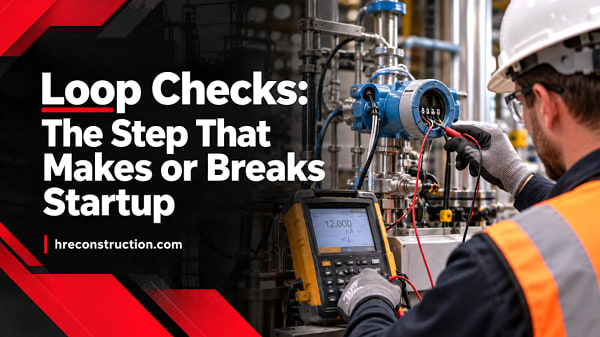 Loop Checks: The Step That Makes or Breaks Startup
October 1, 2026
A loop check proves every instrument signal reaches your control system correctly. Learn how cold and hot loop checks prevent...
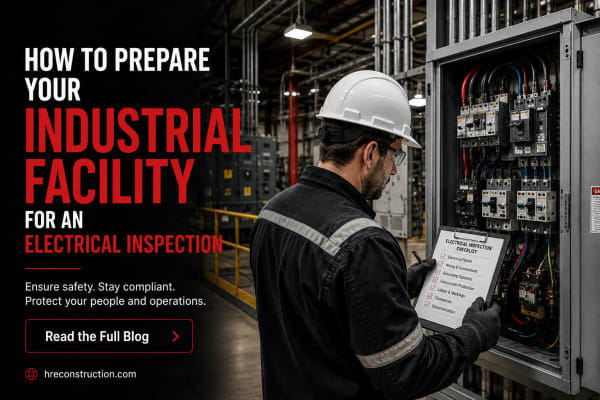 How to Prepare Your Industrial Facility for an Electrical Inspection
May 18, 2026
Getting ready for an electrical inspection? This guide covers what inspectors look for in industrial facilities and the simple...