HRE Construction / Industrial Electrical
Single-Line Diagrams: Why Yours Must Stay Current
November 6, 2026 · 7 min read · By HRE Construction
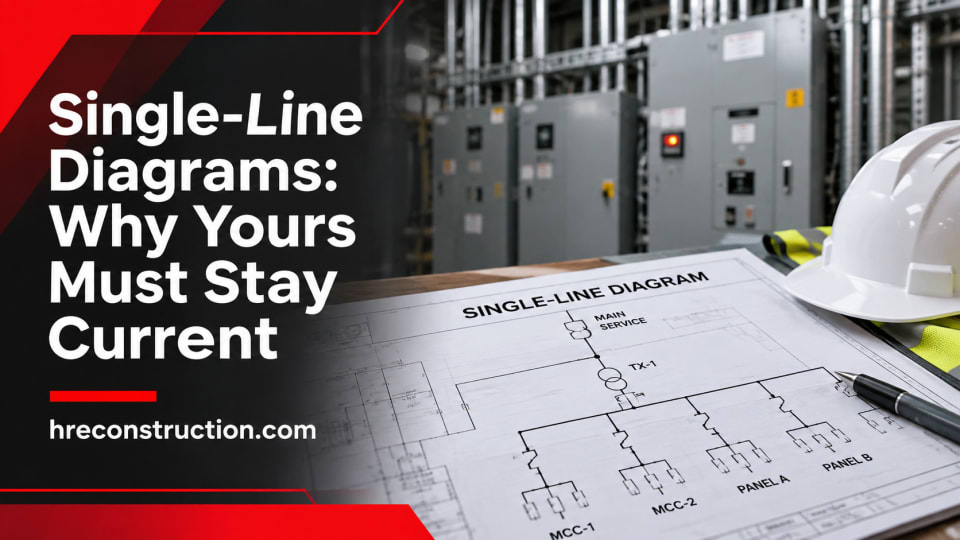
Every industrial facility has a single-line diagram somewhere. The question is whether it still matches what's in the building. In a lot of plants, the one-line on file was drawn for the original construction and has been marked up by hand a few times since, or not at all. Meanwhile, transformers were swapped, MCCs were added, a generator went in and three production lines were rearranged.
That gap matters more than it looks. The single-line diagram is the map everything else is built on: arc flash labels, short-circuit and coordination studies, lockout procedures and upgrade designs. When the map is wrong, every one of those can be wrong too.
What a Single-Line Diagram Is
A single-line diagram, also called a one-line diagram, is a simplified drawing of how power flows through your facility, from the utility service down to the major loads. Instead of drawing all three phases, it uses one line for each circuit and standard symbols for the equipment along the way.
It isn't a wiring diagram and it doesn't show where equipment sits in the building. Its job is to show how everything is connected and how it's rated, so anyone working on the system can see where power comes from, what protects each circuit, and what's downstream.
What the Codes and Standards Expect
NFPA 70E requires that a single-line diagram, where one is provided for the electrical system, be kept legible and current. That language is short, but it means an out-of-date diagram is a gap in your electrical safety program, not just a paperwork issue.
NFPA 70B, which became a mandatory standard in 2023, gives single-line diagrams and system studies their own chapter. Under 70B, the single-line diagram is expected to be accurate and legible, and it serves as the basis for the short-circuit, coordination and arc flash studies that come after it. Industry guidance on 70B compliance generally calls for reviewing diagrams and studies that are more than five years old.
The NEC also leans on the information a good single-line holds. Service equipment has to be field marked with the available fault current and the date it was calculated, and motor control centers need that fault current documented too. You can't keep those numbers right if you don't know how the system is built today.
Why an Outdated Diagram Is a Safety Problem
Arc flash labels can be wrong
An arc flash study is only as accurate as the system model behind it, and that model comes from the single-line diagram. If a transformer was replaced with one of different impedance, or a breaker's trip settings changed, the incident energy at downstream equipment may no longer match the label on the door. Our guide on what arc flash is and how to prevent it explains why those numbers drive PPE selection.
Lockouts can miss a source
Before anyone works on equipment, they need to know every source that can energize it. Generators, UPS systems, solar arrays, battery storage, tie breakers and second feeds can all backfeed equipment that looks isolated. A current single-line diagram shows those paths. An old one may not show them at all.
Equipment can be underrated for today's fault current
When the available fault current goes up, equipment that was properly rated years ago can end up applied above its rating. Control panels, MCCs and breakers all have limits. Our posts on SCCR for industrial control panels and MCC retrofit vs. replacement explain why those ratings matter. Catching the problem starts with knowing what's actually connected.
Troubleshooting takes longer
When a feeder trips at 2 a.m., the maintenance team needs to know what it feeds and what's upstream of it. A diagram that matches the field saves time during an outage. One that doesn't can send people to the wrong panel.
What Your Single-Line Diagram Should Show
A useful industrial single-line goes well beyond boxes and lines. At a minimum it should include:
- Utility service: service voltage and the point of connection
- Transformers: kVA rating, primary and secondary voltage, impedance, winding connection and grounding method
- Switchgear, switchboards and panelboards: bus ratings and equipment names that match the labels in the field
- Protective devices: breaker and fuse ratings, plus trip unit and relay settings
- Conductors: size, type and approximate length for feeders
- Motor control centers and large motors, including VFDs
- Alternate sources: generators, transfer switches, UPS systems, solar and battery storage
- Key equipment ratings: short-circuit ratings where they matter, and the available fault current at major buses
The names on the drawing should match the names on the equipment. If the diagram says "MCC-2" and the door says "Line 4 Starters", someone will eventually make a mistake.
Signs Your Diagram Is Out of Date
- It hasn't been reviewed in more than five years
- Equipment has been added, removed or replaced since it was last revised
- Breaker trip settings were changed during troubleshooting and never recorded
- A generator, UPS, solar array or second service was added
- Equipment labels in the field don't match the names on the drawing
- The only copy is a paper print with handwritten markups
- Your arc flash study is due for review, or nobody knows when it was done
If two or more of those sound familiar, it's time for an update.
How to Bring It Up to Date
1. Start with what you have. Gather the existing single-line, as-built drawings, past studies, recent project drawings and equipment lists. Even an old diagram is a useful starting point.
2. Walk down the system. Qualified electrical workers verify the actual equipment in the field: nameplate data, protective device ratings and settings, conductor sizes and how everything is connected. This work involves opening energized equipment, so it has to follow your electrical safety program and NFPA 70E work practices. Photos of nameplates and trip units save a lot of guesswork later.
3. Redraw and standardize names. Update the drawing in a CAD or modeling format, and make sure every piece of equipment has one name that matches its field label.
4. Update the studies. With an accurate diagram, the short-circuit, coordination and arc flash studies can be rerun on solid data, and labels can be replaced where the numbers changed.
5. Put it where people need it. Keep the current version where maintenance teams can reach it, including in electrical rooms, and make sure old copies are removed so nobody works from the wrong one.
6. Build in a change process. Every project that touches the electrical system should end with a diagram update. That's the step most facilities skip, and it's why diagrams drift out of date in the first place.
Planned outages are a good time for the parts of the walkdown that are easier with equipment de-energized. Our guide to holiday shutdown electrical maintenance covers how to plan that window, and our post on insulation resistance testing covers testing you can schedule at the same time.
How HRE Can Help
HRE Construction works with industrial facilities to document electrical systems as they're actually built and keep that documentation current. Our team can help you:
- Field verify switchgear, transformers, panels, MCCs and protective devices
- Update or redraw your single-line diagram with names that match your equipment labels
- Identify alternate sources and backfeed paths for safer lockouts
- Flag equipment that may be underrated for today's available fault current
- Coordinate field data for short-circuit, coordination and arc flash study updates
- Update drawings as part of every project we complete in your facility
Whether your diagram needs a few corrections or a full rebuild, HRE Construction can help you get a drawing your team can trust.
Frequently Asked Questions
What is the difference between a single-line diagram and a one-line diagram?
They're the same thing. Both names describe a simplified drawing that shows how power flows through an electrical system using a single line for each circuit.
Does NFPA 70E require a single-line diagram?
NFPA 70E requires that a single-line diagram, where one is provided, be kept legible and current. NFPA 70B goes further by making accurate single-line diagrams the basis for system studies in an electrical maintenance program.
How often should a single-line diagram be updated?
Every time the electrical system changes, and at least reviewed every five years along with the studies that depend on it. In an active plant, that usually means updates every time a project touches the distribution system.
Can we update the diagram without a shutdown?
Much of the field verification can be done with equipment energized by qualified workers following NFPA 70E practices. Some details, like inspecting inside certain gear, are easier and safer during a planned outage.
Ready to Update Your Single-Line Diagram?
If your single-line diagram hasn't kept up with your facility, the time to fix it is before the next arc flash review, upgrade or emergency. Contact our team or request a quote, and we'll help you build a diagram that matches what's really in your building.
Related Services
Related Posts
 Electrical Safety Compliance Checklist for Industrial Facilities
August 3, 2026
A practical electrical safety compliance checklist for industrial facilities covering NFPA 70E, arc flash labeling,...
- Signs Your Electrical System Needs Upgrade
March 9, 2026
In today’s rapidly evolving industrial landscape, keeping your electrical system updated is more than a maintenance task—it’s a...
 What Is Arc Flash? Causes, Dangers, and Prevention
April 21, 2026
An arc flash can reach 35,000°F in a fraction of a second. Learn what causes arc flash, how its severity is measured, and how...