Insulation Resistance Testing: What Megger Readings Reveal
September 7, 2026 | Samantha Mariano
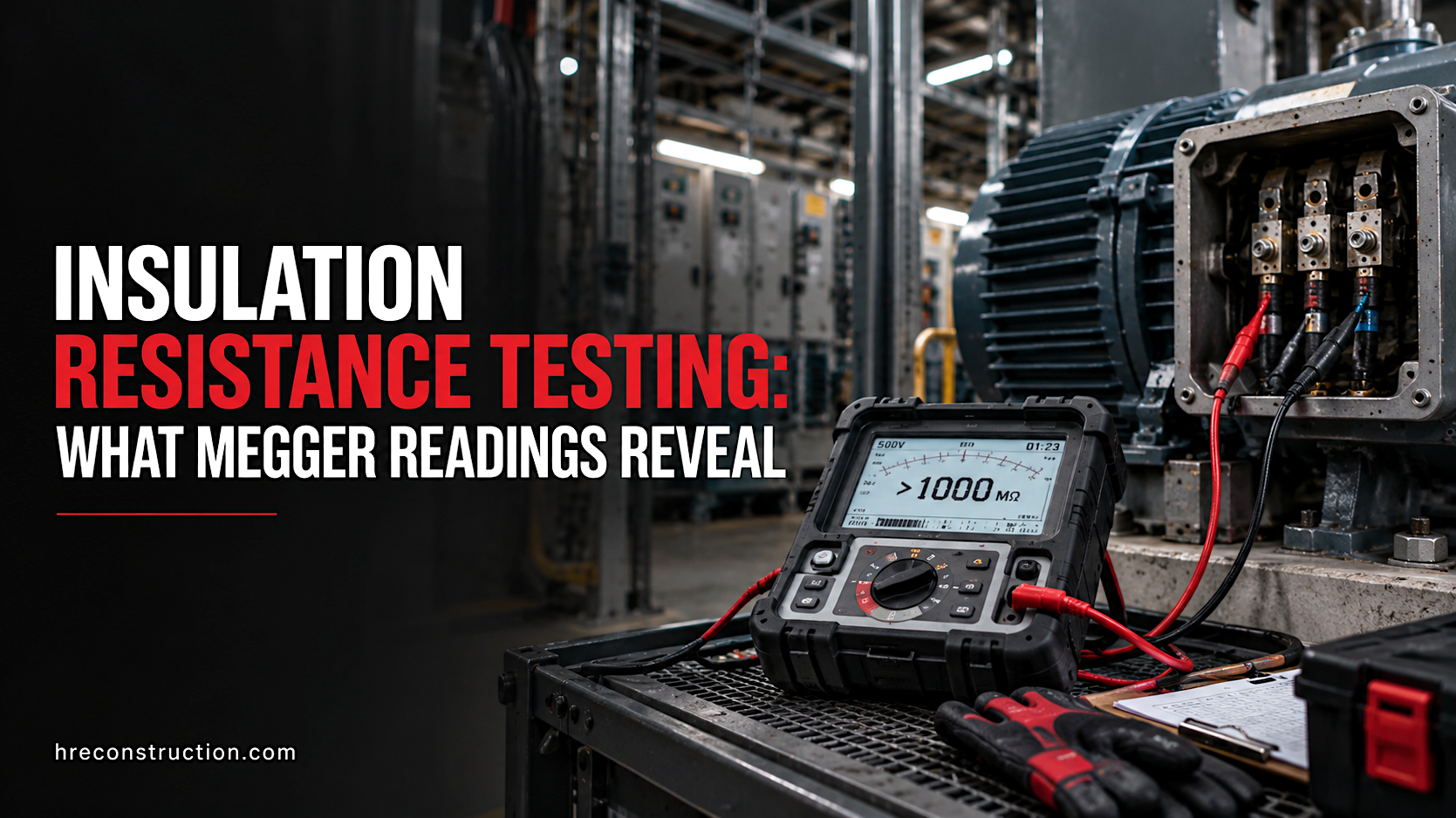
Most facility managers have heard the term "Megger test" without ever seeing what the technician is actually looking for. It sounds like a simple pass or fail number, but insulation resistance testing is really about tracking a trend over time. A single reading tells you where a motor, cable, or switchgear assembly stands today. A history of readings tells you where it's headed.
For industrial facilities running motors, switchgear, and cable runs around the clock, that trend line is often the earliest warning a winding or conductor is starting to break down, well before it shows up as a tripped breaker or a failed start.
What Insulation Resistance Testing Actually Measures
A megohmmeter, commonly called a Megger after the trade name, applies a DC test voltage between a conductor and ground and measures how much current leaks through the insulation. Good insulation resists that current almost completely, so the reading comes back high. Insulation that has absorbed moisture, picked up contamination, or degraded thermally lets more current through, so the reading comes back lower.
The test applies to more than motors. Switchgear, cables, circuit breakers, and control wiring all get insulation resistance tested as part of a standard acceptance or maintenance testing program, following guidance in ANSI/NETA MTS for non-rotating equipment. Rotating machinery, meaning motors and generators, has its own dedicated standard: IEEE 43.
Reading the Numbers
IEEE 43 gives a widely used rule of thumb for rotating machinery insulation: minimum acceptable resistance is roughly 1 megohm per kV of rated voltage, plus 1 megohm, measured at one minute and corrected to 40°C. A 460V motor, for example, should generally read above roughly 2.5 megohms. Low-voltage random-wound stators and form-wound coils rated below 1 kV carry their own minimum around 5 megohms. These are floor values, not targets. A healthy winding on a well-maintained machine typically reads far higher.
A single low reading matters less than a reading that's dropping over successive tests. That's why insulation resistance testing works best as a recurring program with results logged and compared year over year, not a one-time checkbox.
Polarization Index: The Test Within the Test
A single insulation resistance reading only shows one moment in time, which is part of why IEEE 43 also relies on the polarization index, or PI. PI compares the 10-minute reading to the 1-minute reading during the same test. In insulation with good dielectric strength, resistance keeps climbing as polarization current settles out, so the ratio comes out well above 1. A PI at or above roughly 2.0 is generally considered a sign of healthy insulation for most insulation classes, while a PI below that can point to surface contamination or moisture even when the absolute resistance number still looks acceptable on its own.
PI has limits too. IEEE 43 notes that once the one-minute reading itself is very high, the ratio can become unreliable, since the leakage currents involved get small enough that humidity and test lead conditions start to dominate the result rather than the insulation itself. That's part of why this kind of testing needs to be interpreted by someone who understands the standard, not just read off a display.
When a Megger Test Signals Real Trouble
A few patterns tend to matter more than any single number:
- A steady downward trend across repeated tests on the same equipment, even if each individual reading is technically still above the minimum.
- A low PI paired with a low absolute reading, which often points to insulation that's degraded beyond what drying alone will fix.
- A sudden drop from historical baseline after a moisture event, a flood, or extended downtime, which can indicate contamination that needs to be addressed before the equipment is re-energized at full load.
Any of these are reasons to dig further, whether that means additional testing, drying and retesting, or planning a replacement before the equipment fails in service.
Where This Fits Into a Maintenance Program
Insulation resistance testing is one piece of a structured electrical preventive maintenance program, alongside thermal imaging, switchgear inspections, and load analysis. It pairs especially well with predictive maintenance approaches, since trending IR and PI data over time is exactly the kind of condition data that turns a maintenance program from reactive to predictive. For facilities running motor control centers, insulation testing on the motors and feeders they control is a standard part of keeping that equipment reliable.
How HRE Can Help
HRE Construction performs insulation resistance and polarization index testing on motors, switchgear, cable, and control wiring as part of our testing and startup services across our 11-state service area. We test to IEEE 43 and ANSI/NETA MTS guidelines, document results against historical baselines, and flag equipment that's trending toward trouble before it causes an unplanned outage.
If it's been a while since your motors and switchgear had insulation resistance testing, or you've never established a trending baseline, contact HRE Construction to schedule an assessment for your facility.
FAQ
How often should insulation resistance testing be done on industrial motors?
It depends on the criticality of the equipment and the environment it runs in, but most industrial preventive maintenance programs test critical motors annually at minimum, with more frequent testing for motors in wet, dusty, or high-vibration environments.
Is a low insulation resistance reading always a sign of failure?
Not necessarily. A single low reading can sometimes be caused by surface contamination or moisture that clears up after cleaning and drying. The polarization index helps distinguish a surface issue from deeper insulation degradation.
What's the difference between insulation resistance testing and a hipot test?
Insulation resistance testing applies a lower DC voltage and is generally non-destructive, meant to be run repeatedly as a condition check. A hipot (high potential) test applies a higher stress voltage specifically to confirm dielectric withstand, and carries more risk to already-weakened insulation, so it's typically reserved for acceptance testing or when IR and PI results suggest further investigation is warranted.
Can insulation resistance testing be done while equipment is energized?
No. The equipment must be de-energized, isolated, and properly grounded before testing, both for the safety of the technician and to get an accurate reading.