Predictive Maintenance for Industrial Electrical Systems
August 24, 2026 | Samantha Mariano
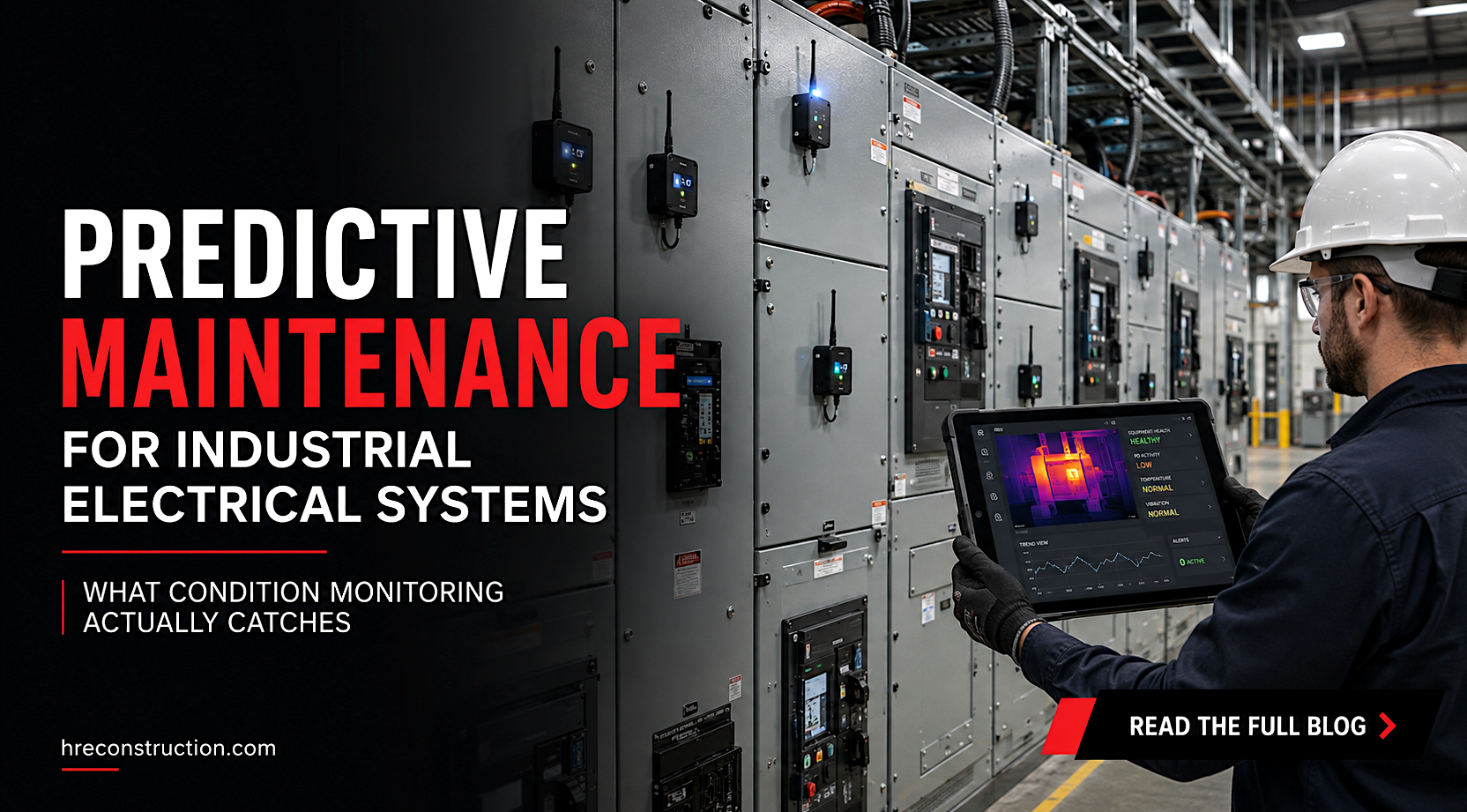
Predictive Maintenance for Industrial Electrical Systems: What Condition Monitoring Actually Catches
Most industrial facilities run some version of a preventive maintenance program: inspect the switchgear every year, test the transformer oil on a schedule, torque the connections at set intervals. That approach works, and it is still the foundation of a sound electrical maintenance strategy. But it has a blind spot. A piece of equipment can pass its scheduled inspection in January and fail in March, because time-based maintenance checks equipment on a calendar, not on its actual condition.
Predictive maintenance closes that gap. Instead of relying only on fixed intervals, it uses continuous or periodic sensor data (vibration, temperature, insulation resistance, dissolved gas levels, partial discharge activity) to track how equipment is actually performing and flag it before a fault develops. It is one of the fastest-growing priorities in industrial electrical maintenance heading into 2026, driven by cheaper sensors, more capable monitoring software, and facility managers who are tired of unplanned downtime eating into production schedules.
This isn't a replacement for the preventive maintenance work we've written about before. It's a layer on top of it. Here's how the two fit together, what condition monitoring can actually detect, and where it makes sense for an industrial facility to start.
Preventive vs. Predictive: What's the Actual Difference
Preventive maintenance is time-based or usage-based. You service or inspect equipment on a set schedule, whether it needs it or not, based on manufacturer recommendations and standards like IEEE 3007.2, the recommended practice for maintaining industrial and commercial power systems. It's predictable, budgetable, and it catches a lot of problems before they become failures.
Predictive maintenance is condition-based. Sensors and diagnostic tools track the real-time health of equipment, and maintenance gets scheduled when the data shows early signs of degradation, not before and not after. The goal isn't to replace scheduled inspections. It's to catch the failures that happen between them, and to avoid unnecessary maintenance on equipment that's still running fine.
Both approaches show up in the same standards world. Organizations like IEEE and ISO publish guidance on both, including ISO 13374 for how condition monitoring data should be processed and presented, and ISO 13381 for using that data to predict how much useful life equipment has left.
What Condition Monitoring Actually Detects
Predictive maintenance isn't one technology. It's a set of monitoring methods, and different methods catch different failure modes.
Vibration analysis. Motors, pumps, and other rotating equipment develop characteristic vibration signatures as bearings wear, shafts misalign, or components loosen. Vibration sensors pick up those changes long before the equipment shows any visible or audible sign of trouble.
Thermal and infrared monitoring. Loose connections, overloaded circuits, and failing components generate heat before they fail outright. We've covered infrared inspection in more detail elsewhere, but it's worth noting here: infrared surveys can be done periodically as a standalone service, or built into a continuous monitoring program with fixed thermal sensors on critical equipment.
Dissolved gas analysis (DGA). For oil-filled transformers, insulating oil breaks down in specific, identifiable ways depending on the type of internal fault developing, whether that's overheating, arcing, or partial discharge. Periodic oil sampling and gas analysis, interpreted against guides like IEEE C57.104, can flag an internal transformer problem well before it shows up anywhere else. This is a natural extension of the transformer maintenance work most facilities already do.
Insulation resistance and partial discharge monitoring. Insulation degrades over time from heat, moisture, and electrical stress. Trending insulation resistance readings and, on higher-voltage equipment, monitoring for partial discharge activity gives an early warning before an insulation failure takes down a circuit or a piece of switchgear.
Power quality and current monitoring. Continuous monitoring of voltage, current, and harmonic content can catch developing problems in motors, drives, and distribution equipment that wouldn't show up during a snapshot inspection.
None of these methods are new on their own. What's changed is how affordable and connected the sensors have become, and how much easier it is to pull that data into a dashboard that actually flags what needs attention instead of burying it in a spreadsheet nobody checks.
Where Predictive Maintenance Makes the Most Sense
Not every piece of electrical equipment needs continuous condition monitoring, and trying to instrument everything at once is usually a waste of budget. Predictive maintenance delivers the most value on equipment where:
- Failure is expensive. Equipment tied directly to production uptime, where an unplanned outage costs real money in lost output, is the clearest candidate.
- Failure is dangerous. Switchgear, medium-voltage equipment, and anything with significant arc flash energy benefits from early warning, since a predictive alert means maintenance can happen on a planned outage instead of during an emergency repair.
- Replacement lead times are long. With transformer and switchgear lead times stretching well beyond a year in the current supply environment, catching a developing fault early gives a facility time to plan a replacement instead of scrambling after a failure.
- The equipment is hard to inspect on a normal schedule. Equipment in hard-to-access locations, or equipment that can't be taken offline often for testing, benefits from sensors that monitor continuously without requiring a shutdown.
A realistic starting point for most industrial facilities is a short list: the transformers and switchgear that feed critical loads, the motors on production-critical equipment, and any equipment with a known history of problems. Expanding the monitoring program from there, based on what the data actually shows, tends to work better than trying to instrument the entire facility on day one.
How HRE Can Help
HRE Construction works with industrial and manufacturing facilities to build electrical maintenance programs that combine scheduled preventive work with targeted predictive monitoring where it makes the most sense. That includes infrared surveys, switchgear and transformer testing, and helping facility managers figure out which equipment actually justifies the investment in continuous condition monitoring versus which equipment is well served by a solid preventive schedule. We're licensed to work across South Carolina, North Carolina, Georgia, Ohio, West Virginia, Texas, Kentucky, Arkansas, Arizona, Louisiana, and Mississippi.
Ready to talk through a maintenance strategy for your facility? Contact HRE Construction to get started.
FAQ
Does predictive maintenance replace preventive maintenance?
No. Predictive maintenance adds condition-based monitoring on top of a preventive maintenance schedule. Most industrial facilities still need scheduled inspections and testing; predictive monitoring fills the gaps between them and helps catch failures that develop faster than the inspection schedule can account for.
What's the difference between predictive and preventive maintenance in terms of cost?
Preventive maintenance has predictable, scheduled costs. Predictive maintenance requires an upfront investment in sensors and monitoring, but it can reduce unnecessary maintenance on equipment that's still healthy and reduce the cost of emergency repairs and unplanned downtime.
Do I need predictive maintenance for every piece of electrical equipment in my facility?
Not usually. It makes the most sense on equipment where failure is expensive, dangerous, or hard to inspect on a normal schedule, such as critical transformers, switchgear, and production-critical motors. A facility-wide rollout on day one is rarely the most efficient approach.
How does dissolved gas analysis work for transformers?
Transformer insulating oil breaks down in specific, identifiable ways depending on the type of fault developing inside the transformer, such as overheating or arcing. Periodic oil sampling and lab analysis of the dissolved gases, interpreted against standards like IEEE C57.104, can flag a developing internal fault before it causes an outage.
Is predictive maintenance only for large facilities?
No, but the scale of the program should match the facility. A smaller facility might start with periodic infrared surveys and vibration checks on a handful of critical assets rather than a full continuous monitoring system, and expand from there if the results justify it.