Medium Voltage Cable Testing: VLF, Tan Delta, and PD
October 21, 2026 | Samantha Mariano
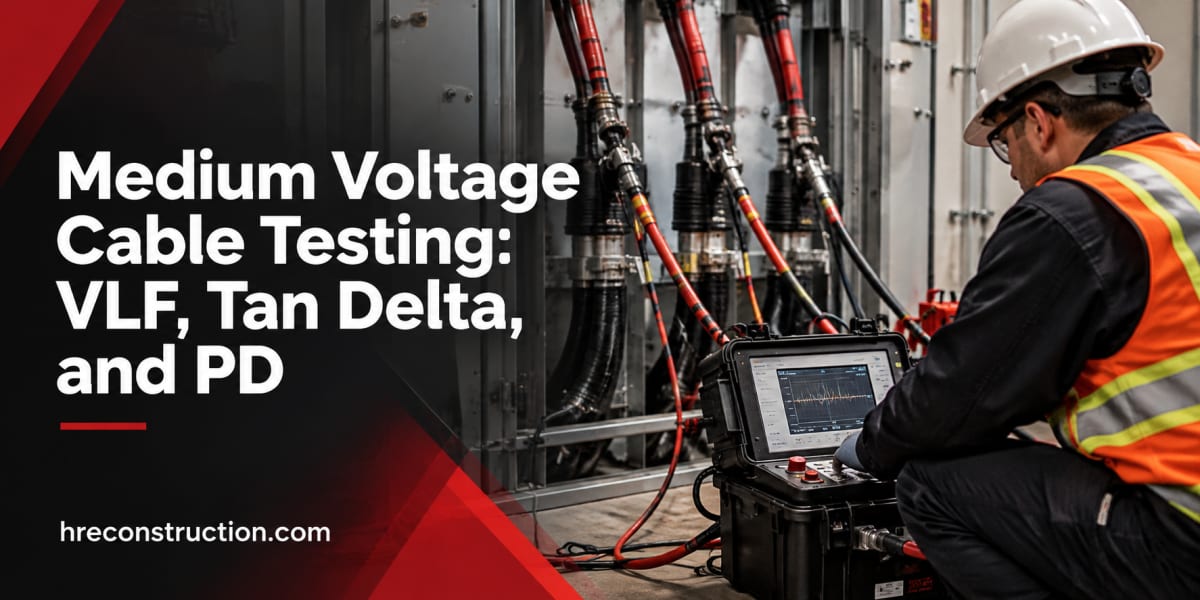
Medium voltage cable is one of the easiest parts of a plant's electrical system to forget about. It runs underground, through duct banks, or up in tray, and it does its job quietly for years. Then one day a feeder faults, a section of the plant goes dark, and the repair crew finds a failed splice that nobody had looked at since it was installed.
The good news is that most cable problems give some warning first, if you test for them. The right test can tell you whether a new cable was installed correctly, whether an aged cable is wearing out evenly, and where a weak spot is hiding before it turns into a fault.
This guide covers the three tests used most often on shielded medium voltage cable today: the VLF withstand test, tan delta, and partial discharge. It explains what each one actually tells you and when each one makes sense.
Why Medium Voltage Cable Fails
Shielded medium voltage cable (5 kV to 35 kV in most industrial plants) is built to keep electrical stress spread evenly through the insulation. Problems start when something disturbs that balance.
The most common causes include:
- Moisture and water trees. Polymer insulation such as XLPE can develop microscopic water-filled channels over years of service, especially in wet duct banks. Water trees don't fail the cable right away, but they weaken the insulation and can eventually convert into electrical trees that do.
- Workmanship at splices and terminations. These are assembled by hand in the field. A nicked insulation surface, a ragged semiconductor cutback, or contamination during installation concentrates electrical stress in a small area. Industry testing data consistently shows terminations and splices are where a large share of medium voltage cable failures start, rather than the middle of the cable run.
- Installation damage. Pulling tension, tight bends, or crushing during backfill can damage insulation or the metallic shield before the cable is ever energized.
- Heat and age. Cables run near their ampacity limit for years age faster. Older paper-insulated lead-covered (PILC) cable is still in service at some facilities and has its own failure patterns.
None of these show up on a visual inspection. That's why cable testing exists.
Why DC Hipot Testing Fell Out of Favor
For decades, the standard field test for medium voltage cable was a DC high potential (hipot) test. Many facilities still have old specifications that call for it.
The problem is what DC does to aged extruded insulation. Research on XLPE cable found that DC hipot testing of field-aged cable can shorten its remaining life and accelerate water tree growth. DC voltage causes charge to build up inside the insulation, and when the cable goes back on AC service, that trapped charge adds to the normal stress around existing defects.
DC testing on brand new cable before it is energized has not been shown to reduce its life, so it still appears as an acceptance option in some standards. For maintenance testing of aged cable, though, the industry has largely moved on. The 2023 edition of ANSI/NETA MTS, the maintenance testing standard used across the industry, rewrote its medium voltage cable section to steer users toward VLF withstand testing.
The Test Before the Test: Insulation Resistance and Shield Continuity
Before any high voltage test, a cable gets basic checks. ANSI/NETA acceptance testing includes an insulation resistance test on each conductor and a shield continuity test on each cable.
An insulation resistance (megger) test is a quick screen. If a cable fails it badly, there is no reason to put a VLF set on it. But for shielded medium voltage cable, the reading depends heavily on cable length, temperature, and insulation type, so it isn't a reliable pass or fail number by itself. NETA's 2023 update made that point directly: use insulation resistance as a pre-test, not as the final verdict on the cable. We covered how to read those numbers in our post on insulation resistance testing and what megger readings reveal.
VLF Withstand Testing
A very low frequency (VLF) withstand test applies an AC voltage to the cable at a much slower frequency than normal power, usually 0.1 Hz instead of 60 Hz. Cable acts like a large capacitor, and testing it at 60 Hz takes a huge, heavy power source. At 0.1 Hz, the test set needs roughly 600 times less power, so a portable unit can test long cable runs in the field.
The test raises the voltage above normal operating level and holds it for a set time. The guide most crews follow is IEEE 400.2, the IEEE guide for field testing shielded power cable systems with VLF voltage. It lists test voltages for new installations, acceptance tests, and maintenance tests, generally in the range of 1.5 to 3 times the cable's normal phase-to-ground voltage.
As an example, for a 15 kV class cable tested with a sinusoidal VLF waveform, the IEEE 400.2-2013 table lists:
| Test Type | When It's Used | 15 kV Cable Test Voltage (phase to ground) |
|---|---|---|
| Installation | After the cable is pulled, before splices and terminations | 27 kV peak |
| Acceptance | After the full system is installed, before service | 30 kV peak |
| Maintenance | On cable that has been in service | 22 kV peak |
The guide recommends a minimum of 30 minutes for a simple withstand test on aged cable and 60 minutes for an acceptance test on new cable at 0.1 Hz.
What a Withstand Test Tells You
A withstand test is pass or fail. If a weak spot exists, the elevated voltage is meant to push it to failure during the test, under controlled conditions, rather than during production. Studies from the Cable Diagnostic Focused Initiative found on-test failure rates in the range of 0.2 to 4 percent for 30-minute tests at IEEE 400.2 levels, and that VLF testing at those levels does not damage good insulation.
That is the tradeoff to understand. If a cable fails a VLF test, it was going to fail anyway, and now it failed on your schedule with a crew already on site. Plan for that possibility by having repair materials and a splicer lined up before testing critical feeders.
What a simple withstand test doesn't tell you is how close a passing cable came to failing. That's where diagnostic tests come in./
Tan Delta Testing
Tan delta, also called dissipation factor, looks at the overall health of the insulation instead of just whether it survives. Perfect insulation behaves like a pure capacitor. As insulation ages or absorbs moisture, it starts losing a small amount of energy as heat. Tan delta measures the ratio of that resistive current to the capacitive current.
The test is usually run with the same VLF source, stepping through several voltage levels. IEEE 400.2 looks at three things:
- Mean tan delta at the cable's operating voltage. Higher values point to more widespread aging.
- Tip-up, the change in tan delta as the voltage rises. Good insulation stays flat. A large increase suggests water trees or other distributed damage.
- Stability, how much the readings vary at a single voltage. Unstable readings can point to moisture or active defects.
Results are sorted into three categories: no action required, further study advised, or action required. The limits differ by insulation type, so XLPE, EPR, and PILC cables are each judged against their own criteria.
Tan delta is especially useful for deciding which aged feeders to replace first. It measures the whole cable as one system, though, so a bad reading tells you the cable is in trouble but not exactly where.
Partial Discharge Testing
Partial discharge (PD) is a small electrical spark inside a void, crack, or contaminated surface in the insulation. It doesn't bridge the full insulation, which is why it is called partial, but each discharge erodes a little more material. Over time, PD at a defect grows into a full failure.
PD testing detects those discharges and, more importantly, can locate them along the cable. That makes it the best tool for finding a single bad splice or termination. IEEE 400.3 covers PD testing of installed shielded cable systems, including the cable, joints, and terminations.
There are two ways to do it:
- Offline PD testing takes the cable out of service and uses an external source, often VLF, to raise the voltage. Higher voltage can make defects discharge that stay quiet at normal voltage.
- Online PD testing uses sensors on an energized cable at its normal operating voltage. It doesn't require a shutdown, which makes it practical for screening critical circuits, but it can miss defects that only discharge at higher voltage.
Combining Tests
These tests answer different questions, so they work best together. A common approach is a monitored withstand test: run the VLF withstand while measuring tan delta or PD at the same time. You get the pass or fail result plus information about how the cable behaved under stress.
| Test | What It Answers | Locates the Problem? | Best Use |
|---|---|---|---|
| Insulation resistance | Is there a gross insulation problem? | No | Quick pre-test before high voltage testing |
| VLF withstand | Can the cable survive elevated voltage? | No (pass or fail) | Acceptance testing and proving repairs |
| Tan delta | How healthy is the insulation overall? | No | Ranking aged cables for replacement |
| Partial discharge | Are there local defects, and where? | Yes | Finding bad splices and terminations |
When Should You Test Medium Voltage Cable?
There is no single schedule that fits every plant, but these are the moments testing pays off most:
- After new installation, before energizing. Acceptance testing catches installation damage and termination mistakes while the contractor is still on the hook. It is a standard part of electrical commissioning.
- After a splice repair or fault. A failed cable often has other weak spots nearby, and new splices need the same proof as new cable.
- On aging feeders. Cable that has been in service for decades, especially in wet locations, is a good candidate for tan delta and PD trending.
- Before returning idle circuits to service. Feeders that sat de-energized through a shutdown, flood, or long outage deserve a check before they carry load again.
- As part of your maintenance program. Under the 2023 edition of NFPA 70B, electrical maintenance is now a standard rather than a recommended practice. Cable testing belongs in that program. Our post on NFPA 70B becoming mandatory explains what changed.
Trending matters as much as any single result. A cable whose tan delta creeps up a little each test cycle is telling you something, even if it hasn't crossed a limit yet. That same idea drives predictive maintenance for industrial electrical systems.
Planning a Cable Test
A few practical points help testing go smoothly:
- Plan the outage. VLF, tan delta, and offline PD tests require the cable to be de-energized, locked out, and usually disconnected from the transformer or switchgear at each end.
- Know your cable. Insulation type, voltage class, age, length, and any known splice locations all affect test voltage and how results are judged.
- Decide what you'll do with the results. Have a plan for a failed withstand test or an "action required" tan delta result before the test starts, especially on feeders that serve critical loads.
- Keep the records. Baseline results from acceptance testing make every future maintenance test more useful.
If your facility is also dealing with older switchgear, transformers, or distribution equipment, cable testing fits naturally alongside switchgear maintenance and testing and a broader look at aging electrical infrastructure.
How HRE Can Help
HRE Construction's testing and commissioning team performs VLF cable testing as part of our electrical testing and startup services for industrial facilities. We help plants:
- Perform acceptance testing on new medium voltage cable installations before energization
- Test cables after splice repairs, faults, or long outages
- Plan cable testing around production schedules and shutdowns
- Document results so they can be trended over future maintenance cycles
- Coordinate cable testing with switchgear, transformer, and protective device testing during the same outage
Our crews work in manufacturing plants, processing facilities, and water treatment operations, where an unplanned feeder failure can stop production for days. We focus on giving you clear results and a practical next step, not just a test report.
Frequently Asked Questions
What is VLF cable testing?
VLF (very low frequency) testing applies AC voltage to medium voltage cable at a slow frequency, usually 0.1 Hz, instead of 60 Hz. The lower frequency lets a portable test set reach the elevated voltages needed to stress long cable runs. It is used for withstand testing and as the voltage source for tan delta and offline partial discharge testing.
Is VLF testing destructive?
VLF testing at IEEE 400.2 levels is not designed to damage healthy insulation. Its purpose is to push existing defects to fail during the test rather than in service. A cable that fails a VLF test already had a weakness that was likely to cause a fault later.
What is the difference between tan delta and partial discharge testing?
Tan delta measures the overall condition of the insulation along the whole cable and is good at finding widespread aging such as water trees. Partial discharge testing looks for local defects, such as a bad splice or termination, and can usually locate where the problem is along the cable.
Can I still use a DC hipot test on medium voltage cable?
DC hipot testing on new cable before energization has not been shown to reduce cable life, and some acceptance standards still allow it. For field-aged XLPE cable, research has linked DC hipot testing to shortened cable life, which is why current maintenance standards favor VLF testing for cable that has been in service.
Find Cable Problems Before They Find You
A medium voltage cable failure rarely happens at a convenient time. Testing gives you the chance to find weak splices, aging insulation, and installation damage while you still control the schedule.
If you have new cable going in, feeders that haven't been tested in years, or a planned shutdown coming up, HRE Construction can help you build a cable testing plan that fits your facility. Call us at (803) 262-2615 or request a quote to get started.