HRE Construction / Industrial Electrical
Holiday Shutdown Electrical Maintenance: What to Plan Now
October 30, 2026 · 7 min read · By HRE Construction
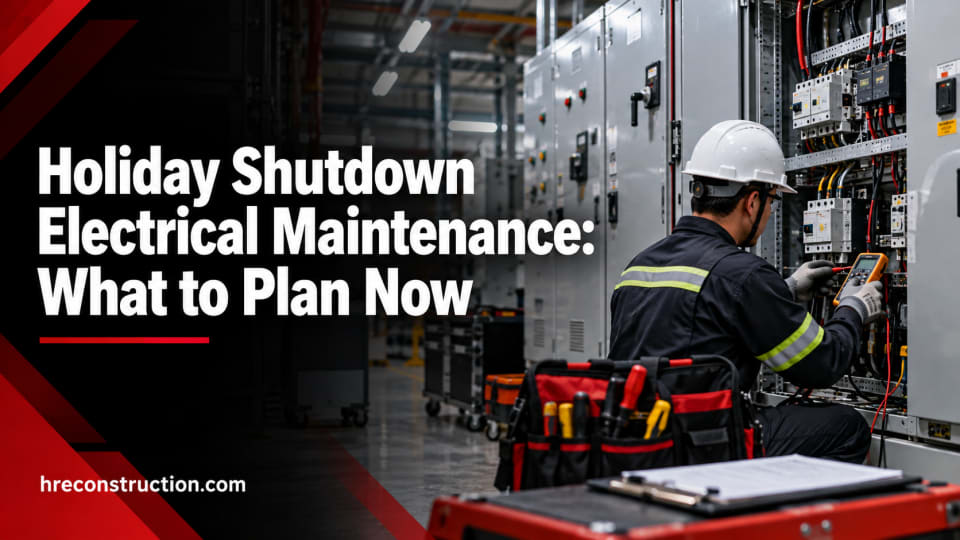
For a lot of plants, the stretch between Thanksgiving and New Year's is the only time all year when production slows down enough to turn the power off. That makes the holiday shutdown the best outage you'll get for electrical work that can't be done hot: tightening and cleaning switchgear, testing breakers, repairing problems you've been nursing along since spring.
The catch is that a good shutdown is mostly decided before it starts. If the scope, crews and parts aren't lined up by mid-November, the window closes with half the list undone. Here's what to plan now, what to do during the outage, and how to bring everything back up safely.
Why the Holiday Shutdown Matters for Electrical Work
Plenty of electrical maintenance can only be done with the equipment de-energized. Cleaning and inspecting the inside of switchgear, torquing bus and cable connections, exercising and testing circuit breakers, and repairing anything that failed an inspection all need an outage.
Since NFPA 70B became a standard in 2023, those tasks are no longer just good practice. The standard requires an electrical maintenance program, a condition assessment of each piece of equipment, and maintenance intervals based on that condition. Equipment in poor condition needs attention far more often than equipment in good shape, and the work has to be documented. If you haven't read up on the change yet, our post on NFPA 70B becoming mandatory covers the basics.
For many facilities, the holiday shutdown is the realistic time to catch up on the de-energized portion of that program.
Before the Shutdown: What to Do in November
1. Scan everything while it's still running
Infrared thermography has to be done while equipment is energized and carrying load. A loose connection or overloaded breaker only shows up as a hot spot when current is flowing. That's why the scan belongs before the shutdown, not during it.
Scan your switchgear, MCCs, panels, transformers and disconnects in the weeks before the outage, under normal production load. Every hot spot you find becomes a repair item for the shutdown, with the parts ordered ahead of time. NFPA 70B calls for infrared inspection at least every 12 months, and more often for equipment in poor condition, so a pre-shutdown scan can count toward that requirement too. Our post on infrared electrical inspections explains what a scan can and can't tell you.
2. Build the scope from what you already know
Pull together:
- Findings from the infrared scan
- Open work orders and equipment that has tripped, run hot or been reset more than once
- Overdue items from your maintenance program
- Any changes planned for next year: new equipment, panel upgrades, added load
Rank the list by risk and by what can only be done de-energized. Anything that can be done hot or on a normal weekend shouldn't take up shutdown hours.
3. Order parts and book crews early
Breakers, contactors, fuses, cable and replacement components can take longer to arrive than people expect, and some larger electrical equipment has lead times measured in months. Our post on transformer and switchgear lead times explains why.
Electrical contractors and testing firms also fill up their holiday calendars fast, because every plant wants the same few weeks. Locking in crews in November is one of the simplest ways to protect your shutdown.
4. Plan the outage sequence and lockout
Write down what gets de-energized, in what order, who owns each lockout, and how long each piece stays down. Check that your energy control procedures cover every source, including backup generators, UPS systems, capacitor banks and any onsite generation that could backfeed. Our lockout/tagout compliance post covers what OSHA 1910.147 expects.
Make sure critical loads that need to stay on during the shutdown, such as freeze protection, security, fire alarm and building heat, are fed from circuits that won't be part of the outage.
During the Shutdown: Work That Needs an Outage
Once the equipment is in an electrically safe work condition, verified by testing for absence of voltage under NFPA 70E, the outage window is the time for:
- Switchgear and MCC maintenance: cleaning, inspection, checking insulators and barriers, torquing connections to manufacturer values, and checking for signs of heat or arcing. See our switchgear maintenance and testing post.
- Circuit breaker testing: exercising breakers that rarely operate and testing trip functions so they open when they're supposed to.
- Insulation resistance testing on cables, motors and transformers, especially equipment with a history of moisture or heat. Our Megger readings post explains what the numbers mean.
- Repairs from the infrared scan and any other known problems.
- Protective device settings: if equipment was added or changed this year, confirm settings still match your coordination study. Changes can also affect arc flash labels. See our post on short-circuit and coordination studies.
- Upgrades and tie-ins that need the system down, from panel replacements to new feeders.
Keep records as you go: what was tested, the results, what was repaired and what still needs follow-up. That documentation is part of what NFPA 70B expects, and it gives you a baseline for next year.
Don't Forget Moisture and Cold
Equipment that normally runs warm can collect condensation when it sits de-energized in a cold building. Switchgear and MCCs that are fitted with space heaters often rely on them to keep moisture out when the equipment isn't carrying load. If the heaters are fed from circuits you plan to shut off, give them another source or check the equipment carefully before re-energizing.
Motors are affected too. When a winding sits at or below the dew point, moisture can form on the insulation and lower its resistance. For large or critical motors that sit idle through a cold shutdown, an insulation resistance test before restart is a cheap way to avoid a failure on the first start.
If moisture or condensation is visible inside electrical equipment, don't energize it until it has been dried and checked.
Bringing Everything Back Up
A shutdown can go perfectly and still go wrong at restart. Plan the restart as carefully as the outage:
- Account for every lockout. All work complete, all personnel clear, all locks and tags removed by the people who placed them.
- Remove temporary grounds and tools and do a final visual inspection before closing doors and covers.
- Re-energize in sequence, from the service and main switchgear down to distribution and then loads, rather than everything at once.
- Start large motors one at a time and watch for nuisance trips, especially if any motors were replaced. New higher-efficiency motors can draw more current on startup, which our post on the 2027 DOE motor efficiency rule explains.
- Check critical systems: generators, transfer switches, UPS, fire alarm and life safety circuits.
- Re-scan with infrared a few weeks after restart, once equipment is back under normal load, to confirm the repairs held.
A Simple Timeline
| When | What to do |
|---|---|
| Early to mid November | Infrared scan under load, build scope, rank priorities |
| By mid to late November | Order parts, book crews and testing, write outage and lockout plan |
| Shutdown week | De-energized maintenance, testing, repairs, upgrades, records |
| Restart | Sequenced re-energization, motor checks, critical systems check |
| 2 to 4 weeks after restart | Follow-up infrared scan, close out work orders, update records |
How HRE Can Help
HRE Construction supports industrial facilities with planned outage and shutdown electrical work. Our team can help you:
- Perform pre-shutdown inspections and help build a prioritized scope
- Plan the outage sequence and coordinate safely with your lockout procedures
- Maintain and test switchgear, MCCs, breakers, cables and motors during the outage
- Complete repairs, panel upgrades and tie-ins that need the system down
- Re-energize in sequence and support startup
- Document the work to support your NFPA 70B maintenance program
Plan Your Shutdown Before the Calendar Fills
Holiday shutdown windows are short, and electrical crews book up early. The facilities that plan in November get their full list done in December.
Contact HRE Construction to plan your holiday shutdown electrical work. Request a quote or call (803) 262-2615.
Frequently Asked Questions
Why should infrared scanning be done before the shutdown instead of during it?
Infrared scanning only finds problems when equipment is energized and carrying load, because loose or overloaded connections show up as heat. Scanning a few weeks before the shutdown turns hot spots into a repair list you can fix during the outage.
What electrical maintenance has to be done during a shutdown?
Work inside energized equipment is generally avoided, so tasks like cleaning and inspecting switchgear, torquing connections, testing circuit breakers, insulation resistance testing and repairs are usually scheduled when the equipment can be placed in an electrically safe work condition.
Does NFPA 70B require maintenance during shutdowns?
NFPA 70B doesn't require a holiday shutdown specifically. It requires an electrical maintenance program with condition-based intervals and documentation. Many facilities use their annual shutdown to complete the de-energized tasks that program calls for.
What should we check before restarting equipment after a long shutdown?
Confirm all lockouts are cleared, temporary grounds and tools are removed, and no moisture is present. Re-energize in sequence, test large or critical motors that sat idle in the cold, start motors one at a time, and verify generators, transfer switches and life safety systems.
Related Services
Related Posts
 Predictive Maintenance for Industrial Electrical Systems
August 24, 2026
Predictive maintenance uses sensor data to catch electrical failures before they happen. Learn how condition monitoring works...
 Switchgear Maintenance and Testing: What Industrial Facilities Need to Know
July 30, 2026
Learn why regular switchgear maintenance and testing matters for industrial facilities, what standards apply, and how to catch...
 Transformer Sizing and Maintenance for Industrial Facilities
July 21, 2026
Proper transformer sizing and maintenance protect industrial facilities from downtime. Learn NEC and NFPA 70B guidelines that...