HRE Construction / Industrial Electrical
2027 DOE Motor Efficiency Rule: What Plants Need to Know
October 28, 2026 · 10 min read · By HRE Construction
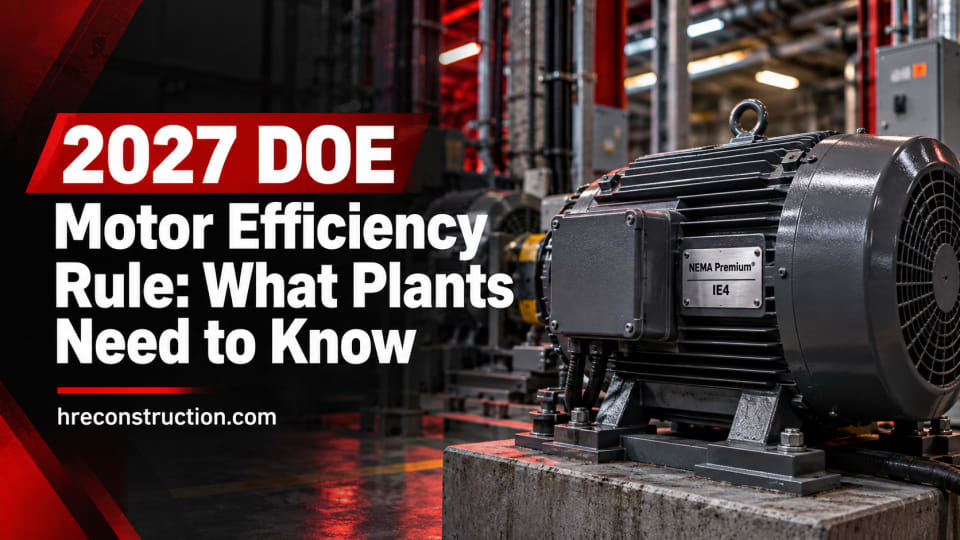
On June 1, 2027, a federal efficiency rule changes which motors can be built and sold for some of the most common sizes in industrial plants. If a 150 hp pump motor fails next summer, the replacement that shows up may be longer, heavier, and pull noticeably more current at startup than the motor it replaces.
That last part is what catches facilities off guard. The rule itself is about efficiency, but the practical impact lands on starters, breakers, conductors, and motor control centers that were sized for older motor designs.
Here is what the rule actually requires, what it does not require, and how to plan for it before the deadline.
What the 2027 DOE Motor Rule Changes
In 2023, the U.S. Department of Energy published new efficiency standards for electric motors, often called the Medium Electric Motor (MEM) rule. DOE confirmed the compliance date that October: the new standards apply to covered motors manufactured in, or imported into, the United States on or after June 1, 2027.
DOE's most recent motor enforcement notice, issued in June 2026, still points to that June 1, 2027 date for these standards. The 2026 notice extended a separate enforcement delay that only affects voluntary efficiency claims for certain newer motor types, such as inverter-only and synchronous motors, out to 2029. It does not move the 2027 deadline.
The biggest changes for industrial facilities:
| Motor Type | Size Range | Before June 2027 | On or After June 1, 2027 |
|---|---|---|---|
| ODP, TEFC, and explosion-proof (2, 4, 6, 8 pole) | 100 to 250 hp | NEMA Premium (IE3) | NEMA Premium 4 (IE4) |
| ODP, TEFC, and explosion-proof | 500 to 750 hp | Not regulated | NEMA Premium (IE3) |
| Air-over motors | 1 to 75 hp | Not regulated | NEMA Premium (IE3) |
| Air-over motors | 100 to 250 hp | Not regulated | NEMA Premium 4 (IE4) |
| Air-over specialized (down-framed) motors | 1 to 20 hp | Not regulated | Energy Efficient level |
Motors outside the 100 to 250 hp band, such as a 50 hp or 400 hp general purpose motor, stay at the current NEMA Premium (IE3) level.
The rule covers single-speed, continuous-duty, squirrel-cage induction motors running on three-phase, 60 Hz sinusoidal power at 600 volts or less, built in standard NEMA or IEC frames. Liquid-cooled, submersible, synchronous, and inverter-only motors are exempt from these standards.
A Quick Note on the Names
NEMA updated its efficiency naming in 2025, so you will see the same level called different things depending on the catalog or spec sheet:
| Older NEMA Name | Current NEMA Name | IEC Equivalent |
|---|---|---|
| Premium | NEMA Premium | IE3 |
| Super Premium | NEMA Premium 4 | IE4 |
If a spec says "Super Premium" and a quote says "NEMA Premium 4," they are describing the same efficiency class.
What the Rule Does Not Require
A lot of the confusion around this rule comes from people assuming it is a replacement mandate. It is not.
- Motors already running are not affected. The standard applies at the point of manufacture. Your installed motors can keep running for as long as they last.
- Existing inventory can still be sold. Covered motors built before June 1, 2027 that meet today's requirements can still be sold and installed after that date.
- Most motor sizes are not moving to IE4. The IE4 requirement is focused on the 100 to 250 hp range (plus air-over motors in that range).
The real exposure is in the replacements and new projects that happen after the deadline. Any project being designed now that won't be built until late 2027 should assume it is getting the new motors.
Why Inrush Current Is the Real Issue
Getting to IE4 efficiency is harder than it looks on paper. The efficiency numbers only move a point or two, but the losses inside the motor have to drop by a meaningful amount. One major motor manufacturer estimates that a 100 hp motor has to cut its electrical losses by about 17 percent to reach the new level.
Manufacturers get there by adding more copper and higher grade electrical steel. That changes the motor's starting behavior. Higher efficiency designs typically draw more locked-rotor (starting) current, and in many cases a NEMA Premium 4 motor can't stay inside the traditional NEMA Design B limits that most plant electrical systems were built around.
To deal with this, NEMA added two new motor design letters in its MG 1-2024 standard: Design BE and Design CE. These designs allow higher locked-rotor current than Design B and Design C. Nidec Motor Corporation reports that the locked-rotor current limit for a Design BE motor is about 42 percent higher than Design B across horsepower ratings.
In plain terms, the starting surge that your starter, overcurrent device, feeder, and transformer see can jump substantially, even though the motor's nameplate horsepower and running current look almost the same.
Other Changes Worth Checking
- Size and weight. ABB notes that some NEMA Premium 4 motors may be longer, may grow in frame diameter, and can weigh up to roughly 20 percent more. Some air-over motors may need to move up one NEMA frame size. Check bases, couplings, guards, and clearances before a swap.
- Slightly higher running speed. Higher efficiency motors usually run with less slip, so full-load speed can be a little higher. On centrifugal pumps and fans, a small speed increase raises the load on the motor and changes flow, so it is worth confirming on critical applications.
- Running current. Full-load current may stay about the same or rise slightly. The efficiency gain comes from lower internal losses, not lower amps.
How the 2026 NEC Handles Design BE Motors
The 2026 edition of the National Electrical Code added Design BE and Design CE motors throughout Article 430. Key changes include:
- 430.7(A)(9): motor nameplate design letter marking now recognizes BE and CE.
- 430.22(H): new conductor sizing requirements for a single Design BE or CE motor.
- 430.24, Exception No. 4: addresses feeders supplying multiple motors where one or more are BE or CE designs.
- Table 430.52(C)(1): Design BE and CE motors are grouped with Design B energy-efficient and premium efficiency motors, which allows an instantaneous-trip breaker (used in a listed combination motor controller) up to 1,100 percent of full-load current.
- New Table 430.251(C): lists maximum locked-rotor currents for polyphase Design BE and CE motors.
Code adoption varies by state and jurisdiction, so check with your authority having jurisdiction on which NEC edition applies to your project. Either way, the motor's starting current is a physical fact that the equipment has to handle, whatever code edition is enforced locally.
What Can Be Affected in Your Electrical System
When a Design BE motor replaces an older Design B motor on an across-the-line starter, these are the components worth reviewing:
- Starters and contactors. Starter sizing that worked for the old motor may not have the margin for a higher locked-rotor current. One motor manufacturer noted in October 2026 that no NEMA starter sizes had yet been defined specifically for Design BE.
- Overcurrent protection. Motor circuit protectors, breakers, and fuses can nuisance trip during starting if settings were already near their limits.
- Conductors and feeders. Existing branch circuits and feeders may need to be rechecked, especially on long runs where voltage drop during starting gets worse.
- Transformers and voltage dip. A bigger starting surge means a deeper voltage dip on the bus, which can drop out contactors, relays, and drives on the same system. Our post on voltage sags and why factory equipment trips offline covers how that plays out.
- Control panels. If starters or protective devices inside an industrial control panel are changed, the panel's short-circuit current rating may need to be re-evaluated. See our post on SCCR and NEC 409.
- Generator-backed loads. Motors that must start on standby power put a bigger demand on the generator during transfer.
Ways to Manage the Higher Inrush
There is no single right answer. It depends on the load, the existing equipment, and how critical the motor is.
- Use a Design B motor where one is available. Some manufacturers are working to offer NEMA Premium 4 motors that still meet Design B locked-rotor limits. When available, this is usually the simplest path because the existing starter and protection may not need changes.
- Check the existing capacity first. In many cases, comparing the new motor's locked-rotor current to the rating of the existing starter, MCC bucket, and protective device shows that the equipment can handle it as-is.
- Add a variable frequency drive. A VFD is sized on full-load amps rather than starting current, so it removes the inrush concern and can add energy savings on variable torque loads. Drives do bring their own considerations for cabling and motor insulation, which we cover in why motors fail on VFDs.
- Use reduced voltage starting. Soft starters, wye-delta, and part-winding starting can lower the starting surge. They also reduce starting torque, which is usually fine for centrifugal pumps and fans but can be a problem for conveyors, crushers, and other loads that start under full load.
- Upsize the starter and protection. When none of the above fit, the starter, contactor, protective device, and in some cases the conductors may need to be upgraded to match the new motor.
A Practical Planning Checklist Before June 2027
- Inventory your 100 to 250 hp motors, plus any air-over fan motors. Note the starter type, MCC bucket size, protective device, and how critical each one is to production.
- Identify motors with no installed spare. These are the ones that will force a rushed decision if they fail after the deadline.
- Decide on critical spares now. Some facilities choose to buy spares built before June 1, 2027 for motors where changing the starter would mean a longer shutdown. Others decide to plan the upgrade path now and move to IE4 on their own schedule.
- Update project specs. Anything designed today but installed after the deadline should be designed around NEMA Premium 4 motors and their starting current.
- Measure before you replace. Real load and run-hour data from power monitoring makes it easier to size motors correctly and estimate savings.
- Look for utility rebates. Many utilities offer incentives for high efficiency motors and drives, which can shorten payback.
- Commission the change properly. After a motor or starter swap, verify rotation, protective settings, starting performance, and running current. Our post on electrical commissioning explains why this step matters.
The efficiency side of the rule has real value. Motor energy costs over a motor's life are usually far larger than its purchase price. One industry example estimates that a motor costing about $7,000 can use more than $600,000 in electricity over 20 years of heavy use, and ABB estimates many IE4 upgrades pay back in roughly two to five years depending on run hours and power rates. The goal is to get those savings without creating nuisance trips or a surprise starter replacement during an emergency swap.
How HRE Can Help
HRE Construction works with industrial facilities on the electrical side of motor upgrades and replacements. Our team can help you:
- Walk your facility and document the 100 to 250 hp motors, starters, and MCC buckets that fall under the 2027 rule
- Compare new motor locked-rotor data against your existing starters, protective devices, and conductors
- Install and set up VFDs and soft starters where they make sense for the load
- Upgrade starters, contactors, and MCC components when the existing equipment can't support the new motor
- Review voltage dip and protective device settings for large motors that start across the line
- Test and commission new motor installations before they go back into production
If you are already seeing electrical overloads or tripping on motor circuits, a motor upgrade is a good time to sort out the root cause at the same time.
Plan Your Motor Upgrades Before the Deadline
June 1, 2027 is closer than it looks, especially when equipment lead times and planned shutdowns are part of the picture. The facilities that plan now get to choose their timing instead of having the decision made for them by a failed motor.
Contact HRE Construction to schedule a motor and MCC review for your facility. Visit hreconstruction.com to request a quote or call (803) 262-2615.
Frequently Asked Questions
Do I have to replace my existing motors because of the 2027 DOE rule?
No. The rule applies to motors manufactured on or after June 1, 2027. Motors already installed can keep running, and compliant motors built before the deadline can still be sold and installed.
Which motors must meet NEMA Premium 4 (IE4) efficiency?
The main IE4 requirement applies to ODP, TEFC, and explosion-proof motors from 100 to 250 hp in 2, 4, 6, and 8 pole designs, along with air-over motors in that same range. Most other covered sizes stay at NEMA Premium (IE3).
What is a NEMA Design BE motor?
Design BE is a newer NEMA design letter created for high efficiency motors that can't stay within traditional Design B starting current limits. It allows higher locked-rotor current, and the 2026 NEC added specific rules and a locked-rotor current table for these motors.
Will a new IE4 motor work with my existing starter?
Sometimes, but it should be checked first. The new motor's locked-rotor current needs to be compared against the starter, overload, protective device, and conductors. If the equipment can't support it, options include a Design B version of the motor, a VFD, a soft starter, or upgraded starter equipment.
Related Services
Related Posts
 Why Motors Fail on VFDs: Reflected Waves and Bearing Currents
October 15, 2026
Reflected waves and bearing currents are why motors fail early on VFDs. Learn the warning signs and the fixes, from dv/dt...
 NEC 110.26 Working Space Rules: 2026 Changes Explained
July 15, 2026
Clear working space depths, the 24-inch egress rule, and when a second exit is required. What the 2026 NEC changed in Section...
 Scout Motors Supplier Growth: What It Means for Electrical Planning
September 21, 2026
Scout Motors' supplier growth in Blythewood is bringing new manufacturing and logistics facilities to the Midlands. Here's what...