Voltage Sags: Why Factory Equipment Trips Offline
October 19, 2026 | Samantha Mariano
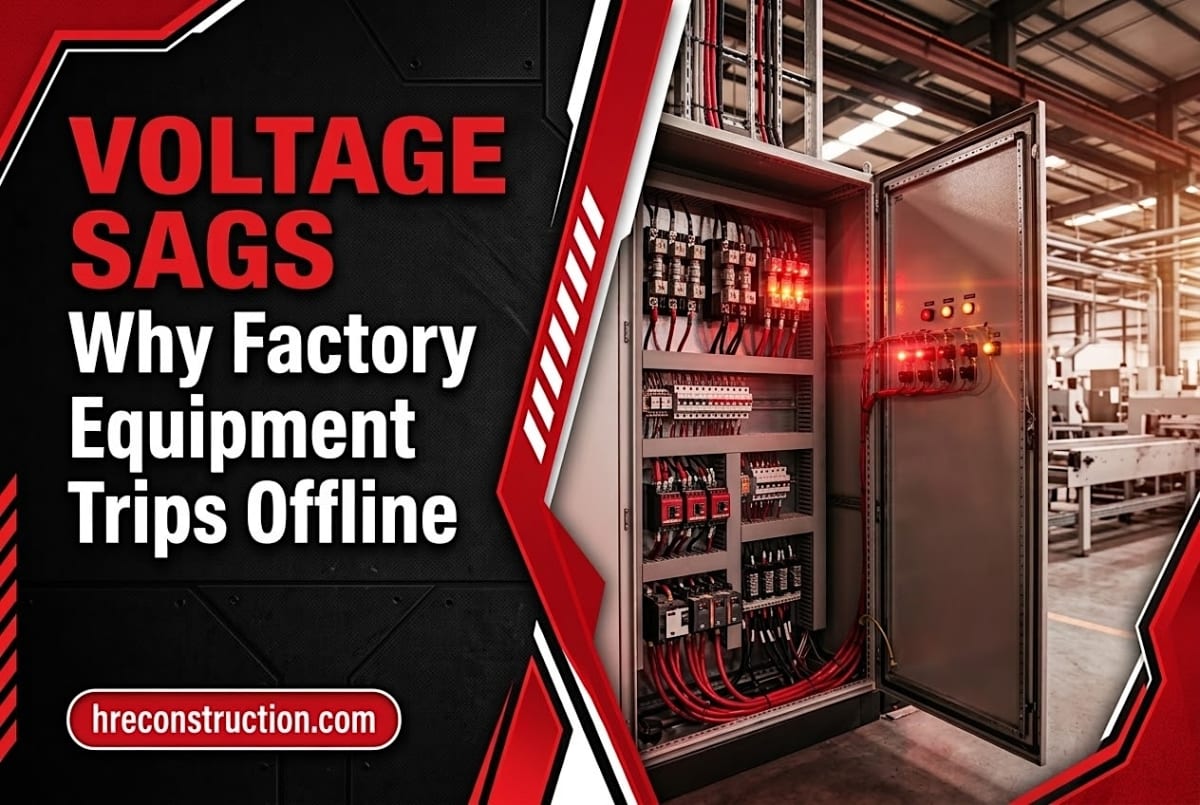
The lights blink. A second later, two lines are down, a few drives are showing fault codes, and maintenance is walking the floor looking for a tripped breaker that isn't there. Everything restarts fine. Two weeks later, during a thunderstorm, it happens again.
When equipment stops and no breaker has tripped, the most likely cause is a voltage sag. A sag is a short drop in voltage, usually lasting a fraction of a second. It is too brief and too mild to trip a breaker, but it is long enough to make contactors drop out, drives fault on undervoltage, and PLC power supplies reset. The machine stops even though nothing in the panel opened.
The good news is that sag problems can usually be fixed, and the fix is often smaller and cheaper than people expect. The first step is understanding what is actually happening.
What Is a Voltage Sag?
IEEE 1159, the standard for monitoring power quality, defines a sag (also called a dip) as a drop in RMS voltage to between 10 and 90 percent of normal, lasting from half a cycle up to one minute. If voltage falls below 10 percent, it counts as an interruption instead.
Most sags that cause trouble in industrial plants are short. Many last only a few cycles, roughly 50 to 170 milliseconds, which is the time it takes protective devices on the utility system to clear a fault. That is too fast for anyone to notice except as a flicker in the lights, and that is exactly why sag problems get misdiagnosed.
A sag is not the same as:
- An outage, where the power is fully gone.
- Sustained undervoltage, where voltage stays low for more than a minute, often because of an overloaded transformer or long feeder.
- A surge or transient, which is a brief spike above normal voltage. (Spikes are covered in our post on surge protective devices.)
Why Equipment Trips When No Breaker Does
A breaker responds to too much current. A sag is too little voltage. The two problems trigger completely different devices, which is why the panel looks normal after a sag event. The trip happens inside the equipment itself. These are the usual weak links.
Contactors and Control Relays
An AC contactor or relay is held closed by a magnetic coil. When voltage drops far enough, the coil can no longer hold, and the contacts open. Some relays can release in less than one cycle. The real problem comes next: most motor starters are wired in a standard three-wire start/stop circuit, so once the contactor drops out, it stays out until someone presses Start again. Voltage comes back a tenth of a second later, but the machine stays down.
One small control relay in the wrong spot can stop an entire line. In most sag investigations, a single weak component turns out to be causing the shutdown, and finding it is most of the work.
Variable Frequency Drives
A VFD converts incoming AC to DC and holds it in a DC bus. During a sag, the bus voltage drops, and if it falls below the drive's limit, the drive trips on an undervoltage fault to protect itself. Many drives have power loss ride-through and auto-restart features, but those features are often left at default settings or turned off. (For other ways drives and motors fail, see Why Motors Fail on VFDs.)
PLCs, Power Supplies, and Sensors
If a PLC, an I/O rack, or the 24 VDC supply that feeds sensors and safety relays loses voltage for even a moment, the controller can reset or see inputs drop out. The program reacts to a "loss of signal" and stops the process, even if the motors themselves would have kept running.
Motors and Undervoltage Relays
Motor torque drops sharply with voltage. At about 60 percent voltage, a motor has roughly a third of its normal torque, so heavily loaded motors can stall or slow enough to trip a process interlock. Undervoltage or phase-monitoring relays set too tight can also take out equipment that would otherwise have ridden through.
Where Voltage Sags Come From
The Utility System
Faults on the utility system are the most common cause of sags in industrial plants. Lightning, wind, trees, animals, ice, and equipment failure all cause faults, and single line-to-ground faults are the most frequent. The fault does not have to be on your feeder. A fault on a neighboring feeder fed from the same substation can pull your voltage down for several cycles until the utility's breaker or recloser clears it. If the recloser tries again, you may see two or three sags in a row.
This is why sag trips often line up with storms, high winds, or utility work in the area.
Inside Your Own Facility
Not every sag comes from the utility. Monitoring studies have found that a large share of voltage events start inside the building. Common internal causes include:
- Starting large motors across the line
- Energizing large transformers
- Faults on your own feeders or branch circuits
- Large welding loads
- A service or transformer that is already near capacity, which makes every sag deeper
If your trips line up with a specific compressor, chiller, or crusher starting, the problem may be one you can fix on your side of the meter.
How to Tell a Sag From Other Trip Causes
| What You See | What It Usually Points To |
|---|---|
| Several machines stop at once, no breaker tripped | Voltage sag |
| Lights flicker at the same moment | Voltage sag |
| Trips happen during storms or utility work | Utility-side sag |
| Trips happen when a large motor starts | Internal sag from motor starting |
| Drive shows a DC bus undervoltage fault | Sag or brief interruption |
| The same breaker trips on the same circuit | Overload, short circuit, or ground fault |
| Trips come with heat, odor, or a hot breaker | Equipment or connection problem |
If a breaker is actually opening, the cause is different, and our guide on why industrial equipment keeps tripping breakers walks through those patterns.
Measure Before You Buy Anything
The most expensive mistake with sag problems is buying a large piece of equipment based on a guess. Measure first.
Install a power quality monitor. A monitor at the main service, and ideally at the panels feeding the affected equipment, records every voltage event with its depth, duration, and time stamp. Leave it in place long enough to catch real events. Thirty days is a reasonable minimum, and longer is better if the problem follows storm season. Facilities with permanent power monitoring systems may already have this data.
Match events to downtime. Compare the monitor's event log against production stop times and drive fault logs. When a recorded sag lines up with a stoppage, you know which equipment is sensitive and how deep a sag it can tolerate.
Compare against the ITIC curve. The ITIC curve (an update of the older CBEMA curve) was written for 120-volt information technology equipment, but plants widely use it as a benchmark for control electronics. It says equipment should ride through zero voltage for up to 20 milliseconds, 70 percent voltage for up to half a second, and 80 percent voltage for up to 10 seconds. If your controls trip on events that fall inside that envelope, the weak link is the equipment, not the power supply.
Ask the utility. Your utility can often confirm faults or recloser operations on the dates of your events. That tells you whether the source is outside or inside your facility.
How to Make Equipment Ride Through Sags
In most plants, the best approach is to protect the control circuits, not the whole machine. Control power is a small load, so ride-through for it is far cheaper than conditioning the power for an entire line.
1. Harden the Control Circuit
- Coil hold-in devices installed with contactor coils can keep contacts closed through deep, short sags.
- DC control power with enough stored energy can hold relays and contactors through events that would drop an AC coil.
- Undervoltage and phase-monitoring relays should be reviewed and given realistic trip levels and time delays, so they respond to real problems and not every flicker.
One important caution: ride-through measures must never defeat emergency stops, safety relays, or required undervoltage protection. Any change to a control circuit should be reviewed against the machine's safety design.
2. Put Control Power on Ride-Through Equipment
- Constant-voltage (ferroresonant) transformers hold control voltage steady through many sags, but they do not ride through a full outage.
- A UPS on control power keeps PLCs, I/O, and sensor supplies alive through sags and brief interruptions. Our post on UPS systems for industrial facilities covers sizing and placement.
- Capacitor-based ride-through units for control circuits bridge short events without batteries.
3. Adjust Drive Settings
Many VFDs can use the motor's spinning energy to hold up the DC bus for a short sag, and can restart automatically into a spinning motor afterward. These settings can eliminate a large share of drive trips. However, automatic restart must be evaluated carefully. NFPA 79 requires machinery to be protected against unexpected restarting after voltage returns where that restart could create a hazard. (See our post on NFPA 79 requirements.) Auto-restart belongs on fans and pumps, not on equipment where someone could be in the machine.
4. Fix Sags You Create Yourself
If monitoring shows internal sags, soft starters or VFDs on large motors, staggered start sequences, and adequate transformer capacity can reduce or eliminate them. Older motor control equipment may also be worth reviewing. Our post on motor control centers and when to upgrade them explains what to look for.
5. Consider Facility-Level Correction Only When the Data Supports It
Dynamic sag correctors, larger UPS systems, and similar equipment can protect an entire process. They make sense when the downtime cost is high and monitoring shows that smaller fixes will not cover the events you are actually seeing.
6. Write Ride-Through Into New Equipment Specs
The cheapest time to fix sag sensitivity is before the equipment arrives. SEMI F47, a standard that started in the semiconductor industry, requires equipment to ride through sags to 50 percent voltage for 0.2 seconds, 70 percent for 0.5 seconds, and 80 percent for 1 second. Many plants now use it, or a similar requirement, in purchase specifications for critical machines and control panels.
How HRE Can Help
HRE Construction works on the electrical systems and controls behind industrial production, from power distribution to control panels, motor controls, and PLC systems. When equipment keeps dropping offline and no one can find a tripped breaker, we can help you:
- Review event data and fault logs to confirm whether sags are the cause
- Trace control circuits to find the relay, contactor, or power supply that drops out first
- Add ride-through to control power with hold-in devices, DC control, constant-voltage transformers, or UPS units
- Review drive ride-through and restart settings with safety requirements in mind
- Reduce internal sags with soft starters, VFDs, and better motor starting sequences
- Plan distribution upgrades when an undersized service is making every sag deeper
Explore our industrial electrical services to see the full scope of what we do.
Stop Chasing Breakers That Never Tripped
If your lines stop when the lights flicker, the problem is real, measurable, and usually fixable without replacing the machine. Talk to HRE Construction about finding the weak link in your system and making your equipment ride through. Request a quote today.
Frequently Asked Questions
What is a voltage sag?
A voltage sag is a short drop in voltage, typically to between 10 and 90 percent of normal, lasting from half a cycle to one minute. Most sags in industrial plants last only a few cycles and are caused by faults on the utility system or large motors starting inside the facility.
Why does my equipment shut off when the lights flicker?
The flicker is the visible sign of a voltage sag. Contactors, control relays, drives, and PLC power supplies can drop out during a sag even though no breaker trips. Many motor starters do not restart on their own, so the machine stays down after voltage returns.
Can a voltage sag damage equipment?
Short sags usually cause shutdowns rather than direct damage. The bigger cost is lost production, scrap, and restart time. Repeated sags can still stress some equipment, such as heavily loaded motors that stall or contactors that chatter during the event.
Will a UPS fix voltage sag problems?
A UPS on control power is one of the most effective fixes, because it keeps PLCs, I/O, and control circuits alive through sags and brief interruptions. Putting an entire production line on a UPS is rarely needed. Monitoring data should show which loads actually need protection.
Related Services: Industrial Electrical Services | Request a Quote