UPS Systems for Industrial Facilities: What They Protect
August 17, 2026 | Samantha Mariano
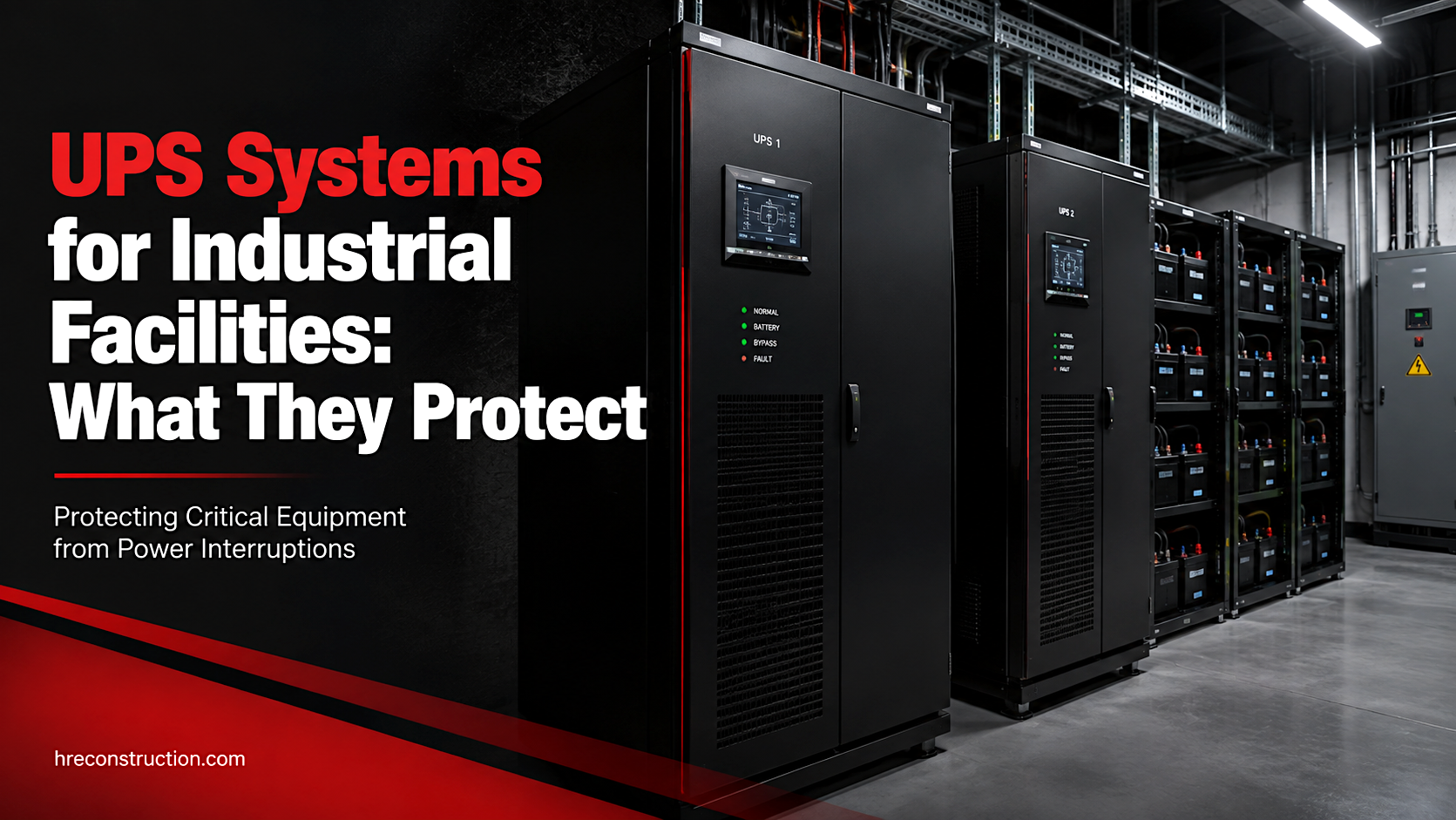
When people hear "backup power" at an industrial facility, most think of a generator kicking on after an outage. That's an important piece of the picture, but it isn't the whole picture. Generators are excellent at keeping a facility running through an extended outage, but they aren't instant. There's a gap, usually somewhere between a few seconds and about a minute, between the moment utility power drops and the moment a generator is up to speed and carrying load. For lighting and most mechanical equipment, that gap is a non-issue. For programmable logic controllers (PLCs), distributed control systems, servers, variable frequency drives, and other sensitive electronic loads, that same gap can mean a faulted process, a corrupted control program, lost production data, or an unplanned shutdown that takes hours to safely restart.
That's the problem an uninterruptible power supply (UPS) solves. A UPS doesn't replace a generator. It bridges the gap a generator can't close and protects the equipment that's too sensitive to tolerate even a momentary interruption.
What an Industrial UPS Actually Does
At its core, a UPS sits between the incoming power feed and the connected load, continuously supplying power from an internal battery bank while also conditioning the power that passes through it. If utility power drops or degrades, the UPS keeps supplying clean power from its batteries with no interruption the connected equipment can detect. Once a generator comes online and stabilizes, the UPS transitions back to using that source to recharge its batteries and continue conditioning the supply.
Beyond bridging outages, a properly specified UPS also protects against the everyday power quality issues that don't show up as a full outage but still damage equipment over time: voltage sags, swells, transients, and harmonic distortion introduced by variable frequency drives, large motor starts, and other nonlinear loads common in industrial environments. IEEE Standard 1100, commonly known as the Emerald Book, is the widely referenced industry guidance for powering and grounding sensitive electronic equipment in commercial and industrial settings, and it's a useful reference point when a facility is evaluating where UPS protection is actually needed versus where standard distribution is sufficient.
UPS vs. Generators: Different Jobs, Not Competing Solutions
It's a common misconception that a facility needs to choose between a generator and a UPS. In practice, most industrial facilities that run critical or sensitive loads need both, because they solve different problems:
- Generators provide extended runtime during longer outages but take time to start, reach rated speed, and transfer load, whether that transfer happens under NEC Article 700 emergency system requirements, Article 701 legally required standby requirements, or Article 702 optional standby requirements. We've covered how those NEC categories apply to industrial facilities in more detail in our Emergency and Standby Power Systems for Industrial Facilities article.
- UPS systems provide instant, zero-interruption power for a limited duration, typically a few minutes to a few hours depending on battery sizing, and continuously condition the power quality reaching sensitive loads even when there's no outage at all.
A common and effective design pairs the two: the UPS carries critical control and monitoring loads through the transfer gap, while the generator carries the facility's broader emergency, legally required, and optional standby loads once it's online.
Common Industrial Applications for UPS Protection
Not every circuit in a facility needs UPS protection, and oversizing a UPS unnecessarily adds cost without adding real value. The loads that typically justify it include:
- PLCs and distributed control system (DCS) hardware, where even a momentary power blip can fault a running process or require a manual restart
- Servers, historians, and networking equipment supporting plant floor data collection and SCADA systems
- Instrumentation and process control loops that need to hold their last known state through a power event
- Fire and life safety monitoring panels that require continuous power independent of the transfer switch sequence
- Motor control center (MCC) control circuits and protective relays, where losing control power during a transfer can leave contactors in an unpredictable state
Sizing and Selecting an Industrial UPS
Industrial UPS sizing is a different exercise than sizing a small office UPS. Facility-scale systems typically need to support three-phase loads, tolerate a wider range of ambient temperatures than a climate-controlled server room, and handle the inrush characteristics of motor-driven and electronically switched equipment. A few factors that should drive the specification:
- Total connected critical load, calculated from actual nameplate and inrush data rather than estimates, since undersizing leaves protected equipment exposed during the exact event the UPS was installed to prevent
- Required runtime, which depends on how quickly a generator or alternate source can realistically take over the load
- Topology, with double-conversion (online) UPS systems generally preferred in industrial settings because they continuously regenerate clean output power rather than only switching over during a disturbance
- Battery type and environment, since VRLA and lithium-ion batteries perform differently across the temperature extremes and duty cycles common on a plant floor
Getting this analysis right usually means pairing UPS sizing with a broader look at facility power quality. Our Power Quality Issues in Industrial Facilities article covers the voltage sags, harmonics, and transients that make this kind of protection necessary in the first place, and ongoing power monitoring data is often the clearest way to identify which circuits are actually experiencing disturbances worth protecting against.
How HRE Can Help
HRE Construction designs and installs UPS systems as part of comprehensive industrial power protection strategies, working alongside generator, automatic transfer switch, and control system installations rather than as an afterthought bolted onto an existing panel. Our instrumentation and PLC services team also works directly with the control systems that most often justify UPS protection, so sizing decisions are grounded in how your facility's control architecture actually behaves during a power event, not just a generic load calculation.
Ready to find out which circuits in your facility need UPS protection? Contact HRE Construction to schedule a facility assessment.
Frequently Asked Questions
Does a UPS replace the need for a backup generator?
No. A UPS provides instant, short-duration power to bridge the gap before a generator comes online and to condition power quality day to day. A generator provides the extended runtime needed for a longer outage. Most industrial facilities with sensitive or critical loads need both working together.
How long can an industrial UPS run on battery power alone? It depends on battery sizing and connected load, but most facility-scale UPS installations are designed to bridge somewhere between a few minutes and about an hour, long enough to reach a generator's transfer time or to allow for a controlled shutdown of the protected equipment.
Which parts of a facility typically need UPS protection?
PLCs, DCS hardware, servers and networking equipment, instrumentation loops, fire and life safety monitoring, and MCC control circuits are the most common candidates, since these are the loads where even a momentary interruption causes a fault, data loss, or unpredictable equipment state.
Can an existing facility add a UPS without a full electrical redesign?
In most cases, yes. UPS systems can typically be added to protect specific critical circuits without requiring a full redesign of the facility's electrical distribution, though a proper load and power quality assessment should always come first.