HRE Construction / Industrial Electrical
Industrial Electrical Demolition: Doing It Safely
November 13, 2026 · 8 min read · By HRE Construction
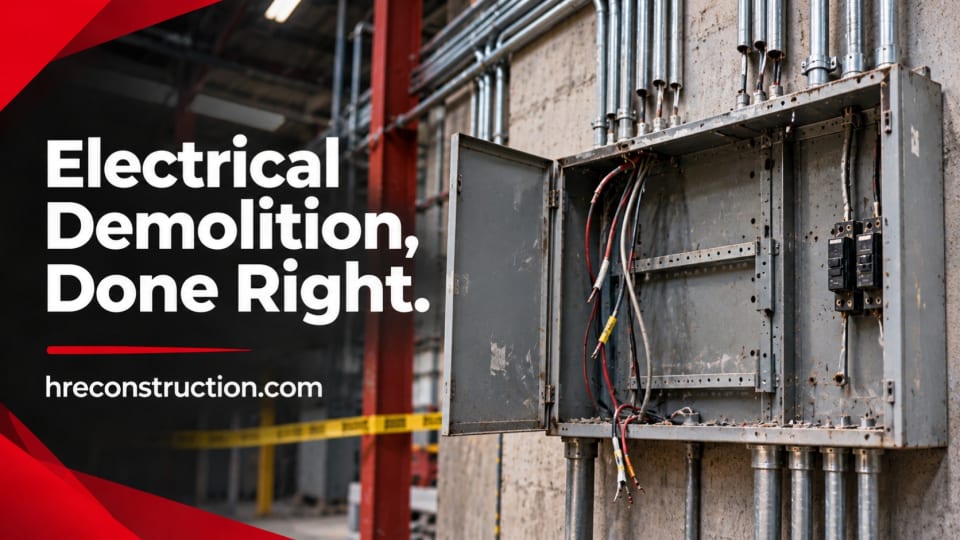
When a plant retools a line, moves equipment, or shuts down part of a building, the electrical work usually starts with demolition. Old motors, panels, conduit, cable tray and controls have to come out before anything new goes in.
It sounds like the simple part of the job. It isn't. Electrical demolition in a working facility means pulling equipment out of a system that is still partly energized, still feeding other loads, and still documented on drawings that may not match what's in the field. The biggest risks are usually not in what gets removed. They are in what gets left behind.
This guide walks through how industrial electrical demolition should be planned and done, from the first survey to the updated drawings.
What Electrical Demolition Covers
In an industrial setting, electrical demolition can include:
- Equipment removal for retooling, line moves or process changes
- Decommissioning part of a plant, a building or a production area
- Clearing space for new equipment, an expansion or an electrical room upgrade
- Removing obsolete gear such as old panels, motor control centers, transformers, lighting and controls
- Pulling abandoned cable and conduit left from earlier projects
Each of these involves the same core job: disconnect safely, remove completely, and leave the remaining system correct, labeled and documented.
Step 1: Survey and Trace Before Anything Comes Out
Every demolition job should start with a field survey, not a drawing review alone. Drawings in older facilities are often out of date, and the circuit you think feeds a machine may also feed something else.
A good pre-demolition survey looks for:
- Every source feeding the equipment. That includes the main power feed, control power from another panel, UPS or battery backup, and any interlocks wired from other machines.
- Shared circuits and neutrals. A conductor being removed may serve equipment that is staying.
- Stored energy. Capacitors, VFD DC buses, UPS batteries, springs and pneumatic or hydraulic systems can hold energy after the power is off.
- Backfeeds. Generators, tie breakers and solar or storage systems can energize a circuit from the "wrong" side.
- Equipment that must stay running during the work, and how it will be kept powered.
The output of the survey should be a marked-up demolition plan that shows what comes out, where each circuit gets cut back to, and what stays. If your one-line diagram is out of date, this is the time to fix it. Our post on why single-line diagrams must stay current covers what an accurate one should show.
Step 2: De-Energize at the Source and Verify
Demolition crews cut, pull and remove conductors. That means every circuit being worked on has to be in an electrically safe work condition, not just switched off.
NFPA 70E lays out the process for establishing and verifying an electrically safe work condition in Section 120.6 of the 2024 edition (it was 120.5 in the 2021 edition). It includes identifying all sources, opening the disconnects, verifying visible breaks where possible, releasing stored energy, applying lockout/tagout, and testing for absence of voltage before anyone touches a conductor. The 2024 edition specifically calls for testing each phase conductor or circuit part at each point of work.
That last point matters on demolition jobs. Crews often cut conductors at several locations along a run, and each of those is a point of work.
When an entire building or structure is being demolished, OSHA's construction demolition rule, 29 CFR 1926.850(c), requires all electric, gas, water, steam, sewer and other service lines to be shut off, capped or otherwise controlled outside the building line before demolition starts, with any involved utility notified in advance. Where power has to stay on during demolition, 1926.850(d) requires those lines to be temporarily relocated as needed and protected.
For a full look at energy control programs, see our guide to lockout/tagout compliance for industrial facilities.
Step 3: Check for Hazardous Materials
Older electrical equipment can contain materials that need special handling and disposal. These should be identified before removal, not discovered in the dumpster.
- PCBs in fluorescent light ballasts. According to the EPA, ballasts manufactured before July 1, 1979 may contain PCBs. Ballasts made between July 1, 1979 and July 1, 1998 that don't contain PCBs had to be labeled "No PCBs." If a ballast isn't labeled, the safest approach is to assume it contains PCBs unless you know it was made after 1979.
- PCBs in capacitors and older transformers. Older capacitors and some older oil-filled equipment may contain PCBs. Check nameplates and records, and test where the content is unknown.
- Mercury. Fluorescent and HID lamps contain mercury and need to be handled and recycled properly.
- Asbestos. Some older wiring insulation, panel components and building materials may contain asbestos. For building demolition and renovation, EPA asbestos survey and notification rules apply in addition to OSHA requirements.
Disposal rules vary by state, so confirm requirements with your state environmental agency and use licensed haulers and recyclers for regulated materials.
Step 4: Remove Back to the Source, Not to the Nearest Box
The most common demolition shortcut is cutting a circuit at the nearest junction box, capping the wires, and walking away. It saves time on the job and creates problems for years.
Dead wiring left in place confuses the next electrician, fills raceways and cable trays, hides real circuits, and can become live again if someone re-lands it on a breaker by mistake. The better practice is to remove conductors back to their source, open the breaker or disconnect, and either remove the device or label it as a spare.
Here is what to look for at the end of a demolition job:
| Leftover | Why it's a problem | What to do |
|---|---|---|
| Dead conductors still landed in a panel | Can be re-energized by mistake; confuses troubleshooting | Remove back to the source and label the breaker as spare |
| Open breaker spaces or knockouts | NEC 110.12(A) requires unused openings to be closed | Install filler plates and knockout seals |
| Abandoned low-voltage, fire alarm, fiber or communications cable | The NEC requires the accessible portion of abandoned cable in these systems to be removed unless tagged for future use | Remove it, or tag it if it truly will be reused |
| Panel directory that no longer matches | NEC 408.4(A) requires circuits and circuit modifications to be legibly identified | Update the directory before closing the panel |
| Empty conduit and cable tray | Takes space and hides what's actually in use | Remove it, or cap and label it if it will be reused |
Removing everything back to the source takes more labor up front. It also leaves the plant with a system that matches its drawings, which saves time on every job after this one.
Step 5: Update the Paperwork
Demolition changes the electrical system, so the documentation has to change with it. Before the job is closed out:
- Update the single-line diagram to show removed equipment, feeders and breakers.
- Update panel directories and equipment labels.
- Review the arc flash study. Removing large motors, transformers or feeders can change available fault current and protective device settings. Arc flash labels may need to be updated. Our article on what arc flash is and how it's managed explains why labels must match the actual system.
- Update the maintenance program so removed equipment comes off inspection and testing schedules.
Doing Demolition in a Running Plant
Most industrial demolition happens while the rest of the facility keeps producing. That adds a few more steps:
- Phase the work so the areas being demolished are isolated from equipment that stays in service.
- Provide temporary power for loads that lose their normal feed during the work.
- Protect live circuits that run through the demolition area with barriers, signage and clear marking.
- Coordinate shutdowns with production, especially for any work at the main switchgear or MCCs.
Planned shutdown windows are often the best time for this work. Our holiday shutdown electrical maintenance guide covers how to plan electrical work around a plant outage.
Salvage and Recycling
Copper conductors, aluminum bus, steel enclosures and some equipment have real salvage value. Plan for how materials will be sorted and recycled before demolition starts, and keep regulated items such as PCB-containing components and mercury lamps separate from general scrap.
Some equipment may be worth keeping as spares or reusing in the new layout. Decide that during the survey, not after it has been cut out.
How HRE Can Help
HRE Construction handles industrial electrical demolition as part of retooling, expansion and upgrade projects. We can help with:
- Pre-demolition surveys that trace circuits, identify every source, and mark up a demolition plan
- Safe de-energization and lockout for the circuits being removed
- Removal of equipment, conductors, conduit and cable tray back to the source
- Identifying older components that may need special handling, such as PCB ballasts and capacitors, so they can be separated for licensed disposal
- Temporary power for equipment that has to keep running during the work
- Updated panel directories, labels and drawings at closeout
- New installation once the space is clear, including new feeders, panels and equipment connections
Frequently Asked Questions
What is electrical demolition?
Electrical demolition is the planned removal of electrical equipment, wiring, conduit and controls from a facility. In industrial plants it is usually done for retooling, line moves, expansions or decommissioning, often while other parts of the facility stay energized.
Do abandoned wires have to be removed?
For low-voltage, fire alarm, optical fiber and communications cable, the NEC requires the accessible portion of abandoned cable to be removed unless it is tagged for future use. For power wiring, best practice is to remove dead conductors back to their source so they can't be re-energized by mistake or confused with live circuits.
Do old light ballasts contain PCBs?
They may. The EPA says fluorescent light ballasts manufactured before July 1, 1979 may contain PCBs, and ballasts made between 1979 and 1998 without PCBs had to be labeled "No PCBs." Unlabeled ballasts should be treated as PCB-containing unless you know otherwise.
Does demolition affect the arc flash study?
It can. Removing large motors, transformers or feeders can change available fault current and protective device coordination. The arc flash study and labels should be reviewed after significant changes to the system.
Plan Your Next Demolition the Right Way
If your facility is retooling a line, clearing space for new equipment, or decommissioning an area, a careful electrical demolition plan protects your crews and leaves the remaining system clean and documented. Contact HRE Construction to request a quote for your next project.
Related Services
Related Posts
 industrial Electrical Maintenance Checklist: What Every Facility Should Be Doing Regularly
April 22, 2026
A reliable industrial electrical system doesn’t happen by accident. This checklist outlines the essential maintenance tasks...
 Cable Sizing and Wire Management for Industrial Electrical Systems
July 13, 2026
Cable sizing looks straightforward until ambient heat, bundled conductors, and terminal ratings start stacking up. Here's what...
 Grounding and Bonding in Industrial Facilities: Why It’s Critical for Safety and System Performance
April 29, 2026
Grounding and bonding play a critical role in keeping industrial electrical systems safe and reliable. When done incorrectly,...