HRE Construction / Industrial Electrical
Brushless DC Motors: Can They Cut Plant Downtime?
November 18, 2026 · 10 min read · By HRE Construction
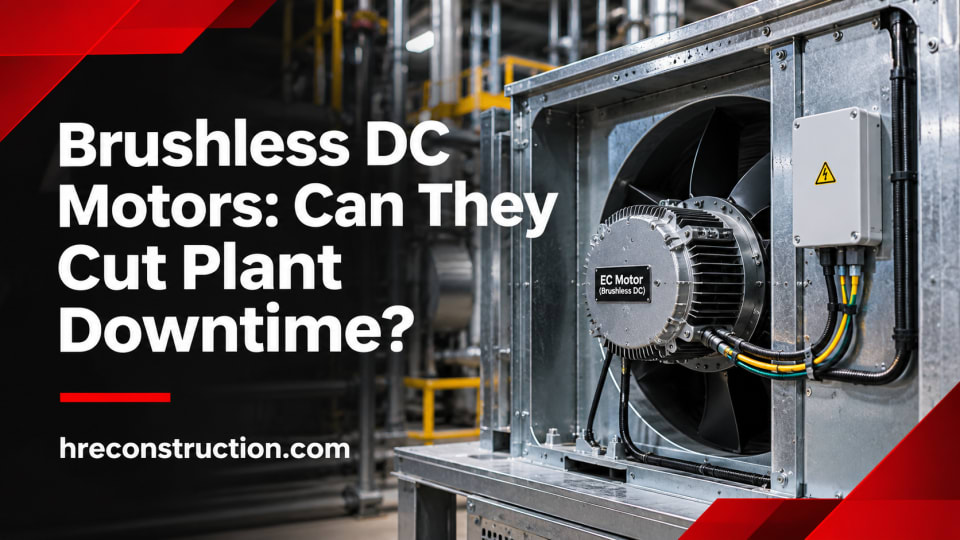
Brushless DC motors have moved well past computer fans and power tools. Many plants now see them on new air handlers, exhaust fans, condenser fans, small pumps and conveyors, usually sold as "EC" (electronically commutated) motors. The pitch is simple: no brushes, higher efficiency, built-in speed control and less maintenance.
Some of that holds up on the plant floor. Some of it needs context. A brushless motor removes certain failure points, but it also adds electronics that a plain induction motor never had. Whether it cuts downtime in your facility depends on where it goes, how it is fed and how your team maintains it.
Here is what plant and maintenance managers should know before standardizing on brushless motors or retrofitting existing equipment.
What Is a Brushless DC (EC) Motor?
A brushed DC motor uses carbon brushes riding on a commutator to switch current through the rotating windings. Those brushes wear, spark and shed carbon dust, and they are the reason brushed DC motors need regular service.
A brushless DC motor flips that design around. The rotor carries permanent magnets, the windings sit in the stationary stator, and electronics do the switching instead of brushes. The controller reads rotor position (from Hall sensors or from the motor's back-EMF) and energizes the stator windings in sequence to keep the rotor turning.
You will see a few names used for closely related designs:
- BLDC (brushless DC): The general term, with the drive electronics separate or built in.
- EC motor: A brushless permanent magnet motor with the rectifier and drive electronics built into the motor itself. It plugs into standard AC power and accepts a speed signal (often 0 to 10 V or Modbus). This is the version most plants see on fans and air handlers.
- PMAC / PMSM (permanent magnet AC or synchronous): A larger industrial cousin that runs on an external drive, often in integral horsepower sizes.
All of them share the same basic idea: permanent magnets on the rotor and electronic commutation instead of brushes.
Where Brushless Motors Can Reduce Downtime
No Brushes or Commutator to Wear Out
Compared with a brushed DC motor, this is the clearest win. Brush inspection, replacement and commutator resurfacing go away completely. If your plant still runs brushed DC motors on older conveyors, winders or process equipment, those brush change-outs are planned downtime you can eliminate.
Compared with a standard AC induction motor, the difference is smaller, because induction motors don't have brushes either. The case there rests on the next few points.
Less Heat in the Rotor
In an induction motor, current is induced in the rotor bars, and that current creates losses and heat in the rotor. A permanent magnet rotor has no bars carrying current, so those rotor losses largely disappear. Less heat means less thermal stress on bearing grease and winding insulation, which are two of the most common reasons motors fail.
That efficiency gain is why many EC motors are rated at IE4 levels or better. IEC TS 60034-30-2 defines efficiency classes specifically for variable-speed motors, including permanent magnet designs, so ask suppliers which class a motor actually meets rather than relying on "high efficiency" claims. If you are already planning around the 2027 DOE motor efficiency rule, brushless options belong in that conversation.
Gentle Starts Without Extra Equipment
A motor started across the line pulls a large inrush current and hits the load with a sudden jolt of torque. That mechanical shock wears couplings, belts and bearings over time. EC motors ramp up under electronic control, so they start softly without a separate soft starter or VFD. (For a deeper look at starting methods on standard motors, see our post on soft starter vs. VFD.)
Built-In Speed Control and Fault Reporting
Because the drive is part of the motor, an EC fan can follow a pressure, temperature or network signal without a separate drive cabinet, contactor or overload relay. Fewer separate components means fewer connections to loosen and fewer devices to fail. Many EC motors also report run status, speed and fault codes over Modbus, which gives your maintenance team a head start on problems and fits naturally into a predictive maintenance program.
Redundancy in Fan Arrays
EC fans are often installed as arrays of several smaller fans instead of one large fan. If one unit fails, the others can usually speed up to carry the load until it is replaced. One failed fan becomes a work order instead of a shutdown.
Where Brushless Motors Don't Eliminate Downtime
This is the part sales sheets tend to skip.
Bearings Still Wear
Removing brushes doesn't remove bearings. In a brushless motor, bearings become the main mechanical wear item, and heat, vibration, misalignment and contamination still shorten their life. "Maintenance-free" usually means sealed bearings with no regreasing, not bearings that last forever. Vibration and temperature trending still matter.
The Electronics Are a New Failure Point
An EC motor carries a rectifier, power electronics, a control board and often Hall sensors right on the motor. Those parts are sensitive to:
- High ambient temperatures and blocked cooling paths
- Voltage surges and poor power quality
- Moisture and corrosive atmospheres
- Static discharge during handling and installation
When the electronics fail, the whole motor or fan module is often replaced as a unit. That can be fast if a spare is on the shelf, and slow if it has to be ordered. Your spare parts strategy has to change along with the motor.
Harmonics on Your Distribution System
Like a VFD, an EC motor draws current through a rectifier, which makes it a non-linear load. Without power factor correction, the input current of a typical six-pulse rectifier front end can carry total harmonic distortion in the 30 to 35 percent range. A few EC fans won't matter. A building full of them, or a large fan wall, can add up to harmonic distortion that heats transformers and neutrals and upsets sensitive equipment. Some manufacturers build active power factor correction into their EC fans to bring harmonics down, so it is worth asking for that on larger installations.
Their filtering also leaks a small amount of current to ground. If many units share a circuit with ground-fault protection, check the manufacturer's leakage current figures during design to avoid nuisance trips.
Magnets Don't Like Heat or Fault Currents
The permanent magnets in the rotor can lose strength if the motor runs too hot, especially when high currents from a fault or severe overload happen at the same time. Once a magnet is permanently weakened, the motor draws more current to make the same torque and runs hotter still. Proper sizing, ventilation and drive protection settings matter more here than on an induction motor.
Size Limits
Brushless and EC motors are most common in fractional to smaller integral horsepower sizes. Many packaged EC fan products top out around 10 to 15 hp per motor. Large pumps, compressors and process drives are still mostly induction motors on VFDs, or larger permanent magnet motors on dedicated drives. Most permanent magnet motors are also built to run only on a drive, not directly across the line.
A Safety Point Your LOTO Procedures Need to Cover
A permanent magnet motor is also a generator. If the shaft turns, it produces voltage at its terminals, even with the supply disconnected and locked out. Motor manufacturers warn against opening the terminal box or touching unprotected terminals while the shaft is rotating.
On fans, this is a real risk. Airflow from other fans or from stack effect can windmill a locked-out fan and energize its leads. Your lockout/tagout procedures for brushless and permanent magnet equipment should include blocking or securing the shaft against rotation and verifying absence of voltage at the motor terminals, not just at the disconnect.
Brushless vs. Induction vs. Brushed DC at a Glance
| Factor | Brushless DC / EC | AC Induction + VFD | Brushed DC |
|---|---|---|---|
| Brush and commutator service | None | None | Regular |
| Main wear items | Bearings, electronics | Bearings, insulation, drive | Brushes, commutator, bearings |
| Rotor heat | Low (no rotor current) | Higher (rotor bar losses) | Moderate |
| Starting | Soft, built in | Soft with VFD or soft starter | Depends on controller |
| Speed control | Built in (EC) | Separate VFD | Separate DC drive |
| Harmonics | Yes, unless active PFC | Yes, unless filtered | Yes, from DC drive |
| Typical sizes | Fractional to low double-digit hp | Fractional to thousands of hp | Wide range, mostly legacy |
| Failure replacement | Often whole motor or module | Motor and drive replaced separately | Rebuild common |
Where Brushless Motors Make the Most Sense
Brushless and EC motors tend to pay off in:
- Air handling units, exhaust fans and fan walls with long run hours and variable airflow
- Condenser and cooling fans that cycle speed often
- Small pumps and circulators that run most of the day
- Conveyors and material handling equipment still running on brushed DC motors
- Locations where a motor is hard to reach and every service visit costs time
Standard induction motors on VFDs are usually still the better fit for:
- Loads above the size range where brushless options are available and supported
- Very hot, wet or corrosive locations that are hard on onboard electronics
- Equipment that must start across the line or ride through without a drive
- Facilities that want common, interchangeable spares across many machines
Before You Retrofit: A Short Checklist
- Know the load and run hours. Savings and reliability gains are biggest on motors that run long hours at varying speed. A motor that runs two hours a week rarely justifies a change. Power monitoring data helps here.
- Check your distribution system. Look at transformer loading, existing harmonics and neutral sizing before adding a large number of electronic motors.
- Review circuit protection. Confirm breaker sizing, ground-fault protection and leakage current limits with the manufacturer's data.
- Plan controls integration. Decide how speed signals and fault reporting will tie into your building automation or PLC.
- Rethink spares. Stock complete replacement units or modules for critical fans and pumps.
- Update procedures. Add shaft-rotation controls to LOTO and train technicians on permanent magnet hazards.
The Bottom Line
Brushless DC and EC motors can reduce downtime by removing brush maintenance, running cooler, starting softly and reporting faults before they become failures. They do not remove bearing wear, and they add electronics, harmonics and permanent magnet hazards that a plain induction motor doesn't have. Used in the right places with the right electrical planning, they are a solid tool for reducing the true cost of downtime. Used everywhere without a plan, they can just move the problem somewhere else.
How HRE Can Help
HRE Construction works with industrial facilities to plan and install motor upgrades that hold up in real plant conditions. Our team can help you:
- Evaluate which motors and fans are good candidates for brushless or EC retrofits
- Review feeders, transformers and circuit protection before new motor loads go in
- Assess harmonics and power quality impacts from added electronic loads
- Install motors, drives, controls wiring and network connections for speed control and fault reporting
- Update LOTO procedures and labeling for permanent magnet equipment
- Compare brushless options against induction motors with VFDs so the choice fits the load
If you are already seeing repeat motor failures, our post on why motors fail on VFDs covers related problems worth ruling out first.
Ready to Cut Motor Downtime?
Thinking about brushless motors or EC fans for your facility? Contact HRE Construction to talk through your equipment, or request a quote for a motor and electrical review.
Frequently Asked Questions
Is an EC motor the same as a brushless DC motor?
An EC motor is a brushless permanent magnet motor with the drive electronics built into the motor. It runs on standard AC power and accepts a speed signal, so it is essentially a brushless DC motor packaged for direct installation.
Are brushless motors really maintenance-free?
No. They remove brush and commutator service, but bearings still wear and the onboard electronics can fail from heat, surges or moisture. Vibration and temperature monitoring are still recommended.
Can I replace an AC fan motor with an EC motor?
Often, yes. Many manufacturers offer EC motors and fan modules designed as direct retrofits. Check the electrical supply, circuit protection, controls signal and harmonic impact before replacing a large number of units.
Why can a disconnected brushless motor still be dangerous?
A permanent magnet motor generates voltage whenever its shaft turns. A windmilling fan or a back-driven pump can energize the motor terminals even with the power locked out, so the shaft must be secured before work begins.
Related Services
Related Posts
 RTD vs. Thermocouple: Choosing the Right Temperature Sensor
October 12, 2026
RTDs and thermocouples both measure process temperature, but they don't fail, drift or install the same way. Here's how to...
 Motor Control Centers in Industrial Facilities: What Facility Managers Need to Know
July 29, 2026
Learn how motor control centers keep industrial facilities running safely, what standards govern them, and how preventive...
 Battery Energy Storage Systems (BESS) for Industrial Facilities
August 6, 2026
Battery energy storage systems help industrial facilities cut demand charges and add backup resiliency. Here's how BESS works...